by Anuradha Shankar
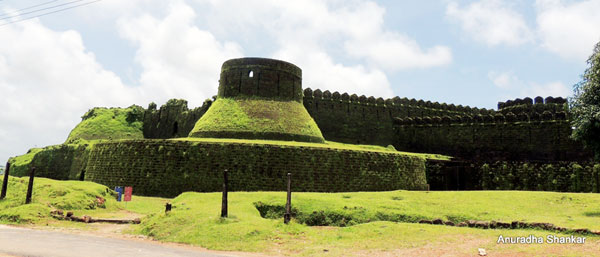
“This is what Sleeping Beauty’s castle must have looked like,” I think, as I survey the scene. A thick carpet of green covers everything in sight. Even the towering walls rise without once breaking the green cover, adding to the feeling that I am in a land long forgotten, left behind in time.
 I am not too far from the truth – I am at Mirjan fort, near Gokarna. The fort, built first in the 12th century and extended in the 16th century, has a long and glorious history. It was the seat of Rani Chennabhairadevi, ruling under the aegis of the Vijayanagar Empire. She was better known as the Pepper Queen, or Raina da Pimenta, as she controlled the spice trade in the area. The fort was especially conducive for trade, located as it was, on the banks of the Aghanashini River, a branch of the Sharavati. The fort changed hands many times, from the Rani to the Sultans of Bijapur, the Marathas, and eventually the British. The unification of the area under the British, as well as the setting up of newer and modern ports along the coast, ultimately rendered the fort ineffectual, and it was abandoned, leaving nature to reclaim it for her own.
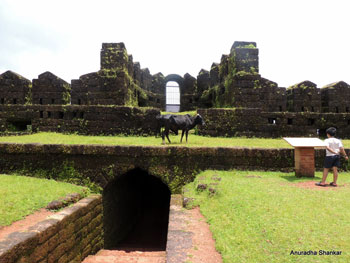
It is only recently that the fort has come into focus again, and efforts are on to restore it, at least to show us a glimpse of its past glory. As of now, the archaeological department has only managed to clear the front part of the fort, and part of its ramparts. Much is left to be done, as is apparent from the rear portions of the fort, which is what remind us of Sleeping Beauty’s castle, forgotten for a hundred years.
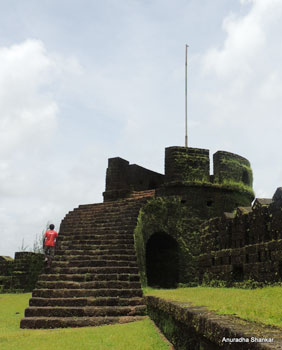 From the outside, it is still apparent why the fort was such a stronghold. Spread over an area of 10 acres, huge double walls protect the interiors, and the whole fort is surrounded by a moat, which, in its heyday, was connected to the river, fed by canals which continue to irrigate the fertile fields which surround the area.
The fort has four entrances, of which only the main one has been cleared so far. Among the others, one was for sole use of the royal family – a private entrance, so to speak; one was a direct approach from the river, and the last one was for the entry of goods – a service entrance. These entrances are barely visible, covered by ruins and foliage.
The inside of the fort is equally impressive, especially when it comes to the planning that went into it. Recent excavations have revealed, among others, an audience hall, part of what must have been the kitchen, and also mechanisms of water transport and storage. There are deep wells inside the fort, providing fresh water, and connecting them, water channels. There are water troughs for the horses, tanks storing water for the kitchen, and even provision for storage and disposal of waste water. Of course, most of these are in ruins, due to the neglect of centuries, and we can just get a glimpse into what made the fort function so well in its prime.
Under the branches of a tree are some idols. These are the only evidence of a temple inside the fort. The biggest idol found here is that of the goddess Mahishasura-Mardini. In all probability, the temple was dedicated to her. Facing her is a stone image of a lion, her vehicle. Around them, lie various stone sculptures, mostly of snakes. The snake is venerated in this part of the country. It is no surprise to see them here. More interesting are the hero stones, and stones which seem to tell stories, lying broken by the side. Unfortunately, there is nothing to tell us what they are.
 What we can see of the fort is simply the tip of the iceberg. Literally, it’s only the top portion of the fort which is accessible today. More interesting are the underground chambers and passages, built for protection and to facilitate escape, but which today lie in ruins, and are unapproachable. The ASI is, to give them credit, trying to restore the fort to its former glory. The fort was built using the locally available laterite stones, and we saw ASI personnel at work, trying to restore the turrets with remnants from the ruins or similar laterite stones, still plentiful in the area.


14DAYS NEPAL TRIP WITH JUNGLE SAFARI- RAFTING-TREKKING WITH 5STAR GOKARNA RESORT
If You Go:
LOCATION: Mirjan Fort is located at Kumta, about 10 kilometers from Gokarna.
HOW TO REACH:
♦ By Road: Kumta is on the highway, and is well connected to both, Mangalore as well as Karwar and Goa by bus. Buses from Mumbai also halt at Kumta. Autos are available from Kumta. It is easier to stay in or around Gokarna and make a visit to the fort.
♦ By Train: Certain trains on the Mumbai – Mangalore – Trivandrum route stop at Kumta. The other nearest railway station would be Gokarna Road. Regular passenger trains run on the route, and make a stop at Kumta.
♦ By Air: Mangalore (200 Km) or Goa (180 Km) would be the nearest airports.
WHERE TO STAY: There are plenty of hotels in the area, suiting every possible budget, from beach shacks to homestays to five star resorts. However, most of them would be situated around Gokarna, Udupi, Mangalore, Karwar and Goa.

16DAYS EVEREST BASE CAMP TREK WITH 5 STAR ACCOMMODATION AT GOKARNA FOREST RESORT
About the author:
Homemaker and Travel Blogger Anuradha Shankar lives in Mumbai, India. She loves exploring known and less known places in India, and is as fascinated by their stories and legends as her 10 year old son, whom she usually drags along on her travels. Her blog, A Wandering Mind, is her attempt to showcase her country to the world.
All photos are by Anuradha Shankar.

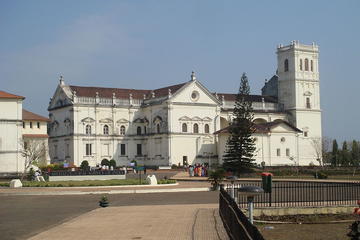
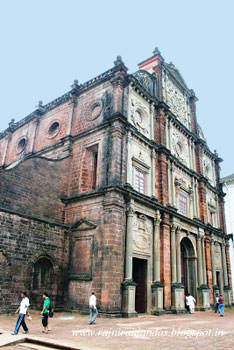 Basilica De Bom Jesus with its imposing facade and baroque architecture stands tall and was the first one that I visited. The Basilica looked quite different from others with respect to its dark colour and size. Though it might seem dilapidated at the first look, the Basilica with its reddish brown colour, ornamented pillars and magnificent carvings stands rock solid even after 400 years. Dedicated to infant Jesus, this grand structure also rests the mortal remains of St.Francis Xavier which is taken out for public viewing once in ten years. The interiors of the basilica has a lot of art work, murals and numerous altars which captivate every visitor.
 Half a kilometer away lies the beautiful Viceroy’s Arch next to Mandovi quay. The arch built in 16th century must have been witness to thousands of people landing on the Goan shores. Near to the arch lies the Gateway of the palace of Adil Shah. Built before the arrival of the Portuguese, it is only the gateway that survives now.

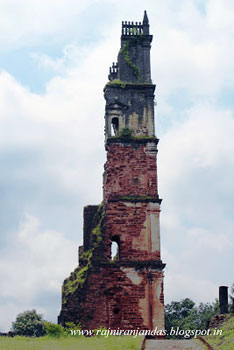
 Next to the Augustine tower lies the Convent of Santa Monica and a christian museum which definitely is worth a visit.
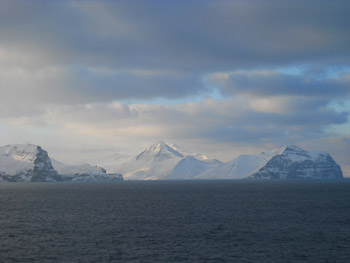
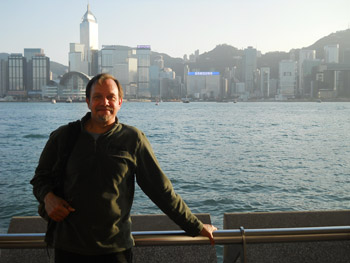
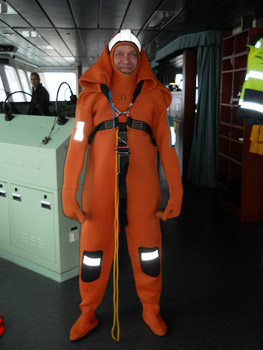 Alas, I had not achieved my boyhood dream of becoming master and commander of my very own ship. But the 21-day trip that followed provided not only spectacular sights and unusual experiences, but also satisfied more personal reasons for choosing such an adventure. It meant I could channel my first career as an 18-year-old indentured navigating cadet on a tramp freighter in the British merchant marine. It allowed me to sail across the North Pacific for the first time. And it dropped me off in Hong Kong, where I had lived as a boy. Too many touchpoints to ignore.
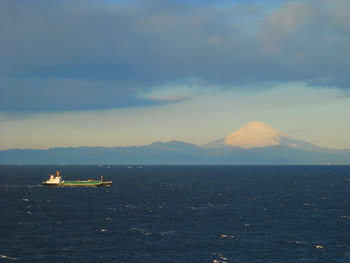 Another memorable morning, as we sailed up the channel leading to Tokyo Bay, I got a magnificent view of the volcanic peak of Mount Fuji in all its snow-sloped splendour. Normally gossamer-garbed in cloud or mist, it was resplendently naked as we motored past, our huge vessel dwarfed by the mountain.
 Our little band of passengers got along so well that we put together a Christmas concert with songs from our varied backgrounds for captain and crew. And with no cruise director to coddle us, we made our own entertainment – ping pong tournaments, card games, movie nights. We had our own passenger lounge, with couches, card table, DVD player, and a hodgepodge of pirated DVDs – the closest we got to anything piratical on this trip. On Sundays and special occasions we were invited for a drink in the officers’ lounge, with the captain and the chief mate hosting the bar.

 Docking a ship the size of the Tosca is an extremely delicate dance choreographed between the pilot, the two tugs, our forward and aft docking parties, and the dockside gang. The tugs nudged us gently toward the pier. A heaving line thrown to the dock was attached to a four-inch-thick nylon mooring line, one of four that would eventually secure us forward. The same process was conducted aft. The gangway went down, was quickly secured and before you can say banzai, the dockside cranes were cranking up, flatbed trucks were lining up, and containers were swinging through the air on their way from ship to land.
 We carried 5,500 containers, although our capacity was 8,500 TEUs (twenty-foot equivalent units), stacked nine deep in the hold with a further eight tiers on deck. It’s a logistical nightmare carefully managed by the head office planners in Marseilles, the chief mate on board, and the port agent and dockside crew, with the help of automated systems that ensure a balanced load fore and aft. It’s important to get this right. Can you imagine the chaos of having to unload 16 stacked containers to get at the misplaced 17th one in the bottom of the hold!

 by Reema Islam

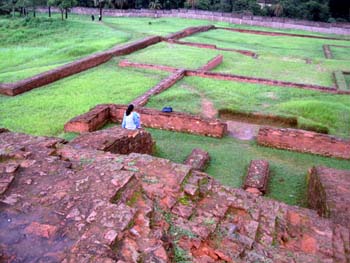

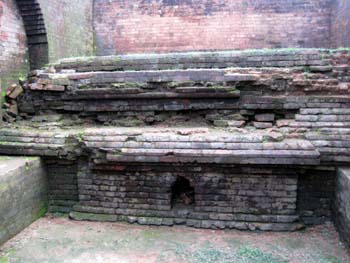
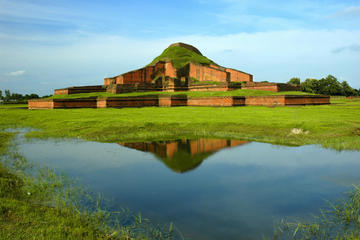
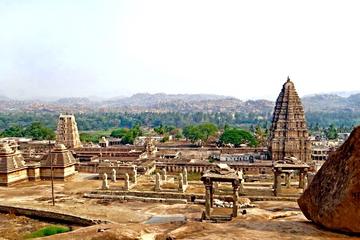
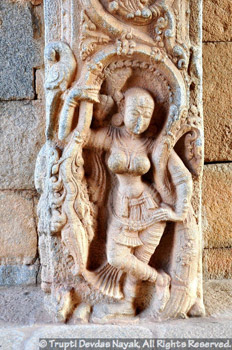 Given its historical significance, Hampi has been designated a World Heritage Site by UNESCO. This means the tourism infrastructure and maintenance is much better now than what it used to be. For many years, as the bustling cities around Hampi grew, the stone mandapas (stone pillared pavilions) on the mountains and carved dancing girls on the stone walls were silent witnesses to all that modern growth brings. Even now when you drive to the main site of Hampi, you pass many historic sites, with ruins of temples and mandapas, carved splendidly, surrounded by the bustling sprawl of city life, cars, modern houses and people. With recent improvements however, the main sites have been well preserved with security and infrastructure enabling travelers to experience this historic city to the fullest.
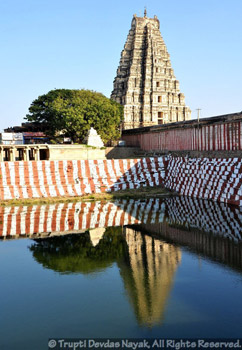 Wandering inside the sprawling metropolis is like traveling back in time. You can almost hear the trumpeting of horns as they welcome the royal family, with gloriously decorated elephants and horses, and the cheer and applause of the people as their beloved king and queen go by. King Krishnadeva Raya was a lover of good things in life, including good art. He ensured that many of the artisans and architects in his kingdom were kept busy and happy creating the most beautiful city in the world, coming to life out of solid boulders. A city which time and tide would never be able to transform into dust, a city which would remain standing forever. And so it does, to this day.
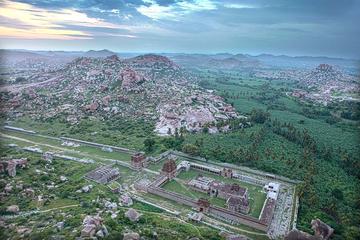
 Hemakuta Hill is behind the Virupaksha temple and as we climbed up the mountain, several stone mandapas cast their long shadows on the granite as the sun began to set. Smaller temples and gopuras (stepped roof of a temple) rose in the distance. English-speaking tour guides are available for a fee and you can get a comprehensive history of the place on a full-day tour. Hemakuta Hill is capped by a “Sunset vista point” which is highly recommended for viewing glorious sunsets over the city. From the top, one also has a vantage viewpoint over the vast fields of banana and sugarcane in the distance. It is a very peaceful and serene scene. A hush falls over everybody as the mellow sun gets warmer, brighter and more beautiful. The glowing orb dips beneath the horizon to the tune of a thousand chirping birds on their way home.
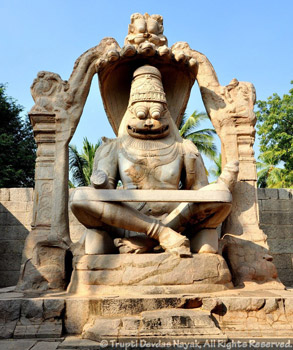 Hemakuta Hill and Matanga Hill are popular for day hikes. The sunrise atop Matanga is legendary, but we did not get a chance to see this for ourselves. All the main sites in Hampi are close by, although it would take longer to walk across to each, it’s easier to hop on to an auto-rickshaw to save time. We met a French traveler who was visiting Hampi for the second time, the first time being 10 years ago when he was just a young man eager to travel and see the world. Now he was much older and had a family. He was excitedly exploring the city on a bicycle to see what had changed and to relive the adventures of his youth.
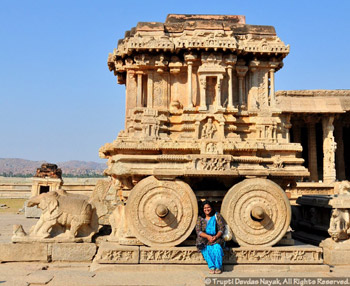
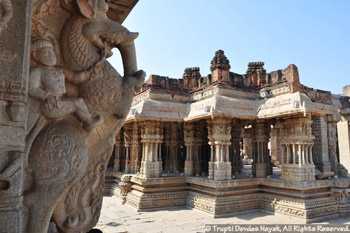 We left the best for the last – the Vittala Temple which is said to have the best carvings and sculptures in all of Hampi. We hiked up to the temple, stopping by at several pushkarni reflections (structures created in the ground to hold water, possibly for royal baths and other purification purposes), and a temple with horses carved out of the pillars (Kudremukh – horse’s face). At the Vittala temple, two things took our breath away. The ornate musical pillars and the royal stone chariot.
 We spent an entire day exploring many nearby temples, spellbound at all the beautiful carvings and sculptures made out of solid stone, imagining what it must have been like at this bustling city at the height of it’s richness and grandeur, with thousands of artisans, artists and sculptors carving away at these huge boulders to create what we are lucky to be able to still see and touch today. Hampi was a truly fascinating and memorable experience. We will be back again, and this time for longer. Maybe we will even get one of those bicycles like the French traveler and spend a couple weeks in this magnificent place, soaking up a bit of history!