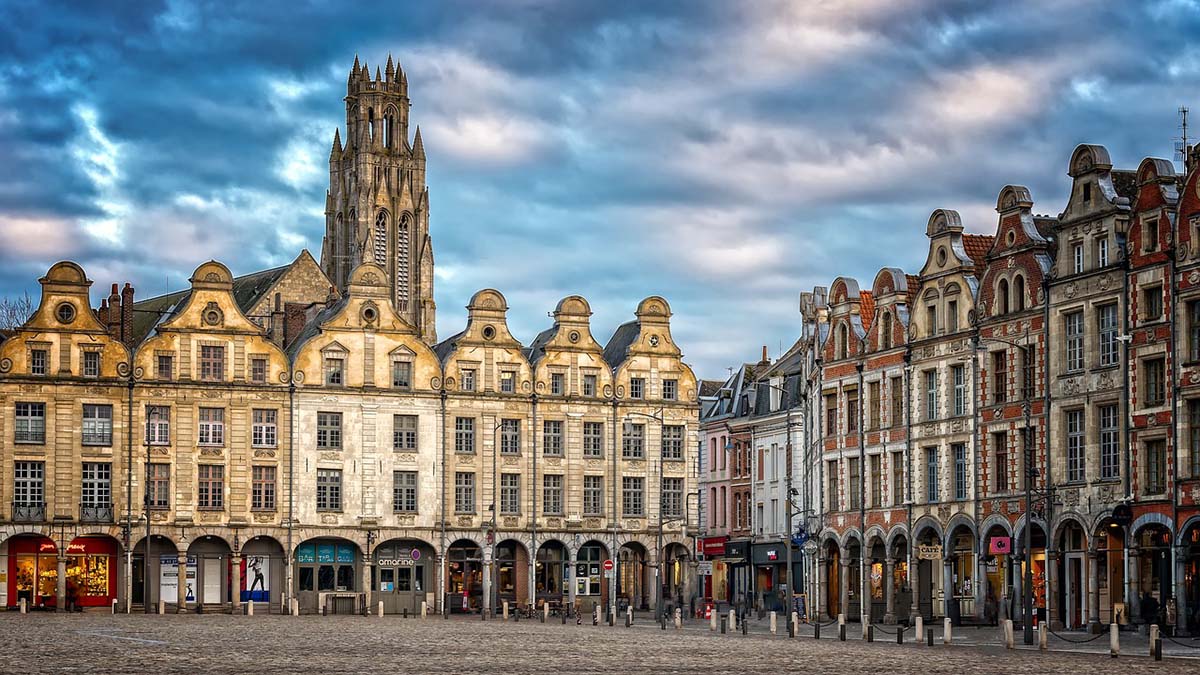
Arras, France
by Anne Harrison
On the 8th September 1916, my great-uncle died from wounds suffered during the Battle of the Somme. Second Lieutenant Henry Byron, 1st/5th Battalion, South Lancashire Regiment, was twenty-two. His brother – my grandfather – enlisted at the age of fourteen, had a kidney shot out in Ypres, contracted TB while convalescing, and was shipped home with six months to live. Deciding escape was the only way to survive the miasmas of war-time Liverpool, he worked his way to Australia, jumped shipped in Perth, and died at the age of ninety two. He could never bring himself to return to France and visit his beloved brother’s grave.
In contrast to the American Army, which built large cemeteries for their war dead, the Commonwealth Forces tried to bury their soldiers near where they fell. Consequently, this area of France is dotted with cemeteries. Uncle Harry rests in Dartmoor Cemetery, Becordel-Becourt, not far from Arras.
 The landscape here is flat, and has been farmed – and fought over – for centuries. Tilled land spreads in all directions, dotted by the occasional stone farmhouse, a church spire, a copse of trees. Shrapnel from the war still surfaces each season as the fields are farmed. The heavy soil stuck to my shoes, and all too easily turns to mud. A confusion of back roads loop and intersect through small villages, where horse-drawn carts are still in use.
Arras is a medieval town of cobbled streets and limestone tunnels. From the end of 1914 until early 1918, the Western Front (which stretched from Belgium to the Mediterranean) was never more than three kilometres away, and the town itself was occupied and nearly destroyed. Much of the town was rebuilt in traditional style, and Arras is now World Heritage Listed by UNESCO.
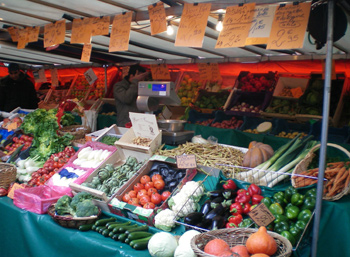
Since medieval times, the main square – Le Place des Héros – has been home to a market, and now every Saturday stalls of meats, poultry, cheeses, fruits de mer and all manner of fresh produce spill over the cobbled stones and into the surrounding streets. Le Place des Héros is dominated by the gothic Hôtel de Ville. For anyone brave enough to climb the Belfry and face the bleak winds, the entire countryside is on display, and on a clear day Paris is visible. Not surprisingly, this was used by both civilians and the military for viewing the progress of the war.
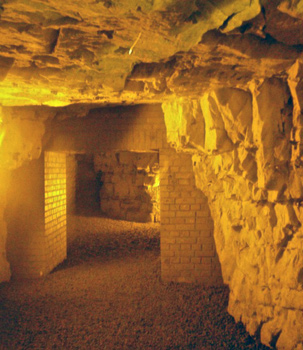 Beneath the Hôtel de Ville is an entrance to the Boves, or medieval tunnels. The origin of the name is uncertain; however, from the 10th century limestone was quarried here, until the practice was moved outside the city amidst fears the town would collapse. The tunnels run along five different levels, at times up to twenty meters deep. Most of the buildings on Le Place des Héros have their own entrance, now used mainly as cellars or for storage (and an exquisite restaurant, La Faisanderie, perfect after a day touring the battlefields).
Despite the cold and damp – the tunnels remain at a constant 11º C, with 80% humidity and no sunlight – people lived here in medieval times. In WWI, New Zealand Royal Engineers (complete with canaries in cages) extended the tunnels so troops could move in secrecy to emerge near the German front line. Up to 24,000 men could be concealed, and the remnants of electrical lighting, makeshift kitchens and even latrines are still visible. Tunnels were divided into those for foot traffic, hand-drawn trolleys and a light rail system. Casualties were moved with relative safety, and a field hospital (complete with operating theatre) was established underground.
After a few hours spent touring the battlefields, the number of lives lost becomes mind numbing. (An organized tour helps give some structure to the mayhem of the First World War.) The Battle of the Somme commenced on the 1st July 1916. On the first day, some 20,000 men died; this figure does not include those, like Uncle Harry, who were to later succumb to their wounds. By this stage of the war, some generals on both sides had come to accept a loss of 1:1 as a good result. Reflecting this, the Franco-British Thiepval Monument is simply huge, largely to accommodate the names of the 73,367 British soldiers with no known grave. The country of Newfoundland never recovered from the loss of men, leading to its absorption by Canada in the 1920s.
In an attempt to break the ongoing stalemate of the war, in March 1918 the Germans launched another offensive to capture Amiens (which, being near the sea, was vital for supplies). As a consequence, the small town of Villers-Bretonneux was captured in the world’s first battle between two tanks forces: British Mark IVs against the German A7Vs. After a house-to-house battle, Australian soldiers liberated the village on 24th April 1918, at a loss of some 1200 Australians. Amiens was never captured, and the German front line began to recede, leading to the Armistice of 1918. Many historians see the liberation of Villers-Bretonneux as a turning point of WWI.


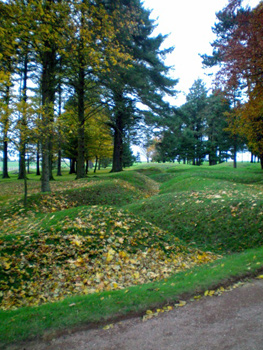
 The Canadian National Vimy Memorial encompasses a 250 acre battlefield park, which includes the area of the Battle of Vimy Ridge (9th April, 1917). Both Allied and German trenches have been preserved, and it is still possible to walk along them. The trenches never ran in a straight line, and had alcoves at regular intervals for shelter from bombs and snipers. Some barbed-wire stakes remain; earlier ones with only one hole, and a later design which could hold three stands of barbed wire. These also had the advantage of having a screw on the base, allowing them to be silently screwed into the heavy soil, and not hammered.
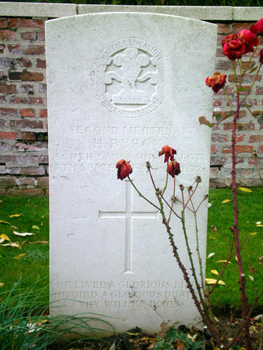
Uncle Harry’s grave is in a corner of the small Dartmoor Cemetery, which began as Becordel-Becourt Military Cemetery in 1915. It has only 768 (762 identified) WWI Commonwealth burials. In September 1916, the XV Corps Main Dressing Station was established nearby, and it is here Uncle Harry died. Surrounded by fields, Dartmoor Cemetery is now a peaceful spot, overlooked by most tourists, for there are so many cemeteries, and so many memorials to the War To End All Wars.
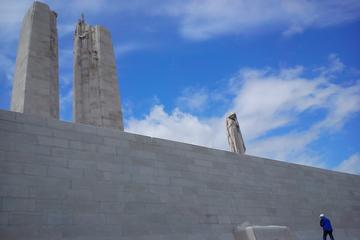
Full-Day Canadian WW1 Somme Battlefield Tour from Arras
If You Go:
♦ www.ot-arras.fr – Official Arras Tourism website (in French)
♦ www.arras.fr – Another website with an English option, but not as detailed
♦ www.westernfronttours.com.au – A web search brings up many companies which run WWI / WWII battle tours. Most are British. Based in Arras, Western Front Tours is run by an Australian who has an extensive knowledge of WWI, and happily modified our tour (of only four persons) to include a visit to Uncle Harry’s gravesite.
♦ www.awm.gov.au – Official site of The Australian War Memorial, with a database for searching for overseas graves
♦ www.restaurant-la-faisanderie.com – If in Arras, try this restaurant. Simply superb.
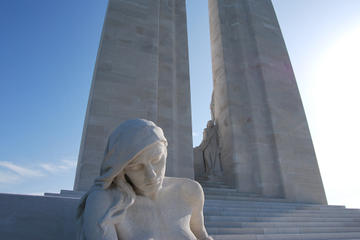
Small-Group Day Trip to Arras and Vimy Ridge WW1 Battlefields from Paris
About the author:
Anne Harrison lives with her husband, two children and numerous pets on the Central Coast, NSW. Her jobs include wife, mother, doctor, farmer and local witch doctor – covering anything from delivering alpacas to treating kids who have fallen head first into the washing machine. Her fiction has been published in Australian literary magazines, and has been placed in regional literary competitions. Her non-fiction has been published in medical and travel journals. Her ambition is to be 80 and happy. Her writings are available at anneharrison.com.au and anneharrison.hubpages.com
Photos credits:
Arras street by Peter H from Pixabay
All other photos by Anne Harrison:
Many WWI trenches remain today
Tunnels in the Boves
Uncle Harry’s grave
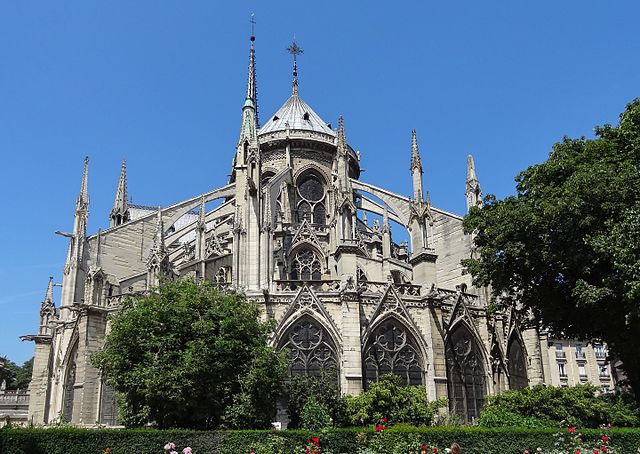


 Emerge from the crypt, and the buttresses of Notre-Dame soar to the sky. This area had long been sacred; the Romans built a temple to Jupiter here (perhaps replacing a site of worship used by the Parisii), which in turn was replaced around 528 CE by the first Notre-Dame (built with stones from the Roman arena on the Left Bank).
 At 1 Parvis Notre-Dame stands the Hôtel-Hospitel Dieu. The first hospital in Paris, it was founded by Saint Landry in 651 CE, and still cares for ill Parisians. The ghosts of some 1300 years of medical history glide the marble corridors, whispering in consultation outside the wards before passing into the old-fashioned lifts to visit the fourteen quiet hotel rooms hidden on the sixth floor.

 Under a burgeoning population the Île de la Cité had become a place where ‘plants shrivel and perish, and where, of seven small infants, four die during the course of the year’. (Victor Considerant, 1845). Diseases such as cholera proved epidemic. Authorities viewed the island as a cradle of discontent and revolution, where narrow streets were easily barricaded by paving stones – with the widest street measuring only 5m, the army had difficulty dislodging rioters.
 On the nearby Rue Chanoinesse, a 14th C baker was renown for his pâtés – until it was discovered they were made from murdered foreign students. Both No. 22 and 24 are 16th C gabled canonical houses, while at No. 26 the entry is paved with tombstones. No.10 is reputed to be the house of Héloďse’s uncle, where she and Abélard fell in love.
 A short stroll but an ethereal world away is the Sainte-Chapelle. Often called “The Gateway To Heaven,” it was built by Louis IX between 1246-48 to house a piece of the True Cross and the Crown of Thorns. The upper chapel is considered one of the highest achievements of Gothic art. Many of the windows date from the 13th C, depicting Biblical scenes beginning with Adam and Eve and ending with the Apocalypse of the great Rose Window.

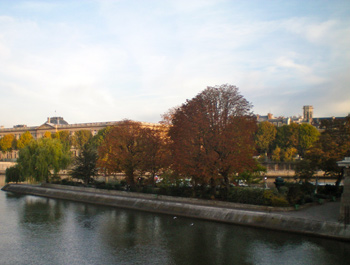 At the end of Le Quai de l’Horloge stand the Tour de César, Tour d’Argent, Tour de l’Horloge and the Tour de Bonbecis, all built between 1250 and 1300 as part of the now vanished Capetian palace. On the Tour de l’Horloge is Paris’ first clock, built in 1371. Along with parts of the Conciergerie, these towers and Saint Chapelle are all of this area to escape Hausmann.
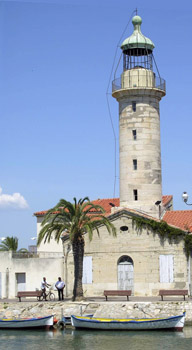 Since its birth fishing and transport have given it purpose and do so to this day, but it was to be the extension of the Nimes-Aigues Morte Railway to the town in 1909 which opened it up for tourism as a major economic driver. The president of France himself declared Grau du Roi a beach resort town in 1924.
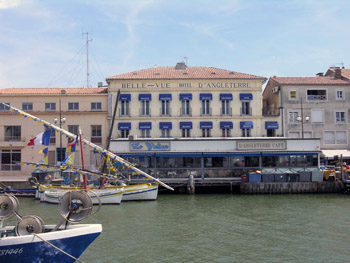
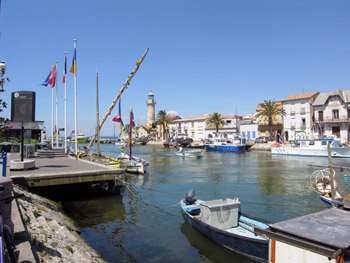 Quai Charles de Gaulle and Quai Colbert occupy either side of the canal and offer a host of cafes and restaurants facing upon a canal full of moored craft of all sorts from recreational through to commercial fishing boats. Water traffic is constant and colourful. In fact colour is inescapable and enhanced under a smiling Mediterranean Sun.
 Where the canal meets the sea either shore stretches long and sandy to the left and right with Plage de Riv Gauche and Plage de Riv Droite. Shallow beaches afford a vast playground for waders and swimmers with ample shore space for sunbathers. Families, knots of chattering teenagers, a few topless strollers and more share the beach with hawkers advertising cool treats as they work their cumbersome wheeled kiosks across the beach. Sun screen and water socks are a good investment and more than a few bathers were spotted doing the hot sand dance across the beach.
 Grau-du-Roi aims to keep its visitors occupied and entertained and to that end is awash with things to see and do. Add to Sun and beach the Seaquarium at Le Palais de la Mer, a healthy beach walk or short town bus trip from the town centre and the arena, home of the unique Camargue Races (a man/bull contest in which both survive to star another day).
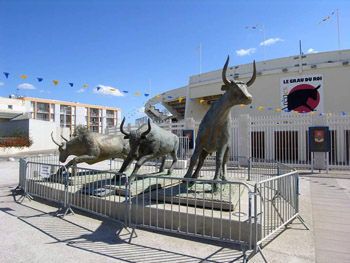 Restaurants abound and we took in a pleasing meal at reasonable fare at a seasonal outdoor restaurant colonizing, with others, a tree shaded enclave; serenaded by by a chanteuse and her accompanying accordion player. The coolness of welcome shade, music and a fine meal reinforced the aura of southern France by the Mediterranean. Walk weary feet drank in comfort.
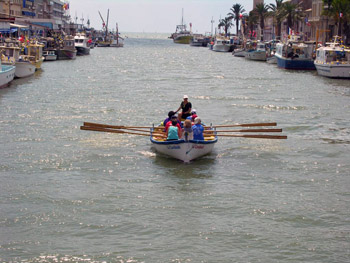 The other, workaday, side of town is revealed in the docks and moorings of craft toiling at sea with care taken towards functionality rather than appearance. Even so there is an aura about this long lasted foundation of the local economy. A business indifferently sharing waters and canal with recreational craft of varying opulence. Crossing Pont Tournant we stopped to watch an 8 man dory, six oars pushing water, making its way inland; its chanting rowers, ladies all, moving as one.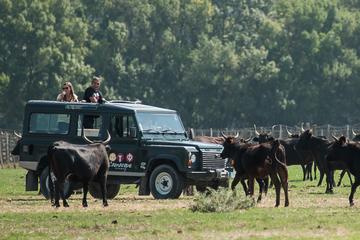

 About the author:
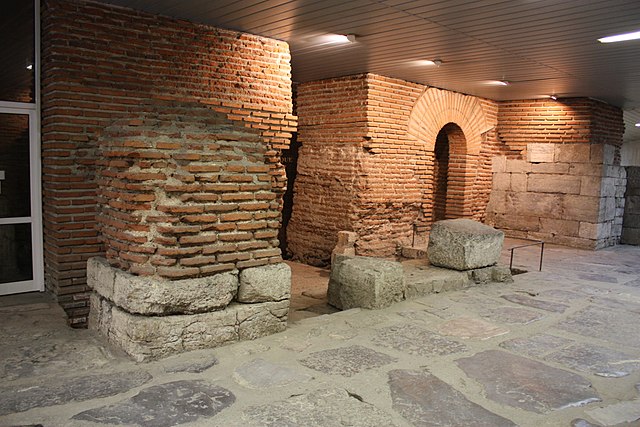 As a history lover, I found several sites of interest, with their unique archaeological heritage. The country is rich in ancient relics, from Neolithic Age to Greek, Roman and Medieval times, the symbol of the ancient grandeur of one of the most well-documented people of antiquity, the Thracians, recognized as one of the most powerful people in the Ancient World. All cities have their own museum with Thracian, Hellenic and Roman treasures of amazing quality and interest, irrespective of many Orthodox churches and monasteries. It is difficult to leave Bulgaria without being held spellbound by its beautiful view.
 Many Bulgarian towns still bear important traces of their Thracian past, such as Kazanlak. Archaeological excavations carried out near Kazanlak, in the famous area of the Rose Valley, discovered substantial remains of tombs, shrines, and other important remnants of Thracian culture. The Odriss Kingdom of the Thraces had its splendid capital at Sevtopolis, ruled by King Sevt III [also known as Seuth], which was submerged and then discovered between the modern Kazanlak and the village of Koprinka. The tomb of King Seuth III was found within the Golyama Kosmatka Mound, near Kazanlak, and it contained a vast treasure including paintings, ornaments, one golden crown, one golden mask and the statue head of the same King Seuth III.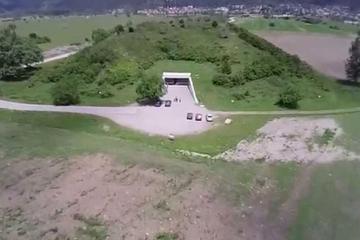

 About the author:


