 by Sarah Humphreys
O lone Ravenna! Many a tale is told
Of thy great glories in the days of old:
Two thousand years have passed since thou didst see
Caesar ride forth to royal victory.
Mighty thy name when Rome’s lean eagles flew
From Britain’s isles to far Euphrates blue;
And of the peoples thou wast noble queen,
Till in the streets the Goth and Hun were seen.”
So Oscar Wilde summarized the history of Ravenna in his poem bearing the city’s name. Ravenna was capital of the Western Roman Empire, The Arian Ostrogothic Kingdom and The Byzantine Empire before becoming kingdom of The Lombards. The final resting place of Dante, was also home to Byron from 1819 to 1821, while he was involved with Teresa Guiccioli, a young married aristocrat. The crowning jewels of Ravenna can be found in her impressive collection of mosaics, which are housed in seven of her eight UNESCO World Heritage Sites. Ravenna is truly the “City of Mosaics” and many of the streets are decorated with modern mosaic designs ranging from flowers to space invaders.
No trip to Ravenna would be complete without visiting her stunning UNESCO sites, described as having “remarkable significance by virtue of the supreme artistry of the mosaic art that the monuments contain, and also because of the crucial evidence that they provide of artistic and religious relationships and contracts at an important part of European History.”
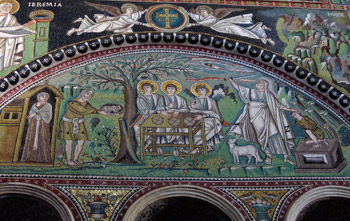 An unknown architect finished the Basilica of San Vitale in 547 on the spot where St Vitalis was martyred by being buried alive. Richly ornamented mosaics inside depict scenes from The Old Testament, including the Sacrifice of Isaac, Moses and The burning bush and Cain and Abel. Decorative leaves, fruit and flowers encircle the Lamb of God on the vault of the presbytery. Glittering mosaics pay homage to the Emperor Justinian I and his Empress Theodora.
After straining your neck to look at the beautiful scenes on the ceiling, don’t forget to look at the floor which features simple mosaics of birds and animals, and a marble labyrinth just west of the sanctuary, which consists of 11 concentric circles and leads to a decorative scallop shell.


 Exiting from the back of San Vitale, you will come across a small, ordinary-looking brick building, which contains Ravenna’s finest treasures. The powerful Roman Empress Galla Placidia, who wielded extreme power as regent for her young son Valentinian III, probably commissioned the tiny Mausoleum which bears her name. Shaped like a Greek cross, the building has sunk 4.5 feet into the ground due to subsidence. The limited space within the structure means visits are restricted to five minutes only, guaranteed to be intense moments.
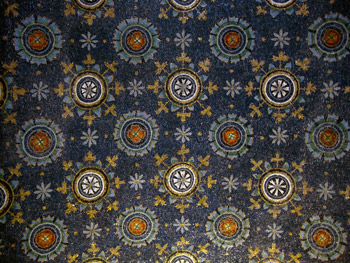
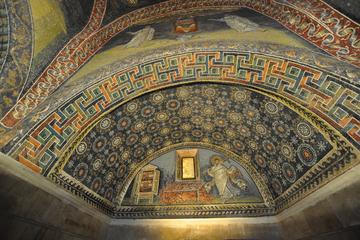
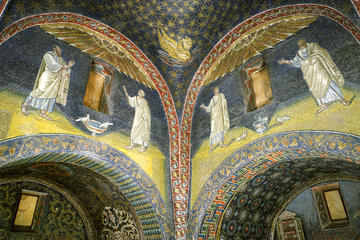
The entire vault is covered in ancient mosaic work dating from 430. More than 800 stars are arranged around a golden cross in a deep blue sky, which is said to have so impressed Cole Porter on his visit during his honeymoon that it inspired him to write “Night and Day.” An early depiction of Christ as The Good Shepherd shows him wearing purple robes and a golden tunic. The arches are covered in geometric patterns, which appear almost contemporary with their vivid colouring. The mausoleum contains three sarcophagi, which are attributed to Galla Placida, and the Emperors Valentinian III and Constantinus III. The largest probably contained falsified relics of Galla Placidia, supposedly in sitting position. The relics were destroyed when local boys accidently set fire to them in 1577.
 The Basilica of San Apollinare Nuovo houses a series of impressive mosaics dating from 500 under rule of the Arian King Theodoric, which show scenes of Christ’s miracles, parables and The Passion. The lower rows of mosaics date from 560, when Ravenna was under Christian rule, and feature saints, martyrs and a procession of Virgins led by The Three Magi, sporting animal-print leggings. According to legend, Pope Gregory had the earlier mosaics blackened to prevent worshippers from being distracted, and many of the original Arian mosaics were removed. It is still possible to see some disembodied limbs that evaded destruction.
A fascinating contrast can be seen between the scenes depicted in the Neonian and Arian baptisteries. Although both ceiling mosaics depict the Baptism of Christ by John the Baptist, there are distinct differences between the representations of Christ. The Arian figures are far simpler and Christ is a youthful, beardless figure.
 The Chapel of St Andrew, housed in the Archbishop’s museum, is the smallest private early Christian oratory to have survived until the present day. Dazzling mosaics create a shimmering tapestry of saints, angels and decorative motifs and 99 species of birds are shown against a splendid starry sky. Christ is shown as a warrior, crushing the figures of a serpent and a wild beast.
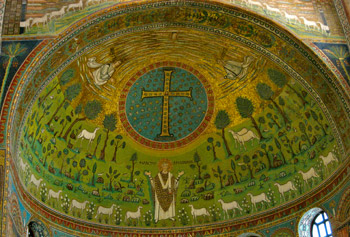
The Basilica of Sant Apollinare in Classe is situated 8km south of Ravenna and contains some of the most impressive artworks in the area. A soft green background, covering the apse, serves as backdrop to various Biblical scenes, representations of the apostles and evangelists and the figure of St Apollinare. This is the first known example of a figure other than Christ being central for the apse decoration. The majestic church also contains Early Christian sarcophagi designed for most of Ravenna’s bishops from the 5th to the 8th centuries.
 The only UNESCO World Heritage Site not to contain mosaics is the Mausoleum of Theodoric. Its unusual structure, consisting of two decagonal parts topped by a monolithic dome, is formed from Istrian stone blocks. The combination of Roman, Barbarian and Medieval architecture fascinated The Romantics and The Mausoleum was popular with tourists on The Grand Tour.
The proud tradition of mosaic making is kept alive today, using ancient Roman and Byzantine techniques, and it is well worth visiting one of the workshops were you can watch artisans at work. A wide range of souvenirs are available ranging from jewellery boxes and ornaments to re-creations of classical works and sparkling homages to rock stars such as Jimi Hendrix and The Rolling Stones.
 Other notable sites include the extraordinary underwater crypt in the cathedral of San Francesco, complete with goldfish, and the “House of Stone Carpet”, the remains of a Byzantine house complete with huge decorative floor mosaics. Just next to the Cathedral is the final resting place of Dante, who died in Ravenna in 1321. Although exiled form Florence in his lifetime, the city has continuously appealed for the great poet’s remains to be returned. Ravenna has constantly turned down this request. On the 2nd Sunday in September, olive oil donated by the city of Florence, is brought to Ravenna to light the lamb that hangs over Dante’s tomb.
Piazza del Popolo is the real centre of Ravenna, and the perfect place to sit at a pavement café, sip a glass of wine, savour a piadina (stuffed flatbread) and watch the world go by. Every June and July the square is transformed into the backdrop for concerts in the Ravenna Festival, which features classical music, opera, jazz, dance and exhibitions.


If You Go:
♦ The nearest airport is Forli, which is 20km away and is served by Ryanair. Bologna airport is 80km away.
♦ Ravenna is on the main rail line to Bologna and Rimini.
♦ By car take highway A14 – Follow signs for the A14D from A14 East.
♦ The Basilica of San Vitale, Mausoleum of Galla Placidia, Basilica of Sant’ Apollinare Nuovo, Neonian Baptistery and Chapel of St Andrew can only be visited by buying a combined ticket form the ticket office in the centre of town. The Ticket costs €9.50-Reductions €8.50. The ticket is valid for seven consecutive days from the date of issue.
♦ Entrance to The Mausoleum of Theodoric costs €4, Reductions €2
♦ Tickets for the Basilica of Sant’ Apollinare in Classe cost €5, Reductions €2.50
♦ Entrance to the Arian Baptistery is free
♦ Admission times vary according to the time of year. See www.ravennamosaici.it for details.
♦ Queues for the Basilica of San Vitale and Galla Placidia can be quite long. It is best to head there early in the morning or around lunchtime.
♦ The UNESCO World Heritage Sites are all central apart from The Mausoleum of Theodoric, which is just outside the centre and the Basillica of Sant’ Apollinare in Classe, which can be reached by car or bus.
Ravenna and its Enchanting Mosaics Full-day Tour
About the author:
Sarah Humphreys is originally from near Liverpool, UK and has lived in Canada, The USA, The Czech Republic, Greece and Italy. She currently lives in Pistoia, near Florence, where she teaches English, writes freelance and is a part-time poet. She has been writing since she could hold a pencil and her passions include Literature, poetry, music and travel. Follow her on twitter: Sarah Humphreys @frizeytriton.
Ravenna and its Mosaics Private Tour with Piadina Tasting
All photos by Sarah Humphreys:
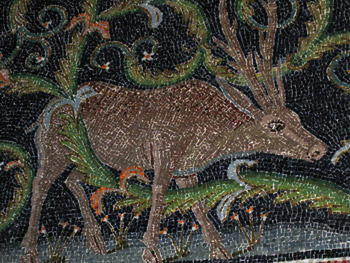
Detail of Mosaic in The Mausoleum of Galla Placidia
The Sacrifice of Isaac-Basilica of San Vitale
Detail of Mosaic in The Mausoleum of Galla Placidia
The Three Magi-Sant’ Apollinare Nuovo
The Apse Sant’ Apollinare in Classe
Traditional Techniques at Work
The Flooded Crypt of San Francesco
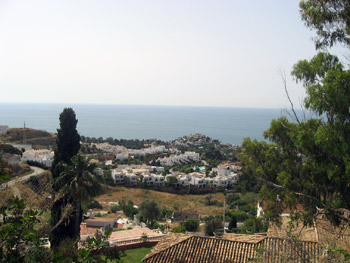 The whitewashed village, lined with narrow cobblestone streets overlooking the Mediterranean Sea, is the oldest of the three as it was founded by the Moors. I was fortunate enough to be in Benalmádena Pueblo in June for the major celebration of Corpus Christi where thousands of locals and tourists gather on the streets to watch the holy procession honouring the Body of Christ. On the eve of this festivity, hundreds of locals congregate to elaborately adorn the altars and decorate their balconies and windows in the brightest coloured tapestries. The community also collaborates in transforming the main street into a work of art by arranging 78,000 vibrant flower blooms in the form of a fabulously designed floral carpet. Meanwhile, the smaller streets are strewn and perfumed with palm leaves, rose petals, lavender, and aromatic herbs such as rosemary and thyme.
 Once the procession was over, I decided to indulge my curiosity by exploring what some have described as “the most beautiful place on earth.” I only knew that the Castillo Monumento Colomares was about a 15 minute walk from the center of the pueblo. However, no indication as to its whereabouts could be found anywhere along the remote area and I began to get discouraged in the blazing heat of the afternoon sun. Fortunately, after asking for directions several times, a cyclist appeared who knew how to get there.
 Nearly an hour had passed since I left the pueblo and I found myself gasping in delight when it finally appeared around the corner amidst isolated trees and bushes on a small curvy road.
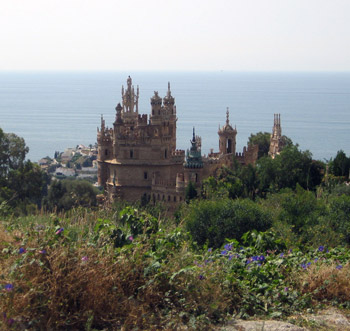 This enchanting structure was built during the late 20th century in memory of Columbus and the Discovery of America. The castle is actually the largest monument in the world dedicated to the Italian explorer. Seven years of work it took with the help of two bricklayers who incorporated several styles of architecture designed by a doctor. The castle, advertised as “a fantasy made by stone”, has 16 points of interest that include Isabella’s Castle, the Oriental Tower, and the Christmas Fortress of 1492. The complex also houses the smallest church in the world as listed in The Guinness Book of Records. The views of the Mediterranean Coast from this hidden gem adorned with decorative fountains, spiral staircases, and ornamental gates are magnificent, and I left wondering why the castle was not better promoted.
 A 20 minute walk from the Colomares Castle is the Mariposario de Benalmádena or “Butterfly Park.” Known as the largest one of its kind in Europe, this tropical garden paradise set inside a Thai temple is home to over 1500 exotic butterflies. More than 150 different species reside here among cascading waterfalls, floral gardens, and tropical plants.
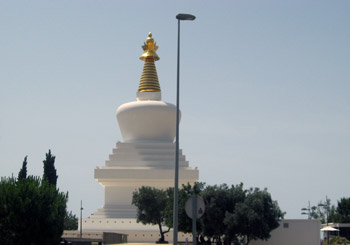 This urban residential town, nestled between the mountains and the sea, is home to several major family attractions and theme parks. Selwo Marina Delfinarium is the only one of its kind in the Andalusian region where you can feed penguins and swim with dolphins and sea lions. Tivoli World is a popular theme park known as the largest on the Costa del Sol. Across the entrance is the Teleférico or cable cars that take you to Mount Calamorro in 15 minutes where you can savour views of the coast and on clear days, Gibraltar and North Africa as well.
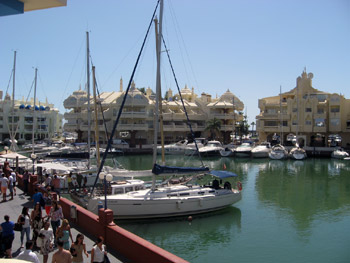 Paloma Park is a vast and serene gated area perfect for an afternoon stroll by the great lake on paved walkways adorned by plants, gardens, statues, and fountains. Peacocks, roosters, geese, ducks, pigeons, doves, and rabbits all call this park their home.
 By the entrance to the Marina stands the Moorish lookout tower, Torre Bermeja (Reddish Tower), the oldest of three that remain along the coast of Benalmádena. These cylindrical towers were raised to warn against the enemy ships approaching from North Africa. Although reconstructed during the 16th century, the tower first appears in documents dated to the 13th century. Of 16th century Christian origin are Torre Quebrada (Broken Tower) and Torre Muelle (Dock Tower) in the nearby, namesake suburbs of Torrequebrada and Torremuelle respectively.
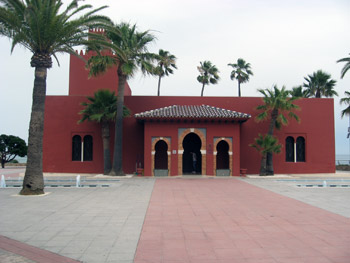
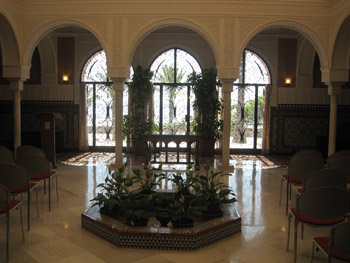 However, the main landmark of Benalmádena Costa is the stunning, burgundy palace known as the Castillo El Bil-Bil. The Moroccan-style structure was built on the seafront in 1930 for a wealthy Spanish-French family. Seven years later it was purchased by an American family who lived here for 30 years. When asking about the curious name, Salvador, the caretaker informed me that the names of the American family were Elsa (El) who was married to William (Bil) and both had a son together also named William (Bil.).
 Within the lovely gardens of El Bil-Bil is the monument to Ibn al-Baytar, an illustrious scholar born in Benalmádena during Moorish rule. The commemorative plaque reads in Spanish and English; Ibn al-Baytar – The distinguished botanist and pharmacologist born in Benalmádena: Benalmádena 1197 – Damascus 1248. Al-Baytar became one of the most renowned scientists of the Middle Ages. He is further immortalized and remembered as the most famous personality in the history of Benalmádena.
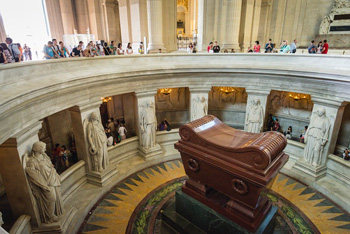
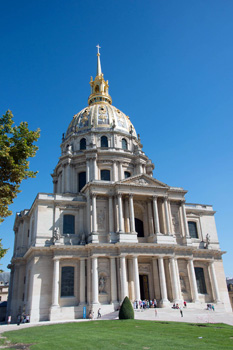 Beneath the golden vault of the Eglise du Dome Church lie the remains of the slight statured Corsican who became France’s greatest soldier. Within his massive crypt, Napoléon’s mystique looms large in death as it did during his lifetime. Hitler was so moved by his visit that as a tribute to the French emperor, he decreed that Napoléon’s son’s coffin be moved from Vienna to lie beside his father.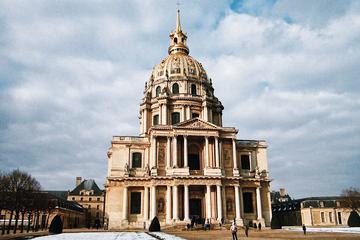

 About the authors:
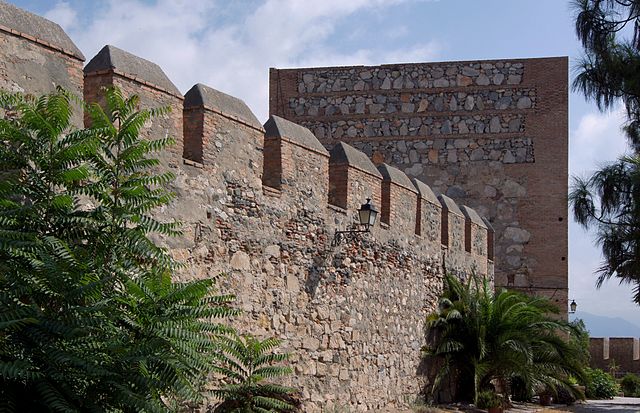 The coastal town of Salobrena is 10 km east of Almunecar. The coastline to Salobrena along the tropical coast is wild and rugged. To the left the awesome peaks of the Sierra Nevada and to the right the glistening blue of the Mediterranean. Salobrena stands unmolested by mass tourism, although now boasts an eighteen hole golf course. In the winter, the snow capped Sierra Nevada provides a magnificent backdrop to the green of the third hole.
 Further down the coast Almeria is home to yet another imposing castle. The drive from Salobrena takes about an hour and the terrain changes dramatically. Gone are the orange groves and fertile valleys to be replaced by a sea of plastic posing as green-houses – a scar on the landscape. From these eyesores the mountains become rocky, yielding neither crop nor greenery.
 The castle underwent changes under different Moslem governors, such as Almanazor and Havran the Slave, the fist independent ruler-lord of Almeria, who extended the walled area of the city towards the plain by three times the size of the original city of Almedina. The time of Banu Somahdis brought an era of splendour and was the setting for a cultured and literary court in the 11th Century. Later, in the 14th and 15th Centuries, under the Kings of Granada, it retained only its role as a coastal defence. It underwent two sieges, which demonstrated its effectiveness as a fortress; one in 1147, when it fell for the first time to the Christians of Alfonso VII, who was helped by the Genoese, the Catalans and the people of Pisa; and the other in 1309, which lasted a year, when James II of Aragon failed to take the castle.

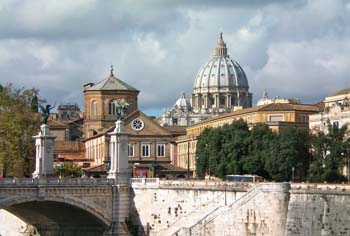
 In 293 BC, Rome suffered from one of the many pestilences which proved the tribulation of the Ancient world. Seeking divine aid, a delegation of high priests and doctors made a pilgrimage to Aesculapius’ temple at Epidaurus. In response to their prayers and offerings, one of the temple’s sacred The success of the quest was thus assured. Upon the ship’s return to Rome, the snake slithered into the Tiber and crossed to the reed-covered island, which lay opposite the city’s port. This was so obvious a sign Aesculapius desired a temple here, not only was one built but the island itself hewn to resemble a ship. Large structures of white travertine were built at either end to augment the resemblance to prow and stern, complete with a bust of Aesculapius and his caduceus. In the centre of the island an obelisk was raised to suggest the main mast of a Roman galley. Thus dedicated to the powerful god of healing, the Isola Tiberina has been associated with the care of the sick ever since.
 With the growth of Rome, the reputation of the Isola Tiberina’s temple and its doctors grew such that the sick ventured here from all over the Empire to seek healing. Like its namesake at Epidaurus, the temple became famous for the drinking of its miraculous waters, and for dream cures. Most probably opium (or a similar opiate) was used to produce a drugged state filled with dreams, hallucinations, and a susceptibility to suggestion. Hypnosis was a key factor; priests appeared in the dim, smoky light dressed as Aesculapius, and sacred snakes and dogs flickered their tongues over ailing body parts. The fame of these cures was to outlast both the Roman and Greek Empires.

 The hospital can be reached from the Left Bank via the Ponte Fabricio, which links the Old Ghetto to the island. At the junction of the two join stands the Pierloni-Caetani Tower. Built by the Pierloni family before 1000 AD at one of the most strategic approaches along the Tiber to Medieval Rome, it was used first by the Pierlonis and then the Caetanis for control of the river. Jewish in origin, the Caetani family was to produce a pope, Anacletus II. The Adjacent Pierloni-Caetani Castle, which fronts onto the Piazza San Bartolomeo, served as a fortress for several fugitive popes in the Middle Ages. It became a Franciscan monastery in the 17th century, and is now the Tiber Island History museum.

 About the author:

