Southern France
by Chris and Rick Millikan
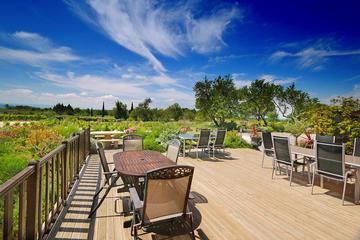
For many years, we dreamed of escaping to sun-drenched Provence and recently fulfill this fantasy. And our stay at Chateau de Boussargues proves the perfect ‘base camp’ for launching journeys back in time in southern France.
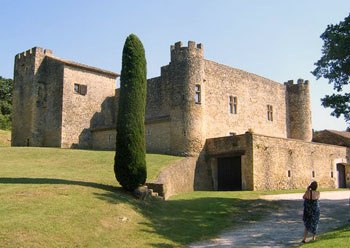
“The Romans first grew grapes here – and not long afterward, Christians built that little stone chapel in the woods,” owner Olivier tells us. As we survey its surrounding estate vineyards he continues, “And in the 12th century, Templar Knights began replacing earlier fortifications with our present castle.”
Crossing the bricked patio to a stone cottage, he points out aged trees, “Those Mulberry leaves fed silkworms once grown inside – and much later it became a shepherd’s dwelling.” Thick oak door unlocked, he shows us inside – an idyllic setting for history buffs like us.
As we wind through the Rhone Valley’s iconic rolling green landscapes on a different day trip each day. Picturesque country roads carry us past countless vineyards, cypress hedged orchards, small farms and into several charming villages.
 Medieval Fontaine-de-Vaucluse nestles among chalky cliffs to the east. After strolling to its renowned spring, the largest in France, we savor luscious crepes at an open-air bistro overlooking its emerald stream. From picture-perfect Gordes, a white stone village clustered atop a hilltop, we hike the rugged trail to enchanting Abbey of Sénanque, set among perfumed lavender fields and golden wheat that undulate in warm breezes. And inside walled Pernes-les-Fontaines, a self-guided walking map guides us to many of its forty treasured fountains.
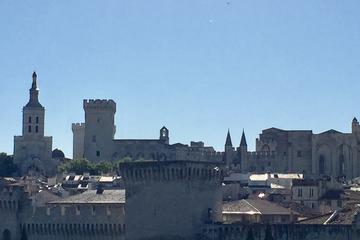
Massive weathered ramparts still encircle Avignon. Passing through the main gate, we follow Rue de la Republic to feast on neoclassical architecture in Place du Horloge in the heart of old town. Then just along a narrow street in a huge nearby square we sight a golden Virgin Mary soaring above Cathedral Notre-Dame-des-Dom’s elaborate angelic marble statuary. And next door, Europe’s largest Gothic palace awaits us.
 Entering the Palais des Papes through enormous portals, we meander through its arched courtyards and into halls with vaulted ceilings, huge treasury rooms and even the colossal kitchen tower. Exhibits and illustrated storyboards explain how in 1309, Pope Clement V escaped the turbulence of Rome to reside in Avignon. A subsequent pope bought Avignon from Queen Joanna I of Sicily for 80,000 gold gulden. And over a span of 68 years, this vast fortified religious fortress protected and pampered seven consecutive popes until the papacy officially returned to Rome.
A maze of now-bare rooms reflect clues to their sumptuous lifestyles: original ornate tiles floor the meditation alcove; lively frescoes of hunting scenes surround an early pope’s bedchamber and compelling paintings of Christ’s life remain in a small chapel. From dining hall windows, we visualize the lush, once-extensive vegetable gardens and exotic papal menagerie filling arched courtyards below. Sweeping views from the ramparts include Le Petit Palais, a restored archbishop’s palace across the square featuring superb Renaissance Italian art.
Rising high above the palace, Rocher-de-Dom’s rocky hilltop park offers us vibrant gardens, shady pathways and classic statuary. From those stone bluffs, we can gaze down at the once-raging Rhone River, today tamed by hydroelectric dams and sight St. Benezet Bridge aka Pont d’Avignon, the city’s most celebrated monument.
 Delighting in cool breezes off the Rhone, we later approach this bridge. Humming the catchy children’s song immortalizing St. Benezet’s bridge, we zanily sing, “Sur le pont d’Avignon, l’on y danse, l’on y danse,” over and over. Circling round and round, we dance our way across the remains of this fabled structure…to the amusement of others strolling there.
Originally 947 meters long, four meters wide with 22 wooden arches, this strategically placed bridge had attracted travelers and merchants from far and wide during the middle ages. Being the sole bridge between Lyon and the Mediterranean, both Avignon and the church prospered greatly from its heavy tolls and taxes on merchandise.
We pause at the two-story chapel precariously perched on the first of four surviving arches. Above, tiny 13th century Chapelle Saint Nicholas, devoted patron saint of Rhone bargemen; below, 12th century Chapelle Saint Benezet honouring the shepherd-saint inspired by holy voices to build ‘le pont’ at Avignon. According to legend, heavenly angels guided the young shepherd to Avignon. Though his proposal first provoked ridicule, he convinced wealthy supporters of the ‘divine will’ by lifting a huge boulder and heaving it down at the designated site. Sadly, Benezet never witnessed this miraculous project’s completion in 1185.
Reaching the furthest span we survey Villeneuve-les-Avignon on the opposite riverbank, at one-time a glittering sister-city of cardinals. This charming medieval village boasts marvelous 14th century structures of its own…
 Along many others, we stream back along this angel-inspired bridge and imagine those alluring bygone days. We then thread our way down cobbled streets to other shaded plazas and discover venerable cathedrals displaying resplendent artistry including refurbished mansions serving as fine art museums. Lingering in open-air bistros over buttery croissants thick with local cheeses and pungent lattes, we contemplate the extravagances of Avignon’s past glory days.
Also a World Heritage site, Arles was established as a major Roman port and also became home to impressionist artists. Following her winding, narrow streets marked with theme plaques of Antique, Medieval, Renaissance and Van Gogh routes, we discover her most prestigious monuments.
The Roman coliseum still crowns Arles’ north hillside. From 90AD, 20,000 spectators sat on 34 rows of stone steps, wildly cheering chariot races…and later slaves, criminals and wild animals fighting for their lives on the wooden stage below. These days, citizens flock to this remarkable oval for summer bullfights, popular since1830.
Basking in the top tier’s cooling breezes, we scan three of four towers fortifying the arena during the turbulent Middle Ages and across red-tiled rooftops sight the Roman theater, our next stop. Now an outdoor cinema and concert venue, this ancient theatre seated 10,000 patrons. Only two of many elaborately carved statues and marble columns adorning its stage remain, fondly nicknamed ‘the two widows.’


A lone flautist fills nearby Place de la Republic with haunting melodies. Amid this busy square an Egyptian obelisk rises 15 meters from a fountain; the chateau-style 17th century town hall boasts a 1553 bell-tower. Most striking, Saint-Trophime Cathedral features an elaborate façade of sculpted biblical scenes, apostles, saints and two beatific angels crowning Saint-Trophime himself, the 2nd century bishop who brought Christianity to this region.
Resting on wooden pews inside, we immerse in the cool serenity. Sunlight streams through stained glass windows, splashing reds, yellows and blues onto the austere stone interior. A sweet, heavenly voice soon lures us into an adjacent courtyard outside. On a shaded stage among medieval carvings and marble columns, a young opera singer polishes stirring arias for her evening concert. Wistful notes circle these hallowed cloisters and follow us onward to Place du Forum.
 Mature plane trees shade the ancient forum, today bustling with shops, hotels and bistros, including Le Cafe la Nuit depicted by Van Gogh in Cafe Terrace at Night. The brilliant yellow walls, awnings and tablecloths recreate this acclaimed impressionist’s luminous effect of shimmering evening lights. Sipping café-au-lait and munching flaky-fresh croissants there, we notice a chunk of the original Roman Forum in the façade of Nord-Pinus Hotel across the way. And just off the square, Hotel d’Arlatan incorporates thick walls from Emperor Constantine’s extravagant royal residence.
Returning to our car on a quiet walkway along the Rhone, we pass the Thermae of Constantine, reminding us that the Emperor’s palace had stretched far along the riverfront. His immense brick bathhouse barely hints at the opulence bathers then enjoyed.
Back at our magical lodgings, we do some lavish bathing of our own. Blissfully afloat in the castle’s pool, we try to imagine what Constantine and those stern Templar Knights might think of today’s luxurious world. Dining later under the stars with friends, we raise goblets filled with robust wines from the chateau’s time-honored cellars and toast the wonders of Southern France.
Avignon Private Tour : The Papal City
If You Go:
– For a good overview
– For car rentals
– For rail service possibilities
– For heritage villas, cottages or hotels
– For cheap flights to Paris
About the author:
much-traveled freelance writer/photographer team living near Vancouver, BC, Chris & Rick Millikan are former educators who now present the joys of travel as an inviting ‘curriculum.’ BC community newspapers regularly publish their travel stories…and occasionally In-flight Magazines, the Vancouver Sun and Province. Both are members in good standing of the British Columbia Association of Travel Writers (www.bctravelwriters.com). Chris is the Board’s Vice President. Often reflecting zany, cultural and historic adventures, their accounts of off the beaten track adventures are featured regularly in Senior Living Magazine (www.seniorlivingmag.com) and Open Road Driver Magazine (www.openroaddriver.com) The 2009 Kalama Award acknowledges this team’s array of stories reflecting the rich culture of Maui, Molokai and Lanai. As contributing writers for www.travelwriterstales.com their tales are syndicated in newspapers throughout BC. Contact: Chris at chrsmillikan4@gmail.com & Rick at millikan@axion.net
All photographs by Rick & Chris Millikan.
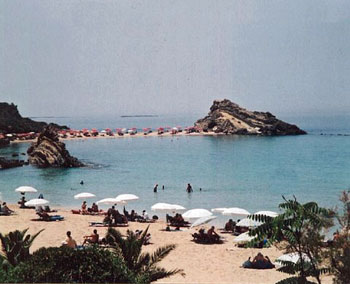


 As I watched the glorious sunset from the Venetian-style lighthouse, Fenari, I contemplated the many tragedies that have befallen this beautiful island.
 The harbor of Vathi is surrounded by houses with red-tiled roofs. Cafes animate the waterfront. The summer evening is scented with the smoke of grilling kebabs and fresh-caught fish grilling over charcoal coals. There is a curious atmosphere here. Ithaka’s hillsides are scented with wild sage and oregano, dotted with vibrant wild-flowers and silvery olive groves. Surrounding the tranquil orchards and vineyards are the high menacing mountains.
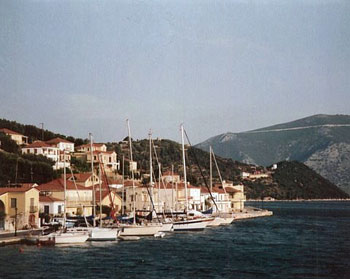 It’s an Odyssey in itself just getting off Ithaka. The taxi picked me up as scheduled in order to make the sailing to Lefkada. I enjoyed the scenic drive and arrive in plenty of time, but fifteen minutes before the ferry was due to arrive, I discovered that the ferry that had broken down, and we must leave from a different port. After a hair-raising wild race by taxi on a twisting road with hairpin curves and precipices, I arrived at the port just minutes before the ferry sailed.
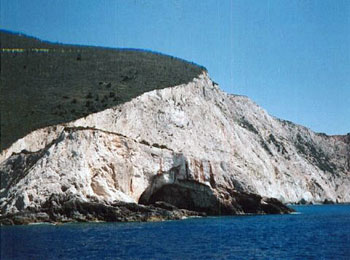 Sailing past Cape Doukas, the towering white cliffs rise from a sea that is as blue as a robin’s egg. The Cape looks like a gigantic wedge of cake with a lighthouse on top for a candle.
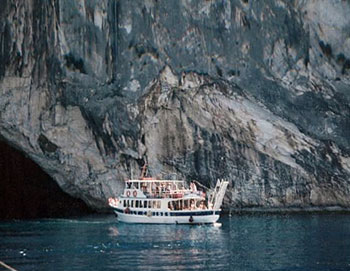 The boat circled the island of Skorpios, a small island, densely wooded with cypress and pine trees. The red-tiled roofs of the Onassis’ villas are half-hidden behind the trees. In each little cover there are piers, each with a palm tree planted at the end. Around the dock areas, the grounds are landscaped and showers of magenta bougainvillea spill over the stone fences. One of these villas was a gift to opera singer Maria Callas in the days before Onassis abandoned her in favor of Jacqueline Kennedy.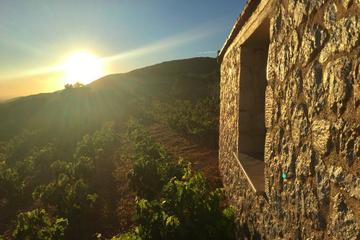
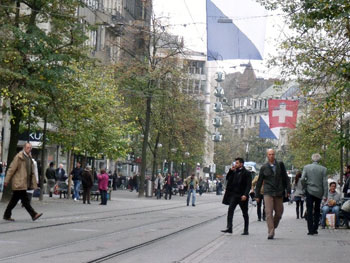
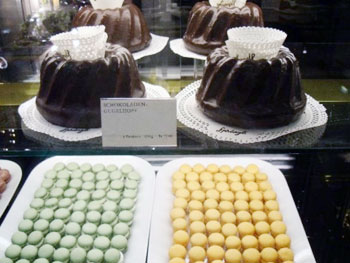 Because the Swiss are known for their quality chocolate making, and combined with my passion for the confection, it was on my agenda to check out some of the shops, nestled among other outlets selling high line fashions, watches, and jewelry. Two chocolate shops, Confiserie Sprungli and Teuscher produced a hearty scent of cocoa that pleasantly flowed through my nostrils. It was a chocolate feast for my eyes, as meticulously-decorated items with such names like Pariser-Konfekt and Gianduia-Rustica lined the shelves of delights, many of which are handmade at Confiserie Sprungli.. Even though chocolate prices range around $50 a pound here, one can keep things more budget-friendly by purchasing the treats in 100 gram increments (around 3.5 oz).
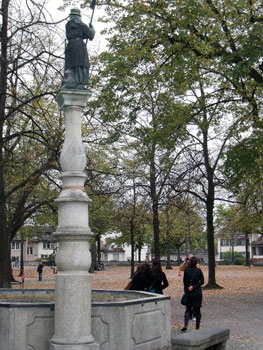
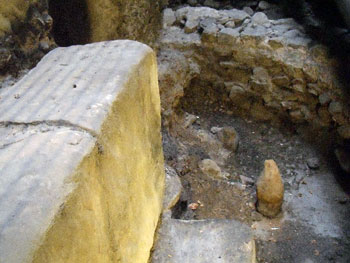 Switzerland is one of the most expensive countries in the world to visit, but ironically, Zurich gives away one of the most important staples of life: water, via its 1,200 public fountains that dispense the crystal clear liquid (my taste buds noticed no chemical taste) from unique statues that have needles on top of them so as to keep pigeons away. I couldn’t help but notice St. Peter’s church, one of the conspicuous landmarks of the area, for its 28 foot in diameter clock face, the largest in Europe. I wanted a nice vantage point of the Old City, and got it a few blocks north at the Lindenhof. It’s called that because of the Linden trees that dominate the park area that overlooks the river, offering great views of the Old Town. It’s the highest point of the Old City that dates back to pre-Roman times, when the Celtic Helvetti resided here. Across the river, I spotted the double Neo-Gothic domes of the towers of the Grossmuenster, which dates back to the 12th century, and where the Reformation began in the country.

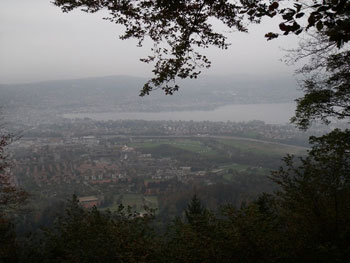 The beauty of a place truly shows through, not when the weather is picture perfect with the sun a blazing, but when the weather isn’t ideal, as was the case with my ascent to Uetliberg to get a bird’s eye view of the area. Once again, with my Swiss Pass, I was able to take a 22 or so minute commuter train ride from the Hauptbahnhof (Tracks 1 or 2) to the base, taking in chalet homes, green soccer pitches, and Switzerland’s own brand of autumn foliage that complimented the greenway paths along the tracks. From the station above, I proceed upwards for about ten minutes on dirt paths “beautifully-littered” with fallen red, green, brown, orange, and yellow foliage. As I ascended the mountain top, I noticed tall giraffe-like figurines whose antlers serve as lights. There are numerous hiking and biking paths that cut through lush greenery that makes getting lost a pleasant experience.
 Even though Zurich West is a just a few minutes away from the Haptbahnhof by numerous S-Bahnen commuter trains to Hardbrucke station (including the S9) or around ten minutes by tram, it was as if I stepped out into a totally different world. After disembarking, I noticed I was close to 415 foot high modern skyscraper called the Prime Tower. It’s a world that’s a cross between a post-modern and old Communist-style city mixed uniquely with new ideas in design that cherishes the old remnants of Zurich’s past going back two centuries. This area was once made up of factories and foundries that produced soap, various mechanical parts, etc. In the early 1990s, Zurich West began to revitalize itself, using the skeletons of its industrial past as a basis for what it is today, a bustling multi-cultural melting pot containing trendy clubs and bars with names like “Supermarket”, retail and second hand shops (there’s a nicely-stocked Salvation Army thrift store that’s called “Heils-Armee”), and offices full of white collar workers glued to their laptops.
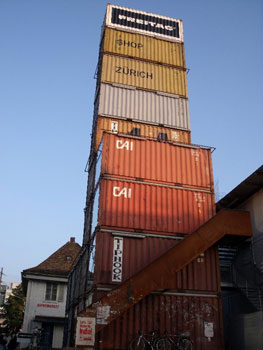 As I walked on the wide walkways among the edifices, I took in such bizarre sights as the the Freitag shop which uses 19 old shipping crates stacked nine stories high to sell handbags and wallets made out of recycled industrial components. And down the street, the outlets in a strip mall called Im Viadukt are nestled inside the arches of a railroad bridge that was built in the late 1800s.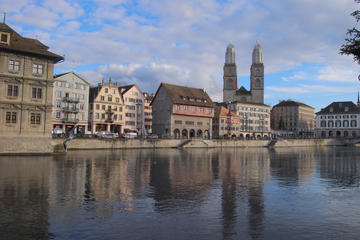
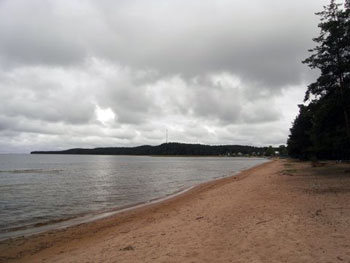
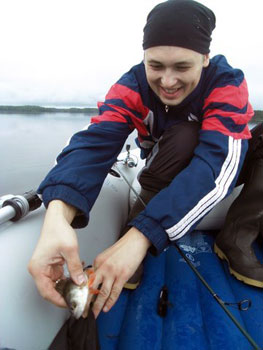 I could stay on its shores for ages, admiring its mirror-surface and abundant vegetation but we had plenty things to do. It was already 4 p.m. when we arrived. Hungry sick and tired after a long trip we had to pitch tents while others sought firewood and cooked dinner. It was rather complicated to find dry firewood as soil was damp and mossy. Trees covered with lichen were demi-rotten. Fortunately my husband Vadim found a huge fallen birch that was dry enough to make fire.

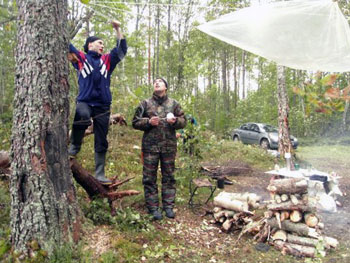 Despite our hopes and expectations, rain didn’t stop and wind became even more furious, making trees swing from side to side.
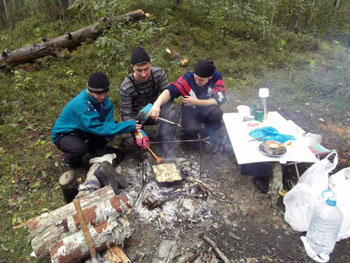 For a moment we kept silence. Wind gained strength. It started to snow, although it was July. I didn’t expect it would be so cold and windy. Shivering with cold I offered others to fish on the lake bank hidden in thick vegetation. As it turned out the idea was great. Our friends who preferred to stay near fire were chilled to the bone as we returned with our modest catch. It is that we set up our tents and made fire in the forest edge winded from every side. Hard wind and rain turned our fire into smoldering coals. Three perches and two roaches we managed to catch made a fragrant and tasty hot fish soup that warmed us up and filled with energy. Our joy didn’t last long. The hot tea Vadim boiled on a bonfire became cold in a few minutes. There was no hope that the weather would improve. Severe wind almost blew out our fire. It started to hail. Trees were swinging in the strong wind threatening to fall down. It became clear that we would have to spend the whole night in fragile tents under huge trees. The idea to spend night under the Sword of Damocles frightened Kristina so much that she pledged us to drive away as soon as possible. It was already 2 a.m. It would take at least two hours to pack two tents and a boat in the darkness of Karelian night lightened by two tourist lanterns. There was no choice. The only thing we could do is to go to bed.
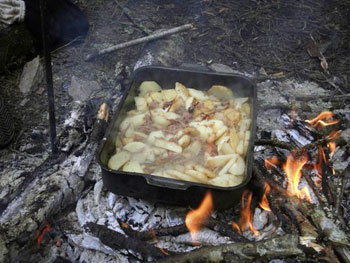 When I zipped my tent from the inside, I felt myself like a small insect caught by hail under a fragile leaf. I saw nothing but darkness in my small tent, although noises and howls made it clear that huge trees were swung and thrashed severely in the thundering wind as if they were ears of wheat. In spite of my anxiety I slept like a baby after active day in nature. As we got up the weather didn’t changed for the best, on the contrary it became even colder. It was time we left. One may think that it’s a pleasure to leave stormy, rainy and hostile place for cozy armchair in your sweet home. It depends on the person. Karelia is not sunny and friendly most of the days. It can be rather rigorous and austere. Nevertheless it recharges you with vital energy, makes one strive for life, be grateful for small favors made by nature and notice sun even during rainy days.
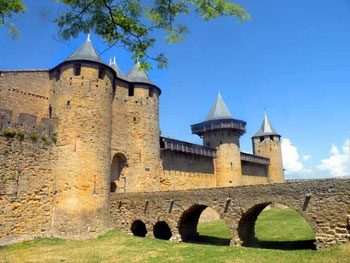
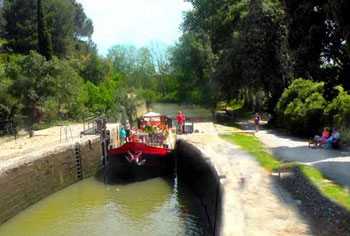 The captain and deckhand swiftly dismantle the roof and windows of our boat’s raised wheelhouse as an ancient stone bridge comes into view. We crouch and duck our heads; the vessel just barely fits underneath. Beyond, the boat slips serenely along on a ribbon of green under a shady canopy of plane trees. At the occasional break in the foliage, we spot a tall church spire, sprawling vineyards and the distant snowy peaks of the Pyrenees. Our captain will not need to replace the wheelhouse for days to come. It is May, and the weather remains blissfully warm and dry. Welcome to the Canal du Midi, which crosses Languedoc in the sunny South of France.
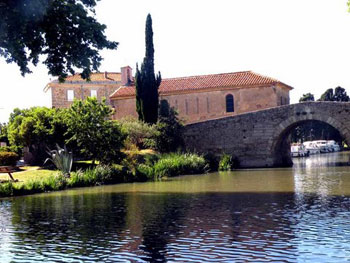 We arrive in the town of Beziers on the 330th anniversary of the canal’s official opening. Gala concerts, sound and light shows, and fireworks mark the event. With narrow cobblestone streets, a beautiful hillside park, and inviting little outdoor restaurants, Beziers is the birthplace of Pierre-Paul Riquet, the genius who conceived and spearheaded the 150-mile long canal project, beginning in the 1660s. The goal was to link the Atlantic with the Mediterranean, thereby avoiding the dangerous journey around Spain and past the fierce Barbary pirates. Its design is unlike most other canals, in France and elsewhere, which are excavated trenches that generally follow natural river valleys and draw their water supply from those rivers. The Canal du Midi follows the contours of hillsides and crosses right over natural features like rivers and streams on the raised archways of elegant stone aqueducts. Its source of water is a large mountain reservoir. Near Beziers, the canal leaps up a steep stone “staircase” of nine consecutive locks and later tunnels through a low mountain. A 17th century engineering marvel.
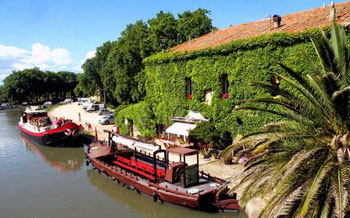 Captain Uli Weber picks us up at our hotel, along with our Australian companions Jan Kenchington and Janette Frost, and drives us west out of Beziers to join Caroline, which we have booked through FranceCruises.com. Built in the 1920s as a classic Dutch sailing barge, the boat is brightly painted with graceful hull lines, upswept both fore and aft, and a broad, spacious main deck. We are greeted by Uli’s wife Ute, who takes us below and shows us to our well-appointed cabins.
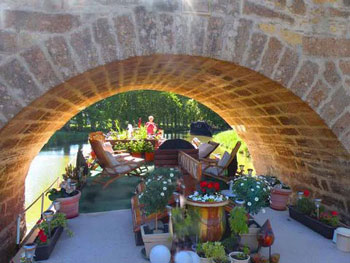 Caroline, however, is a much smaller and more intimate boat. Uli and Ute are the owners. They live aboard year-round and do everything themselves, which allows them to charge considerably less. He pilots the barge, is waiter at mealtimes, and serves as driver and highly knowledgeable guide during side trips in their mini-van. She is the five-star chef, with 250 cookbooks in her collection, as well as chambermaid and deckhand while docking or going through locks. From the first moments, we feel ourselves to be guests in a lovingly decorated home. It is an informal space that is planted with on-deck flower beds and studded with cushioned deck chairs, zany wooden sculptures, even a tiny pond full of fishes and water lilies. Although there is a cozy salon below, with a dining table, sofas and a wood-burning fireplace, we are favoured by good weather and take most meals up on deck.
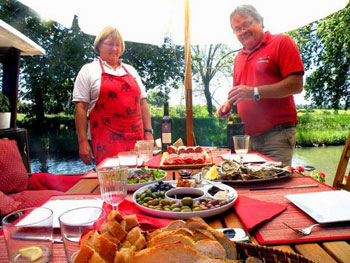 For guests who prefer to sample the many interesting canal-side eateries, the Caroline cruises offer a lower priced half-board option. Guests take breakfast and a large lunch on board but eat most dinners in nearby restaurants at their own expense. We do this one night and enjoy an excellent dinner with wine at a classic auberge within easy staggering distance of the moored barge. Another variation is to have lunch in a market restaurant during a side trip, or to select and bring back the fixings for a picnic lunch or a barbecue on board the boat. Uli and Ute are flexible and open to all suggestions. One side trip takes us to the morning market in a nearby town, where Uli invites us to select anything we want him to purchase for our lunch. There are at least 25 kinds of olives, prepared in different ways, and an amazing assortment of cheeses and dry salamis, with each vendor offering taste tests. I am eager to try the Mediterranean oysters, and Uli knows just who has the best shellfish. Back on board, Ute serves me half of them raw, and they are the freshest and most succulent I have ever eaten. The rest she grills lightly with Parmesan cheese and parsley for the others to taste. They are sublime.
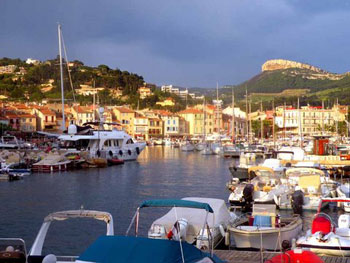 Most side trips, however, are focused on more than food. Languedoc is rich in historical sites. In Narbonne, we view a small excavated section of the Via Domitia, the ancient road that linked Rome with Spain. Hannibal probably passed this way with his elephants to attack Rome in 218 B.C. We tour the fortified hilltop village of Minerve. A little museum with dioramas tells the grim tale of how the redoubt was besieged and captured in 1210 during a papal crusade against the region’s heretical Cathar Christians. Nearly everyone, including women and children, was slaughtered in the fighting or burned at the stake afterwards. Uli drives us to a hilltop to view a huge, strangely symmetrical depression in the land that stands out even from Earth orbit. It marks where a lake was drained around 1200 to eradicate mosquitoes. Local monks did this by digging a precise pie-shaped network of ditches that converge at the centre of an enormous circle, now planted in orchards and grape vines.