Ðakovo, Croatia
by Valeria Teo
Ðakovo’s biggest traditional festival in the summertime is the Ðakovacki Vezovi which literally means “Ðakovo Embroidery” because Slavonian embroidery is a well-known Croatian craft.
The 43-year old festival lasts for two weeks. Starting from mid June, people come to Ðakovo to enjoy the best of the Slavonian traditions – delicacies, wines, arts, music and horse breeding. The last day of the celebration, always a Sunday, attracts the largest crowd. The grand day in 2009 falls on July 5.
The Ðakovo Tourist Office says that the number of people in the town doubles in the beginning of July every year. The additional bus service we found on July 5 might be the first evidence of its truth. The second evidence came when our bus was moving slowly into the town center at 8:30. We saw cars from all over Croatia and neighboring countries. All these visitors were going to the same place as we were – the St. Peter’s Cathedral.
 Pope John XXIII praised the Ðakovo’s landmark as “the most beautiful church between Venice and Istanbul.” We were impressed by the cathedral’s neo-Gothic-Romanesque style even without the Pope’s words. Before we had time to fully appreciate the magnificent cathedral, we had to join in the first program of the day.
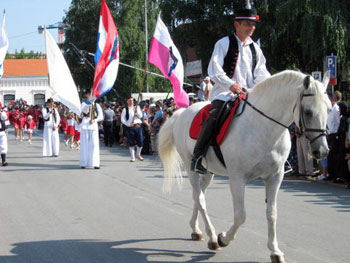
The streets outside the St. Peter’s Cathedral were already filled with festive crowd. Once the cathedral bell tolled at 9:00, everybody got their cameras ready for the most colorful parade in Croatia. More than 2,000 people in their folk costumes were singing and dancing in the procession. Participants came from every part of Croatia, Macedonia , Bosnia, Serbia etc. The wedding carriage and horsemen at the end of the procession revived memories of the Slavonian past. Summer was once the time for fun, feast and fete in the Croatian countryside.
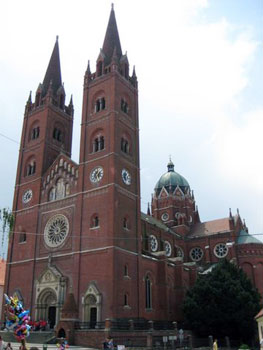 Religious practices have always been an integral part of all Croatian festivals. Ðakovacki Vezovi is no exception. Mass at the St. Peter’s Cathedral follows the parade.
We entered the church earlier to secure our seats. People were standing all around inside the colossal cathedral when the Mass started. Older people were in the majority. That did not come as a surprise as we had seldom met young people in most Sunday morning services.
I was likely to be the first Chinese receiving Holy Communion at the St. Peter’s Cathedral. Curious gaze followed me throughout the service. I could even tell from the children’s stare that they had never met any Chinese in their lives.
No Croatian festival is complete without an open-air market. We went slowly for our treasure hunt in the Ðakovo bazaar after the Mass.. Embroidery and other traditional arts and crafts were attractive to most visitors. We bought a bag with Slavonian embroidery at a bargain price. However, stall men were less willing to cut price later when more guests were arriving. The basic principle of supply and demand held true even in this rustic town.
The bazaar often smelt of savory local food. The aroma of roast lamb was the most inviting. It came from an old-fashioned rotating spit outside a restaurant. A man was roasting three full-sized lambs when we joined the queue to get a bite of the tender meat. It turned out to be a real treat!
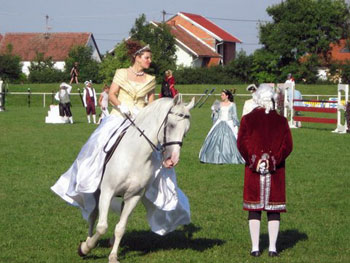 The highlight in the afternoon was equestrian competition and performance held in the hippodrome, showcasing the Lipizzaner breed. Ðakovo’s first official stud farm was founded more than 500 years ago, long before the Lipizzaner horses came to Ðakovo in 1806. But Ðakovo soon shifted exclusively to the breeding of these noble horses. The Lipizzaner breed has made Ðakovo famous beyond the Croatian borders for more than 200 years.
The Lipizzaner breed is interesting because they were not born white. Most Lipizzans were born dark—usually bay or black—and become lighter each year. The graying process is complete at between six and ten years of age. Adult Lipizzans are in fact gray horses with a coat of white hair.
 Visitors could go to the stable for a close contact with these beautiful creatures. To my surprise, the horses remained calm even though so many strangers were moving around them. In the meantime, the equestrians were busy preparing the horses for the performances at the hippodrome.
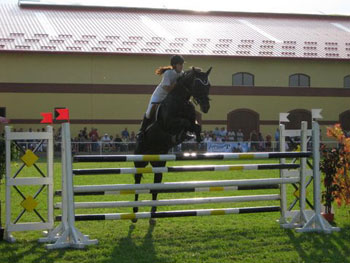
We knew nothing about dressage or show jumping. But for every walk, trot, canter and jump, we cheered and applauded together with the elated audience. The festive spirits diffused joy all around us.
The whole town was getting ready for the evening shows when dusk was slowly approaching. Staying a night in Ðakovo was necessary to fully experience the whole-day program. But we had to leave Ðakovo before night fell. Missing the best folk costume competition and the two concerts left us with some regrets in our otherwise memorable day in Ðakovo.
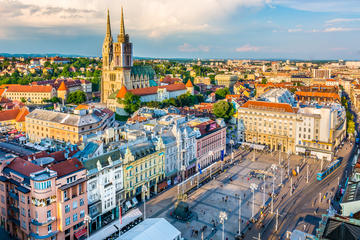
Private Full Day Trip to Croatia including Capital Zagreb
If You Go:
Ðakovo is well served by bus from Osijek, the third largest city in Croatia. The bus ride takes about an hour. It goes through the most beautiful farmland in Slavonia. In summer, passengers can see huge yellow sea of sunflowers. The Tourist Board of Ðakovo
About the author:
Valeria Teo and her husband divide their time between their home in Split, Croatia and Hong Kong. See their website at: www.freewebs.com/valeriaijosip
All photos are by Valeria Teo.
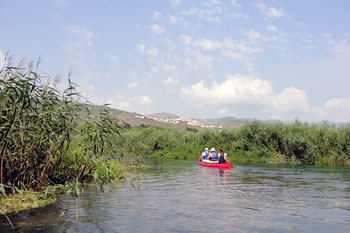
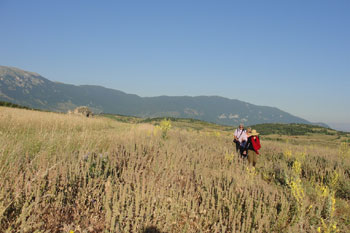
 I wonder what it would be like to live here in Abruzzo all the time, far from the pressures of city life, far from tourist traps, close to nature, and to inner peace. Like Celestine. Back in the thirteenth century, he lived higher up these rugged slopes, in a cave, until he was called to the Papacy. But he hated all the glitz and glamour, and missed his life as a hermit, so he swiftly issued a decree allowing popes to abdicate, and returned to his cave.
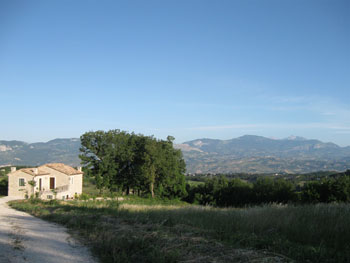
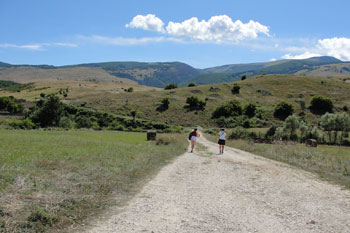
 Yes, I think, turning back down the mountain, there’s a spiritual energy here. But I would want a little more material comfort than Celestine had: perhaps I could buy that stone ruin over there on the slope, and convert it. Like Ezio and Mariangela did. A few years ago, they decided to flee the pressures of city life, and bought an eighteenth century property here. They restored it using original materials, and made it into a four-bedroom B&B. They named it Casa Giumentina, after this valley. That’s where I’m staying…and I’m getting hungry. The sun is now warm on the back of my legs. As I approach the house, I see that breakfast has been laid out on the table under the oak tree. I can already smell the cappuccino…and Mariangela’s freshly baked apple cake.
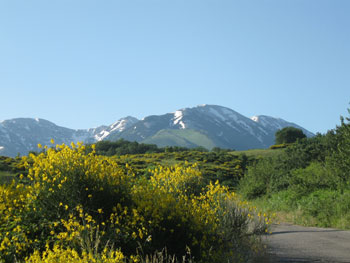 As I enter the village, I notice that the roads have been recently paved. There’s a feeling of progress, of development. After the war, this was one of the most depressed areas in Italy. People left in their hundreds, looking for work, often in mines in northern Europe. The population dropped from 2000 to 450. But things are changing: people are trickling back.

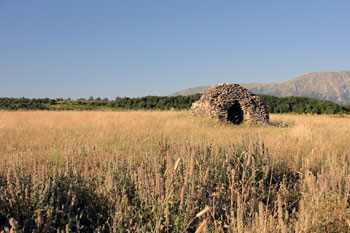 ‘My husband died in the war,’ she says. ‘I never married again. I couldn’t have my sons calling another man “papà”.’
 I stroll down to Il Carro, a restaurant which serves local delicacies. I start with an antipasto of salame and pecorino cheese, then have wild boar, with spelt, which is the staple cereal in this area. I accompany it with a glass of Montepulciano wine, and finish up with a fresh strawberry sorbet and an espresso.
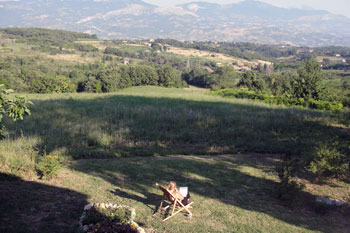
 But no, here is where I want to be. The view is too beautiful. I feel warm and relaxed. I’ll sit in a deckchair and read, or write, or perhaps just gaze into space until sunset.
 We chop and stir together in the large kitchen. Before settling down to dinner on the terrace I slip on a cardigan. Up here, fifteen hundred feet above the sultry plains below, the evening air is cool.
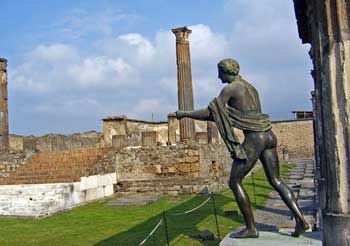
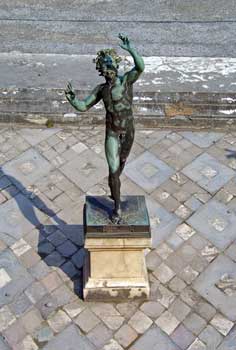 Entering ancient Porta Marina’s pedestrians-only passage, our guide introduces Pompeii. “Just like now, thousands of visitors traveled here,” Massimillio informs us. “And many different languages were spoken.”

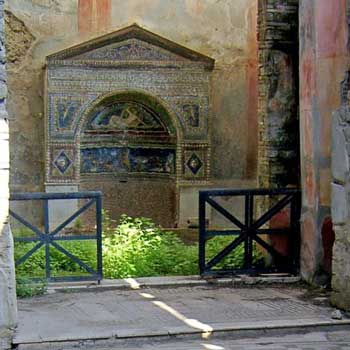 Wealthy nobles lived along via de la Fortuna where elegant homes covered with bright-white ground-marble stucco stood next door to smaller houses. At House of the Faun, an undamaged mosaic displaying the original sign HAVE meaning ‘hail-to-you,’ welcomes us into the entrance hall and open courtyards. Then covering an entire block, its forty stylish rooms included magnificent dining rooms, one for each season. Carved columns had lined two immense gardens filled with marble and bronze statuary and beautiful fountains.
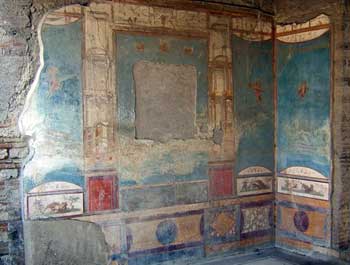 Nearby, the House of the Vetti belonged to bachelor brothers, prosperous wine-merchants. This patrician villa retains original mosaics in green jade, white Carrera marble and indigo-blue onyx; vibrantly colored frescoes decorate well-preserved entertainment rooms. At a smaller house next door, we linger over frescoes in rich earthen tones depicting delicate flowers and winged cherubs, among my favorites for their simple whimsy.
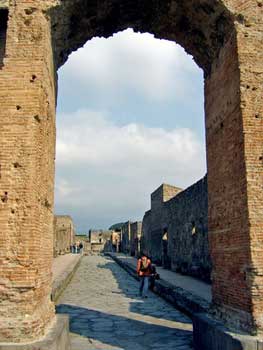 Raised sidewalks wind along the street to one of the 34 bakeries needed to feed Pompeii’s population of over 20,000. “Those squat towers made of volcanic stones milled flour on-site,” reports our guide. Amazed that the well-built ovens so closely resemble today’s brick pizza ovens, we imagine tantalizing aromas floating on the air. During excavations, centuries-old loaves of blackened breads were found inside many ovens.
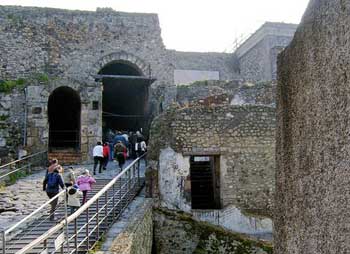 Inside, surprisingly small cells held stone beds once covered by mattresses. Using a separate entrance, wealthier clients had used the more private second-story rooms bedecked with rich frescoes leaving little to the imagination.
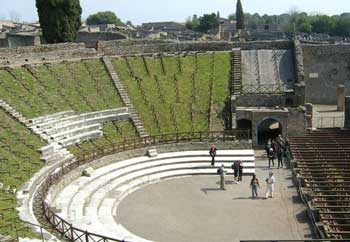 Onward past a former Temple of popular Egyptian goddess Isis, we pause among columns remaining in a second public Forum. This is where theatergoers had mingled in bars and cafes before open-air performances at their Grande Theater. First built in the 2nd-century BC, this theater seated over 5000 citizens in three price ranges. Its smaller semi-circular neighbor, the Odeon staged more intimate mime, plays and musical events.
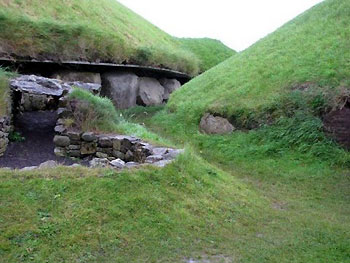
 Knowth, specifically, was first established in the early Neolithic six thousand years ago. First settlement is the ancient remains of a wooden/wattle rectangular enclosure with probably a thatched roof. Knowth is one thousand years older than Stonehenge, England and five hundred years older than the Pyramids of Giza in Egypt yet most people have never heard of it. The first use of the tombs was marked by cremated human bones and other material inside and elaborate ceremonies outside.

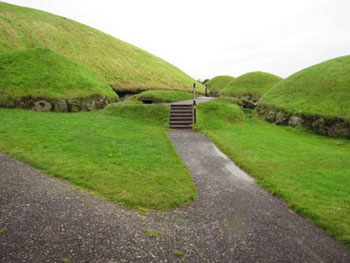 Knowth’s most impressive passage tomb is a great grass-covered mound measuring 80m by 95m. It is encircled by 127 kerbstones, a ring of engraved huge stones. Our word ‘curb’ must come from the same idea of being marked as a boundary. Passage tombs have certain features: being in the shape of an egg, or tumulus; being outlined by kerbstones, having a passageway and also an inner chamber often in the shape of a crude cross.
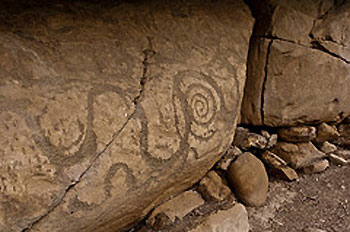
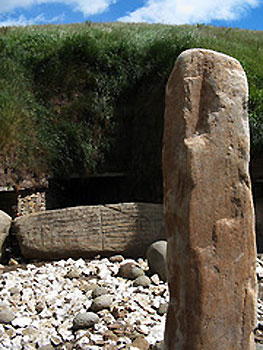 There is evidence that the art developed over many centuries and also ideas were apparently borrowed from Britanny on the continent. A picked cup mark is a feature of Knowth stones and may well represent the idea of a tunnel, a symbol of death. Also, unlike Newgrange, the stone work is developed based on the shape of the rock itself.
 Still burdened with my pull-along bag, my pack sack and umbrella I entered the mound through the entrance which faced east. I slowly made my way along the stoned passageway to the crude cross-shaped chamber, delighting in the subtle light and the energy of the countless many who had also walked as I now did. What will be revealed in the years to come?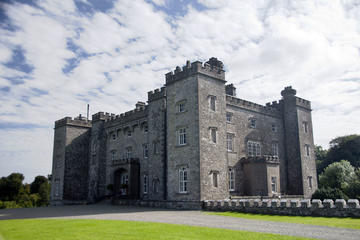
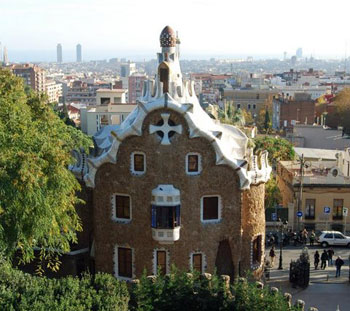
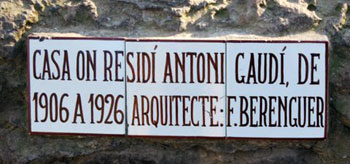 Certainly the buildings were different. Nature, it is said, abhors a straight line. So did Gaudi; the builders, glaziers and carpenters of Barcelona must have hated him. But, we didn’t stop at either of them. We were on our way to the Güell Park, where some of the best of Gaudi’s work is to be seen. Indeed, Gaudi used to live here, in a pink, fairy-tale house which is now the Gaudi Museum.
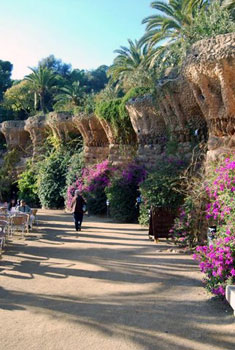 Güell wanted to build a model village, on the lines of similar villages in England, such as George Cadbury’s Bourneville, in the Midlands. But, Cadbury built his village for workers in his chocolate factory. Güell was much more ambitious. He intended his village for the more affluent and influential people of Barcelona.

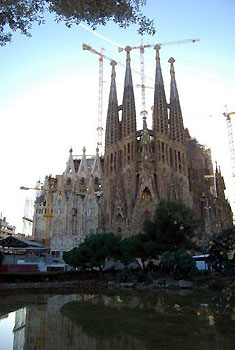 Gaudi was a devout Catholic, and, in his later years, made the building of the Sagrada Familia his life’s work. However, Barcelona already had a perfectly good Cathedral, and this could have been the reason that no money at all came from the Church. The building was founded solely by public subscription. So, construction progressed very slowly.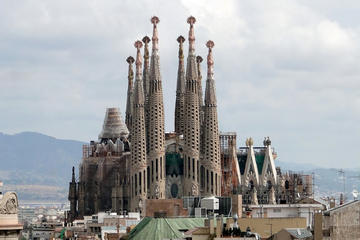
 by Maria Antonietta Crippa, ISBN 978-3-8228-2518-1
