Russia (formerly Finland)
by Maria Kozyreva
It was in the middle of summer when we decided to spend a few days in Karelian lakes. None of us had ever been there but we were sure to find a picturesque place to stay. Our Garmin navigator determined plenty of lakes to the West of the White Sea but we were attracted by a small lake not far from Essoila village.
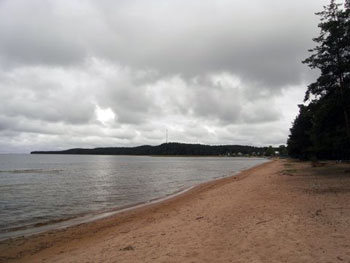
The road across Karelia was fascinating. High fir trees growing on rocky soil, huge stones covered with moss and berries made Karelian landscape unique and inimitable. As approaching to the place of our destination, we noticed a wonderful lake which remote shores were not visible and made it look like a small sea. Not far from it we found the lake we had chosen at home. It was hidden behind mossy trees that surrounded all its shores. We got out of cars and approached water. Seagulls were flying over our heads. It was a windy but sunny day.
 I could stay on its shores for ages, admiring its mirror-surface and abundant vegetation but we had plenty things to do. It was already 4 p.m. when we arrived. Hungry sick and tired after a long trip we had to pitch tents while others sought firewood and cooked dinner. It was rather complicated to find dry firewood as soil was damp and mossy. Trees covered with lichen were demi-rotten. Fortunately my husband Vadim found a huge fallen birch that was dry enough to make fire.
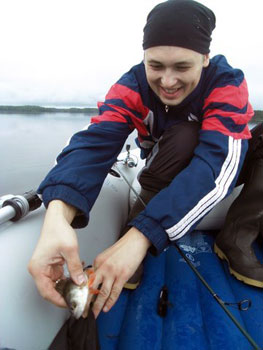
We had at least three hours before it got dark. To save time we divided into two groups. Kristina and Alexander were to make fire, while my husband and I inflated a boat and went fishing. The lake was still and calm. Firstly I thought that there were no fish but after approaching to floating grassy islands it became clear that our lake was swarming with fish. What a pleasure to catch your first perch! Slippery and nimble it tried to tear away and jump into clean waters. I took a silver fish glittering under bright sun by its rust-colored tail making it thrash even more fiercely in my hands.
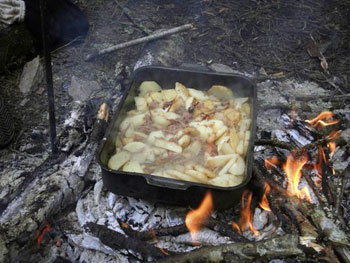
We hardly spent one hour fishing in the middle of the lake when clear blue sky turned into ominous grey mantle. It became darker and darker. Gusty wind drifted pelting rain, making us return to the shore and construct a tent above our fireplace to prevent it from extinguishing because of wind and rain. Our first meal made of several perches and potatoes was cooked in cast-iron pan, placed in the middle of burning fire woods. After a long road and sleepless night this modest but nourishing dish seemed to be the most exquisite dish we had ever tasted.


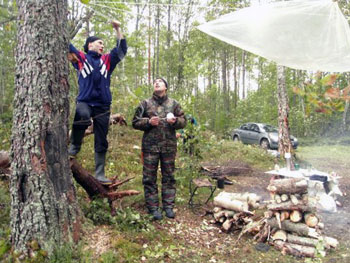 Despite our hopes and expectations, rain didn’t stop and wind became even more furious, making trees swing from side to side.
“Hello! Is anybody here?” An unfamiliar voice resounded from far away and in a few seconds we saw a middle-aged man wearing khaki-coloured suit.
“My name is Andrei. I am a forest warden. How are you going?”
We were going well enough and would go even better if only the weather were not so hostile.
“Haven’t you heard about storm in the outskirts of Saint-Petersburg? Probably you will have to survive its consequences. Beware that there are lots of rotten trees that could fall down at any minute”.
We exchanged frightened glances, making him burst out laughing:
“Don’t be so faint-hearted. Everything will be ok,” he said as he waved us goodbye and disappeared in dense forest.
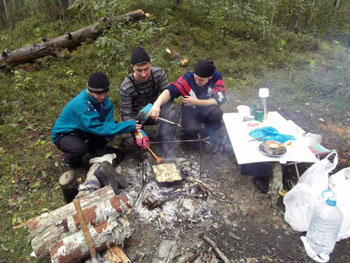 For a moment we kept silence. Wind gained strength. It started to snow, although it was July. I didn’t expect it would be so cold and windy. Shivering with cold I offered others to fish on the lake bank hidden in thick vegetation. As it turned out the idea was great. Our friends who preferred to stay near fire were chilled to the bone as we returned with our modest catch. It is that we set up our tents and made fire in the forest edge winded from every side. Hard wind and rain turned our fire into smoldering coals. Three perches and two roaches we managed to catch made a fragrant and tasty hot fish soup that warmed us up and filled with energy. Our joy didn’t last long. The hot tea Vadim boiled on a bonfire became cold in a few minutes. There was no hope that the weather would improve. Severe wind almost blew out our fire. It started to hail. Trees were swinging in the strong wind threatening to fall down. It became clear that we would have to spend the whole night in fragile tents under huge trees. The idea to spend night under the Sword of Damocles frightened Kristina so much that she pledged us to drive away as soon as possible. It was already 2 a.m. It would take at least two hours to pack two tents and a boat in the darkness of Karelian night lightened by two tourist lanterns. There was no choice. The only thing we could do is to go to bed.
 When I zipped my tent from the inside, I felt myself like a small insect caught by hail under a fragile leaf. I saw nothing but darkness in my small tent, although noises and howls made it clear that huge trees were swung and thrashed severely in the thundering wind as if they were ears of wheat. In spite of my anxiety I slept like a baby after active day in nature. As we got up the weather didn’t changed for the best, on the contrary it became even colder. It was time we left. One may think that it’s a pleasure to leave stormy, rainy and hostile place for cozy armchair in your sweet home. It depends on the person. Karelia is not sunny and friendly most of the days. It can be rather rigorous and austere. Nevertheless it recharges you with vital energy, makes one strive for life, be grateful for small favors made by nature and notice sun even during rainy days.
If You Go:
If you are to visit Karelia for the first time, it would be easier to travel through Petrozavodsk, the capital of the Republic of Karelia in Russia. There you would find plenty of tourist offices that would offer a variety of tours.
By Train
Moscow to Petrozavodsk
St. Petersburg to Petrozavodsk
By Airplane
Moscow to Petrozavodsk
St. Petersburg to Petrozavodsk
Helsinki to Petrozavodsk
Petrozavodsk Web Site
www.petrozavodsk-mo.ru/eng/about/map.htm
About the author:
Maria Kozyreva is a freelance writer and interpreter working and living in Russia. She is fond of learning foreign languages as she believes that they open the door to the world. She also enjoys traveling and painting. Contact: fleurlaska@hotmail.com
All photos are by Maria Kozreva.
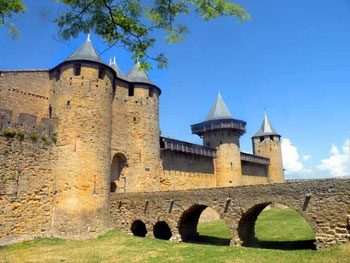
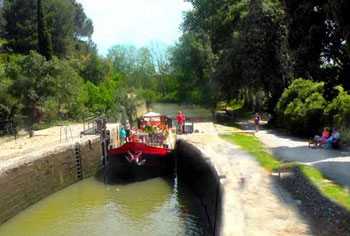 The captain and deckhand swiftly dismantle the roof and windows of our boat’s raised wheelhouse as an ancient stone bridge comes into view. We crouch and duck our heads; the vessel just barely fits underneath. Beyond, the boat slips serenely along on a ribbon of green under a shady canopy of plane trees. At the occasional break in the foliage, we spot a tall church spire, sprawling vineyards and the distant snowy peaks of the Pyrenees. Our captain will not need to replace the wheelhouse for days to come. It is May, and the weather remains blissfully warm and dry. Welcome to the Canal du Midi, which crosses Languedoc in the sunny South of France.
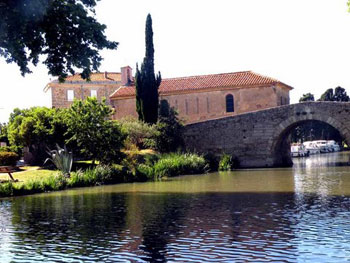 We arrive in the town of Beziers on the 330th anniversary of the canal’s official opening. Gala concerts, sound and light shows, and fireworks mark the event. With narrow cobblestone streets, a beautiful hillside park, and inviting little outdoor restaurants, Beziers is the birthplace of Pierre-Paul Riquet, the genius who conceived and spearheaded the 150-mile long canal project, beginning in the 1660s. The goal was to link the Atlantic with the Mediterranean, thereby avoiding the dangerous journey around Spain and past the fierce Barbary pirates. Its design is unlike most other canals, in France and elsewhere, which are excavated trenches that generally follow natural river valleys and draw their water supply from those rivers. The Canal du Midi follows the contours of hillsides and crosses right over natural features like rivers and streams on the raised archways of elegant stone aqueducts. Its source of water is a large mountain reservoir. Near Beziers, the canal leaps up a steep stone “staircase” of nine consecutive locks and later tunnels through a low mountain. A 17th century engineering marvel.
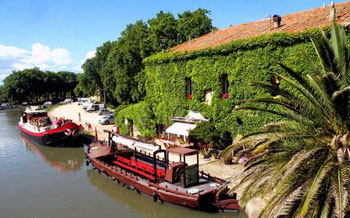 Captain Uli Weber picks us up at our hotel, along with our Australian companions Jan Kenchington and Janette Frost, and drives us west out of Beziers to join Caroline, which we have booked through FranceCruises.com. Built in the 1920s as a classic Dutch sailing barge, the boat is brightly painted with graceful hull lines, upswept both fore and aft, and a broad, spacious main deck. We are greeted by Uli’s wife Ute, who takes us below and shows us to our well-appointed cabins.
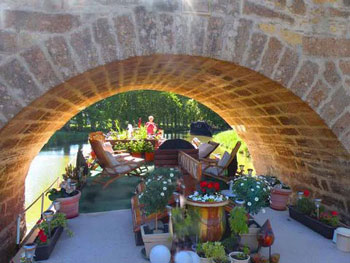 Caroline, however, is a much smaller and more intimate boat. Uli and Ute are the owners. They live aboard year-round and do everything themselves, which allows them to charge considerably less. He pilots the barge, is waiter at mealtimes, and serves as driver and highly knowledgeable guide during side trips in their mini-van. She is the five-star chef, with 250 cookbooks in her collection, as well as chambermaid and deckhand while docking or going through locks. From the first moments, we feel ourselves to be guests in a lovingly decorated home. It is an informal space that is planted with on-deck flower beds and studded with cushioned deck chairs, zany wooden sculptures, even a tiny pond full of fishes and water lilies. Although there is a cozy salon below, with a dining table, sofas and a wood-burning fireplace, we are favoured by good weather and take most meals up on deck.
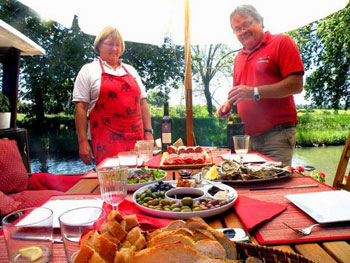 For guests who prefer to sample the many interesting canal-side eateries, the Caroline cruises offer a lower priced half-board option. Guests take breakfast and a large lunch on board but eat most dinners in nearby restaurants at their own expense. We do this one night and enjoy an excellent dinner with wine at a classic auberge within easy staggering distance of the moored barge. Another variation is to have lunch in a market restaurant during a side trip, or to select and bring back the fixings for a picnic lunch or a barbecue on board the boat. Uli and Ute are flexible and open to all suggestions. One side trip takes us to the morning market in a nearby town, where Uli invites us to select anything we want him to purchase for our lunch. There are at least 25 kinds of olives, prepared in different ways, and an amazing assortment of cheeses and dry salamis, with each vendor offering taste tests. I am eager to try the Mediterranean oysters, and Uli knows just who has the best shellfish. Back on board, Ute serves me half of them raw, and they are the freshest and most succulent I have ever eaten. The rest she grills lightly with Parmesan cheese and parsley for the others to taste. They are sublime.
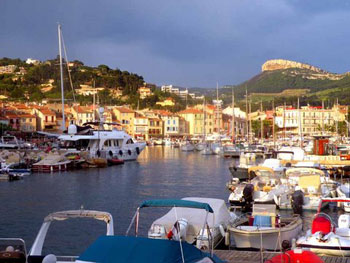 Most side trips, however, are focused on more than food. Languedoc is rich in historical sites. In Narbonne, we view a small excavated section of the Via Domitia, the ancient road that linked Rome with Spain. Hannibal probably passed this way with his elephants to attack Rome in 218 B.C. We tour the fortified hilltop village of Minerve. A little museum with dioramas tells the grim tale of how the redoubt was besieged and captured in 1210 during a papal crusade against the region’s heretical Cathar Christians. Nearly everyone, including women and children, was slaughtered in the fighting or burned at the stake afterwards. Uli drives us to a hilltop to view a huge, strangely symmetrical depression in the land that stands out even from Earth orbit. It marks where a lake was drained around 1200 to eradicate mosquitoes. Local monks did this by digging a precise pie-shaped network of ditches that converge at the centre of an enormous circle, now planted in orchards and grape vines.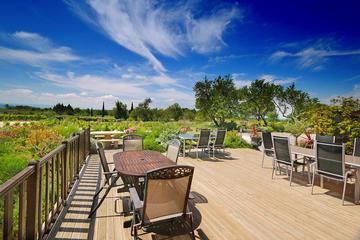
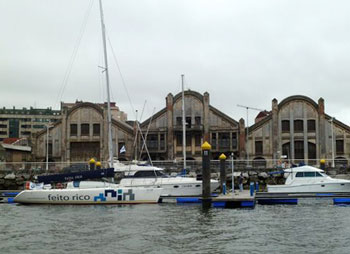 Roman Alvarez Gonzalez is a teacher by profession. We met him during a boat ride along Rio Aviles. Currently he is serving as the Councilor for Culture and Sports in Aviles. Roman’s history 101 lesson includes among other things that Aviles sits on the most northerly tip of Spain and is the third largest city in the Principality of Asturias with 80,000 residents. The natural estuary made it a perfect seaport in the Middle Ages and a key to the salt trade with France, when salt was worth more then gold. Sabugo now a district of Aviles began as a fishing port on the Rio Aviles. In part because of over fishing the fishing industry is no longer a major player in the economy. For a time in the mid 20th century shipbuilding and a steel industry also prospered on the waterfront.
 El Café de Joey is in old town Aviles. Joey is Asturian/American and a bit of a history nut. Never reluctant to share his knowledge as he rushes about catering to his customers, Joey tells me over a potato tortilla and cold drink that Aviles was a key to Spain’s exploration for new territory. He points out that the 16th century Spanish explorer Pedro Menedez de Aviles sailed from the walled city to the new world where he founded America’s oldest continually populated city of San Augustin (St. Augustine, Florida). San Augustin is their sister city and their patron saint. While he stops to top up my glass Joey expounds on Asturians in Cuba. Spaniards sailed from Aviles to the Caribbean Island where they were instrumental in developing the island country’s tobacco farming prior to Castro’s regime. El Café de Joey now sits where the medieval cities wall once stood.

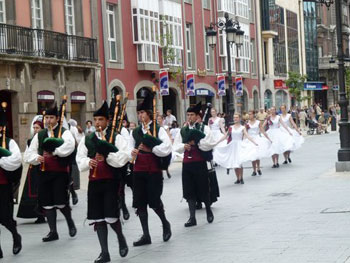
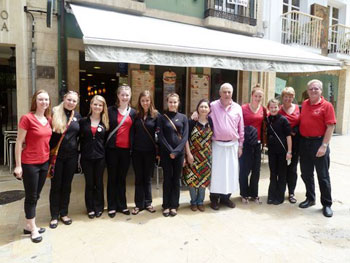 That brings us back to The Beltaine Festival. Celtic music is a big part of Asturian history including bagpipes or gaitas, as they are known in Spain. The Gaiteras are usually accompanied by tamboril (snare drum) and requinta (fife) and folk dancers. The Beltaine Festival attracts Celtic performers from around the Principality of Asturia, Scotland, France, England and this year Juan Carlos took a leap of faith and for the first time invited a Canadian group. From the start of the festival The Inverglen Scottish Dancers performed on the main stage in Parque De La Muelles, in the Plaza De Espana and around the old town to enthusiastic audiences.
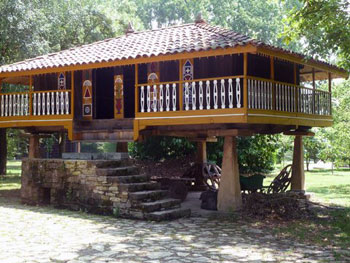
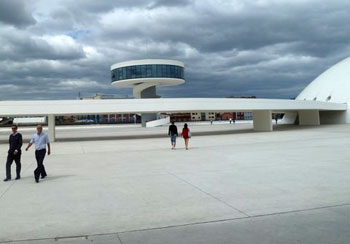 A short train ride away is Gijon, much more touristy then Aviles it is worth a day trip. The Museu del Pueblu d’Asturies preserves the history of the Asturian people and includes a collection of habitats and Horreos from the 17th to 20th century as well as the Asturian Pavilion that was built for the Seville Expo ‘92. It’s well worth a visit. Before catching the train back to Aviles check out the market in Plaza Mayor or just enjoy the sun and sand along Plaza de San Lorenzo.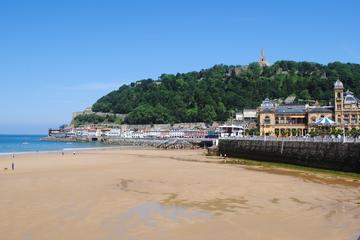
 Joe, my husband, and I arrived in Munich, Germany on a sunny afternoon in September. Using the airport mini bus service we arrived in Kundle an hour and a half later. Anna, the Master Carver’s wife, a small, slim lady with sparkling eyes ran down a flight of stairs to greet us. She whisked us to a spacious second floor guest room with a large deck overlooking gardens and a spectacular view of the mountains. We followed Anna as she ran across the garden and up another flight of stairs that led to a door with an impressive eagle carved in relief. Stepping through the door was akin to entering a tree house filled with industrious wood spirits. Sunlight filtered through floor to ceiling windows of a huge workshop, sharp tools sizzled across fragrant pine. Intricate carvings came to life under Herr Binder’s soft spoken direction and shrewd eye.
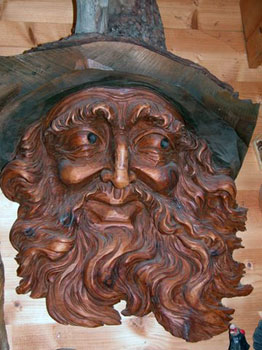 Carving in Kundle was a unique experience, surrounded by beautiful carvings it was impossible not to be inspired. Eagles, wings outstretched, perched near windows as though waiting to take flight. Alpine Ibex, with enormous backward curving horns, seemed ready to leap off craggy, wooden rocks. Larger than life faces with swirling beards, tangled hair and mischievous eyes smiled down from walls as we carved.

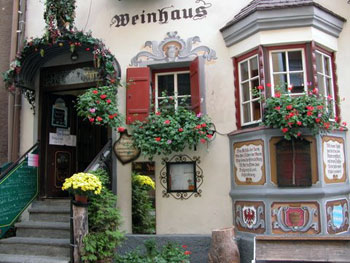
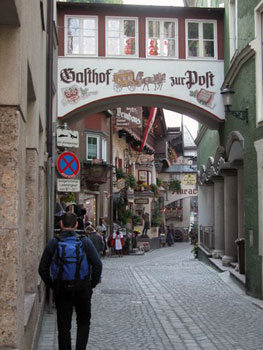
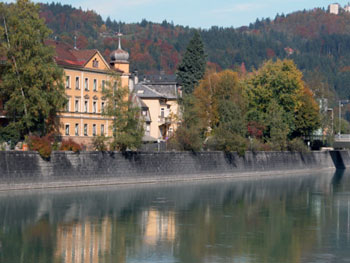 Postcards often depict glimpses of destinations quite unrelated to reality. Kundle is the exception. Intricately carved wooden balconies and eves changed pastel colored walls of houses, shops and restaurants into whimsical gingerbread creations. Geraniums, petunias and ferns tumbled in cascades of color from every balcony and window box. The Hanging Gardens of Babylon could not have looked more beautiful. Narrow winding streets led to fountains where children splashed on their way home from school and towns people gathered to eat lunch. Five restaurants served a variety of food, we enjoyed authentic Austrian dishes in a restaurant where massive wood furnishings, beams and doors were heavily decorated with carvings. Family members gathered in large groups for dinner and men in colorful lederhosen stopped for a pint of lager en-route to festival rehearsals. As the atmosphere filled with camaraderie, clinking glasses, bursts of regional songs and laughter, enhanced by wafts from the kitchen of frying Wiener Schnitzel, Goulash and apfelstrudel, we felt we were on stage, part of the cast in a movie extravaganza.
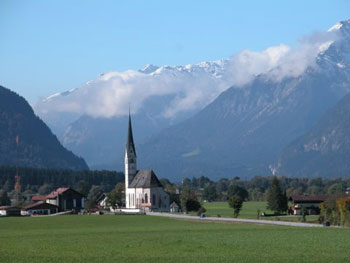 Strolling home one evening after a delicious meal of smoked trout in a mid seventeenth century Pension we heard the clanging of cow bells. A herd of cows came bustling up a side-street heading for their night quarters in a barn attached to a house. At seven o’clock in the evening it was the duty of anyone passing by to stand at the top of the street and encourage the animals not to make a detour through town.
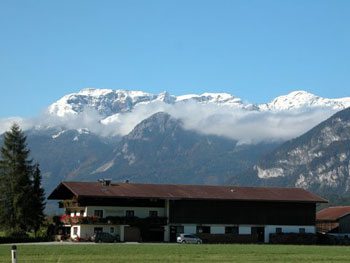 I signed up for three weeks carving instruction, choosing to carve mornings only, leaving time to catch the train to numerous small Tyrolean towns within thirty minutes ride of Kundle. Even the smallest town boasted a castle, large or small, huddled on mountain tops the castles looked down on the inhabitants like benevolent protectors. Rattenburg with a population of 440 is the smallest town in the country. Founded in the 14th century it was built in the shadow of Rat Mountain to protect it from marauders. Following ancient cobblestone streets we stumbled upon a glass blowing demonstration. A cavernous area hewn deep into rock displayed hand blown glass animals, birds, dragons and flowers. Suspended from the cave ceiling lit by soft, revolving colored lights the glass sculptures cast dancing shadows across ancient stone walls. Sparkling Austrian crystal, dazzling rainbows of color, glistened like stalactites in dark corners. This little town, characterized by its medieval ambience is known far and wide as “glass town.”
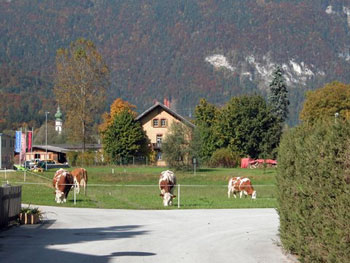 Kufstein, located between South Tyrol in Italy and Bavaria in Germany is known as the “pearl of the Tyrol.” It has about 15,000 inhabitants, the majestic Kufstein Fortress, a massive fortification dating from the mid 12th century rears above the town on a precipitous crag. An interesting feature of the fortress is the “Heroes” organ built in 1931 it was the first open air organ in the world. During summer months concerts are played at noon each day in memory of those who died in the two world wars. In both world wars the Fortress tunnels were used for shelter. Sitting in an out-door café by the beautiful Inn River savoring chocolate cream cake while listening to the soulful organ music float down from the fortress and drift through the flower filled historical district below is a magical experience. The music can be heard eight miles away.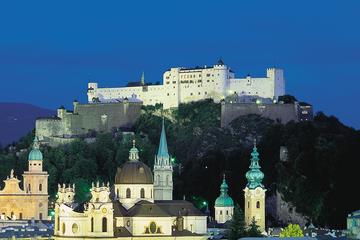


 The year was 1492 and as they rode into town Ferdinand and Isabella were accompanied by a certain Christopher Columbus, there to seek support for an expedition to the Indies.
 Perhaps the royal couple did not pick up on the allegorical design (the original meaning of harem, or al haram, is sanctuary). The four streams of paradise flow from each wing to the central fountain of aforementioned lions. The impression is that of a desert oasis, with the columns lining the courtyard standing in for palm trees.
 The conquest of Granada was of such importance to Ferdinand and Isabella that they commissioned a royal chapel in the city to house their remains. Visitors can still pay their respects here, just around the corner from the muscular Christian cathedral.
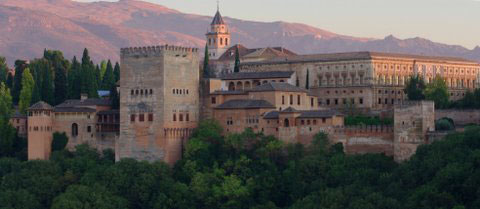
 There was to be another brick-and-mortar response to Islam and at much closer quarters, within the walls of the Alhambra itself . When Charles V came to power in Spain, not long after the conquest of Granada, he wanted his residence to be both close to the Nasrid palaces and fit for an emperor.
 It would appear that alongside the religious fervour that was to culminate in the expulsion of all Muslims from Spain in 1609, there was something of a grudging respect for their culture. On the day they entered Granada, Ferdinand and Isabella wore elaborate Moorish costumes which had been commissioned especially.
 Walking up the Caldereria Nueva, a sloped street in the lower Albaicin and within sight of the Alhambra, you could be forgiven for thinking you’re not in Spain at all. That or you are, but it’s the middle ages. The narrow street is lined with souk style North African merchants and Moroccan teterias, or tea houses. The owners sit outside their shops at the quieter times and gossip here as they do in Fez, Cairo and Damascus. From the teterias the aroma of minted tea is accompanied by that of the sheesha, or water pipe. Arabic is the lingua franca in this neighborhood, along with French, Spanish and of course English.
 Coincidence it seems, is to be found at the heart of this city’s defining moments as often as are these two faiths. Across the Darro valley, the Alhambra’s most prominent feature from here is the Comares tower which houses the Hall of the Ambassadors. It’s the most impressive and stately of the rooms a visitor will see on their tour, having just stepped in from the bright light of the Courtyard of the Myrtles, a delight for the ear as well as the eye, its fountains babbling at either end of a mirror smooth pool.
 Some things change, and some never seem to. The centuries that have passed since Columbus’ voyage have frequently been troubled by encounters between Islam and Christianity, between both and secularism. The ramparts of the Alhambra have withstood. In our times of idealogical clash and religious hatred, the Moorish edifice stands all the more alluring; a testament to the shared history of cultures and faiths, if not reconciled then at least intertwined in the stone and tile work of the Alhambra and in the lives of its occupants.