by Wynne Crombie
Two hundred years ago Galena, Illinois was mainly for traders, miners and Indians. Fifty years later the population topped 14,000 and Galena was the largest port on the Mississippi between St. Louis and St. Paul. It was even larger than Chicago. Much of Galena’s early growth was due to lead mining. During this boom time period, Abraham Lincoln and Ulysses S. Grant walked the streets. Alas, Galena began a long decline in the 1860s as railroads succeeded rivers as the main transportation method and the lead industry collapsed.
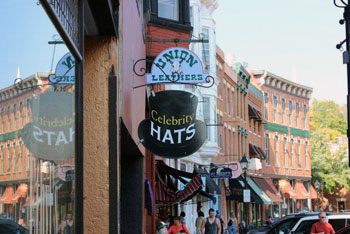
Today, cars move slowly through streets originally built for horse and buggies. Shop windows…some two hundred galleries, boutiques and antique stores…catch the visitors’ eye along with eateries with names like, Durty Gurts, the Generals’ Restaurant, and Miss Kitty’s Grape Escape. Go inside and squeak the original plank floors.
Galena is a National Historic Center with 3,500 residents. Its downtown brick-fronted buildings look much the same as they did 150 years ago…undeniably, part of the charm. The Historic District encompasses 85 percent of the city of Galena and includes more than 800 properties.


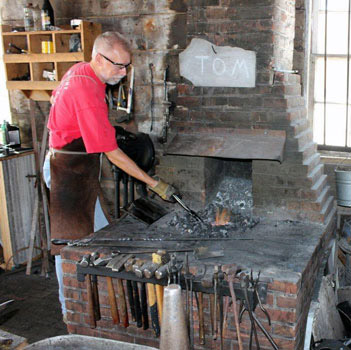 Parking was almost impossible on Main Street, so my husband Kent and I circled around to one of the back streets. We found ourselves behind the Old Blacksmith Shop dating back to 1897. We began to explore.
Inside, the two coal forges were being manned by Tom, a retired volunteer. He delighted in relating the history and craft of blacksmithing. “What you see,” he explained, “are the original tools and equipment. Besides, horseshoes, the blacksmiths made tools like nails and wrought iron ornaments. This,” he said, regretfully, “is the last surviving blacksmith shop. At one time there were thirty-five.”
Just outside, on Commerce Street, an upright player piano was perched upon a very large tricycle. A glass urn stood ready for donations. In the next block, a guitarist was playing period tunes. Across the street, stood the 1846 Old Market House. We could almost hear the calls of the vendors and shoppers. It seemed to be frozen in time.
A two-block stroll brought us to the Dowling House. Built in 1826, it’s Galena’s oldest residence. The downstairs had served as a trading post and general store. Take in the bourbon barrels, the original beams, and the piles of rock salt which were used to preserve meat up to a year. The upstairs living quarters had the original fireplace and period furnishings. One bedspread went back to 1836. One side displayed a winter motif; the other, summer. Mattresses were stuffed with straw.
 Even older than the Dowling House is the 1820’s The Old Stockade at 208 Perry Street. Originally a log building, The Old Stockade was a result of preparing for an attack during the Blackhawk War of 1832.
Building styles range from simple commercial-style buildings to Greek Revival, Italianate, Gothic Revival and later, Victorian styles.
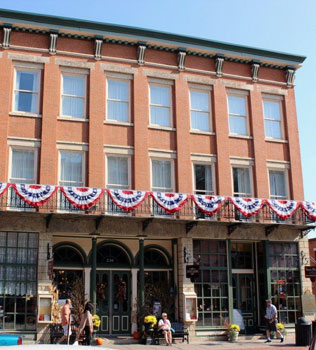
One of Galena’s highlights is certainly the DeSoto House Hotel. Upon its bunting-draped second-floor balcony, Lincoln had given a speech in July of 1856. Two years later, Stephen A. Douglass spoke from the same balcony. Ulysses Grant had used the hotel as his campaign headquarters. The action had taken place in rooms 209 and 211.
 On September 13, 1860, a crowd of over 15,000 rallied in front of the DeSoto in response to a “Grand Republican Mass Meeting” in support of Lincoln’s presidential bid.
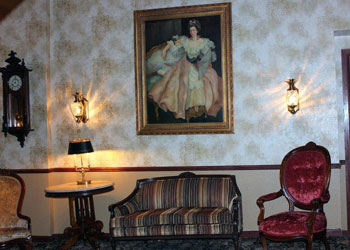
In 1855, the DeSoto boasted 225 guest rooms, a gentleman’s reading room, ladies’ parlors and a 300 seat dining hall. Today, it offers fifteen rooms with private baths, three dining areas, a ballroom, conference and banquet rooms, specialty shops, and a private parking garage.
We traveled back in time again for dinner at the Generals’ Restaurant, named in honor of Galena’s nine Civil War Generals. The ambience was delightful: candles and portraits, soft music, and the original brick walls and beamed ceilings.
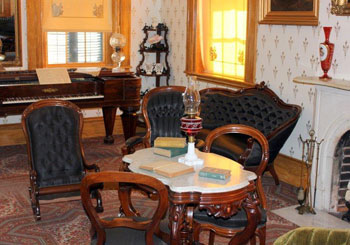 A walk over the Galena River (it joins the Mississippi further downstream) brought us to General Grant’s House. A group of tourists were standing on the main porch awaiting the next tour. A Grant House guide in period costume came out to greet us. She conducted a narrative tour of the main floor with some interesting asides: Julia, Grant’s wife, was the FIRST “First Lady”, both of Grant’s parents were alive when he was president and, the silverware on the dining room table had also been used in the White House. The upstairs bedrooms are self-guided. Tours begin on the half-hour. What a living history experience of mid-19th century America!


If You Go:
Before heading into Galena, we recommend picking up a street map at the Visitor Center by the Railroad Station at 101 Bouthillier Street. Galena’s compactness easily lends itself to self- guided walking tours along Main or Bench streets. Note: Most of the historic sites are free, although they do ask for a donation.
If you would rather have someone take you on a tour here are three to consider:
Galena Trolley Car Tours
314 S. Main St. Galena, IL 61036
815-777-1248
All About A Ghost Tour
230 S. Main St. Galena, IL 61036
815-777-9252
Main Street Walking Tour with General Grant. (May through October)
DeSoto Hotel lobby (starting point)
230 South Main St. Galena, IL 61036
815-777-9129 ($10/person)
Galena is an all-year attraction: fall for the color, winter for skiing and of course, the summer season. During the Christmas season more than 200 downtown shops in the Victorian historic district dress up for the holidays.
Driving Directions: Take the route 20 exit off the Northwest Tollway from Chicago and drive through the hills above the Mississippi River to Galena. You can easily make it a day trip from Chicago, or stay overnight in one of the 19th century B and B’s.
Dining: Prices range from the elegant Generals Restaurant in the Desoto House to the moderately-priced Fried Green Tomatoes.
Additional Information:
Old Market House State Historic Site
123 N. Commerce St. Galena, IL 61036
866-487-4965
The Old Blacksmith Shop
245 Commerce St. Galena IL 61036
815-777-1893
Ulysses S. Grant Home State Historic Site
500 Bouthillier St. Galena, IL 61036
815-777-3310
The Dowling House
220 Diagonal St. Galena, IL 61036
815-777-1250
About the author:
Wynne Crombie has a master’s degree in adult education. Her work has appeared in, Travel and Leisure, Dallas Morning News, Yours (UK) Italy Magazine (UK), Senior Living. Irish-American Post and Travelthruhistory.com.
All photos are by Wynne Crombie:
Galena’s Main Street
Tom, the blacksmith
Desoto Hotel balcony (where Abe Lincoln spoke)
Desoto Hotel interior
Grant’s living room
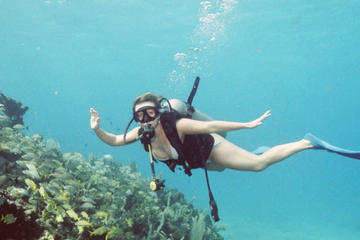
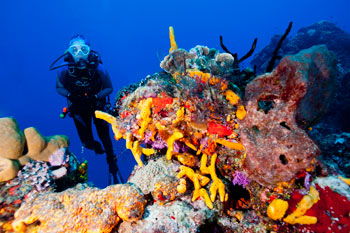 “That was one of the best dives I’ve ever done,” Kathryn proclaimed after surfacing at Cozumel’s Tormentos Reef. Comprised of coral pinnacles towering approximately 20 to 30 feet high and interspersed with wide, sandy areas. The colorful coral heads are adorned with purple and orange sponges, brain and whip corals. Tormentos is a veritable ocean garden where the reef’s maze of twisting tunnels, overhangs and barrel sponges provide shelter for marine life. Teeming with shoals of bream fish, French grunts and yellow snappers, I lost count on the number of blue tangs, pork fish, trigger fish, black durgon, file fish, big eyed jacks and parrot fish we saw. Lurking within the ledges, nooks and crannies were Caribbean king crabs, spiny lobster, giant hermit crabs, juvenile spotted drums, spotted moray eels and delicate-looking arrow crabs. Grey and French angelfish seemed unwary of the divers in their midst as were the barracuda seen hovering over the patch reef on the hunt for their next meal.
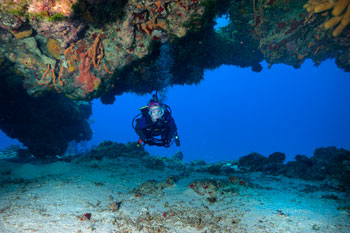 While our dive at Tormentos Reef was quite literally off the scale, we equally enjoyed our dives at other well known Cozumel dive sites. Interestingly, we seemed to be seeing more large animals on every dive than I could recall ever seeing here over two previous trips. Nurse sharks, sea turtles, Southern stingrays all seemed to be in greater abundance. Our decision to bring our family to Cozumel for Christmas and New Years felt entirely right. This year, the gifts were indeed under the sea.
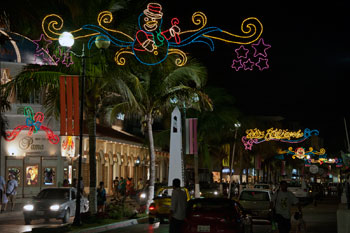
 San Miguel’s quaint downtown zócalo (Plaza del Sol) extends for about eight blocks along the waterfront and for several blocks back from the water. The tiny municipality exudes a casual relaxed ambiance with excellent shopping, superb night life, an exceptional number of fine dining restaurants, more than 200 gift shops, souvenir stalls and jewelry outlets that sell everything from T-shirts to fine silver jewelry, pottery, wood carvings, leather goods and tourist kitsch. While prices tend to be fixed when cruise ships are in port, bartering is relished by shopkeepers on the side streets located as little as ½ block in from the water. In fact, the potential for striking a great bargain increases the further you stroll back from the waterfront.
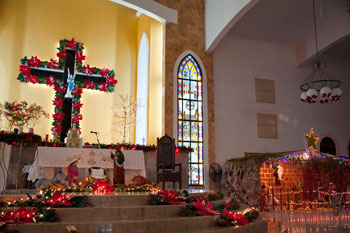
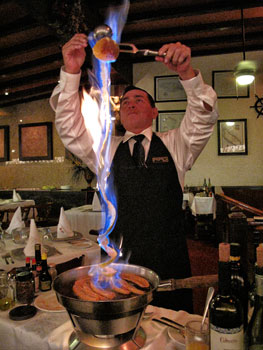 On Christmas Eve our trip got off to a festive start with a delicious dinner at Pepe’s Grill, followed by bananas flambé for desert, which is simply to die for! After some shopping at some waterfront shops we attended Midnight Mass, which the Mexicans call “la Misa Del Gallo” or “the rooster’s mass,” at the beautiful Cathedral of Corpus Christi. One does not need to be religious to appreciate familiar Christmas carols or a church service performed entirely in Spanish. Curiously, we noticed several church patrons were carrying and hugging a baby Jesus doll. We soon learned the building of the “El Nacimiento” or “Nativity scene” is a seasonal tradition here. During the holiday season, most Mexican families construct a Nativity scene in their home. At midnight on Christmas Eve, a figure of baby Jesus is placed in the nacimientos to commemorate the Lord’s birth.

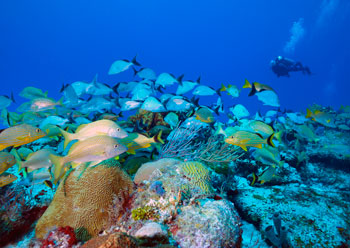 Another notable feature that sets Cozumel’s waters apart from other Caribbean dive destinations is the Yucatan current offers endless opportunities for drift diving. These continually flowing ocean currents are often less than half a knot and tend to flow in a south to north direction. Sometimes the current can be fairly strong, attaining velocities of two knots or more. Essentially, the dive plan for drift diving is simple. The dive tender drops you in the water and follows your bubble trail, standing by to pluck you from the water when you surface.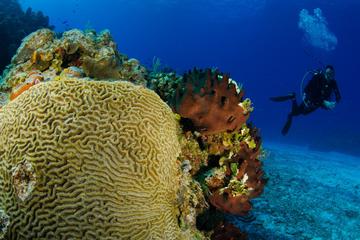
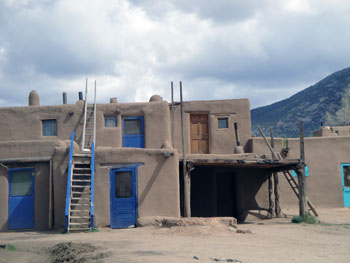
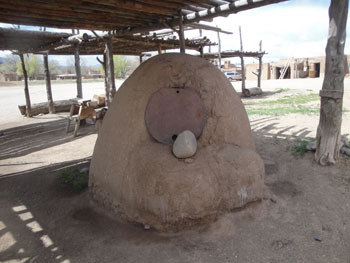 We are invited into one of the homes to warm ourselves in front of the fire. Wood stoves and fireplaces heat the houses and are used for cooking. Bread and pastries are baked in hornos, outdoor adobe ovens scattered around the site. We purchase delicious cookies and pies made in a horno, which warm us from the inside out. We also sample fry bread in another home, made in front of us and drizzled with honey. So tasty.
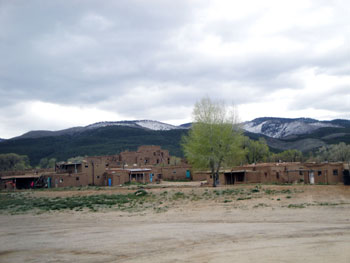 Many of the homes are inhabited by native artists who welcome visitors to enter, view their art work, chat and make purchases. We buy a number of handmade items to take home as gifts, and a couple of pieces for ourselves. At a shop called “Morning Talk”, I buy a fabulous piece of pottery for my potter daughter, knowing she will appreciate the work put into it. Everyone is so hospitable and willing to take time to talk to us. We soon forget about being cold.

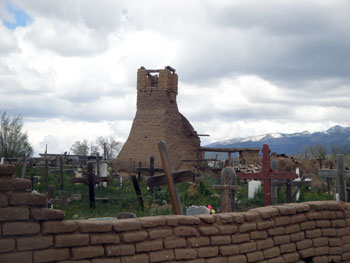 We explore the modern day San Geronimo Church, built in 1850, a Registered National Historic Landmark and still used by the mostly Catholic inhabitants of Taos Pueblo. The thick adobe walls, keep it cool in summer and warm in winter.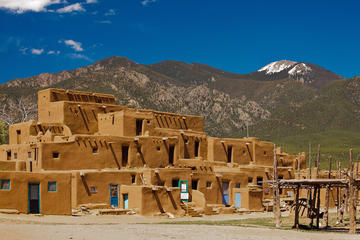
 And it is but a small part of the God’s carven world of the seven Canadian National and B. C. Provincial Parks hugging the Rocky Mountains’ Great Divide. So stunning the national parks; Kootenay, Banff, Yoho and Jasper along with the B.C. Provincial Parks Assiniboine, Hamber and Mount Robson were declared a UNESCO world heritage site in 1984.
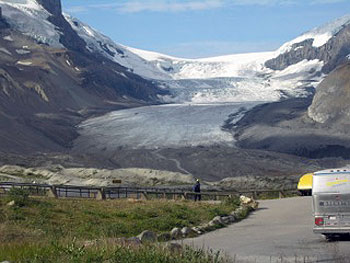
 Our now grown children with children of their own were but pre-teens when we last drove the parkway between Lake Louise and Jasper and we were stunned to see how far the Athabasca Glacier, that long intrusive tongue of the massive Columbia Icefield, had retreated. Already in natural retreat there are signs acknowledging the decline that have been hastened by global warming. They spoke of the advancing flora chasing the fleeing glaciers and of the inherent change so bespoken for wildlife. Where once the icy tongue licked the opposite side of the valley, at its greatest extent in 1844, the long flight saw it now crawling into the very folds of the great icefield itself. Here, atop the World, the ice achieves depths of 100 to 365 metres; enough to engulf cities, skyline and all.
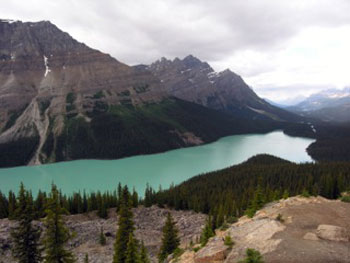
 Turquoise hued Peyto Lake is a short uphill jaunt from the highway parking lot. Oft photographed and resident on many a calendar the lake is laid out resplendent, guarded by its mountains and replenished by thin cascades streaking across their faces. Named after historic early trader and guide, Bill Peyto, the lake is safely viewed from a guard-railed viewpoint.
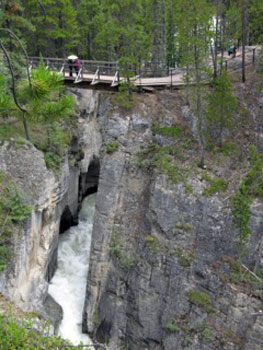
 The Johnston Canyon waters ran cold and clear through the narrow chasm carved over the millennia, spilling white fury in misty display as they pass. It is claimed almost one million people annually trod its tended pathways, bridges and ramparts which swing over the very turbulence itself. Despite crowds politeness prevailed as people quietly stopped to let others pass. Cameras, hung at the ready – necessarily so as you would just take one picture only to find another waiting around the corner. At the lower falls (30 minutes in) rock walls appeared to almost close and the waters pounded into a pool hidden within a a hollow accessible through a carved tunnel at the end of a bridge crossing the chasm. Spectacular in the extreme, people lined up to experience the pounding, misty cavern.
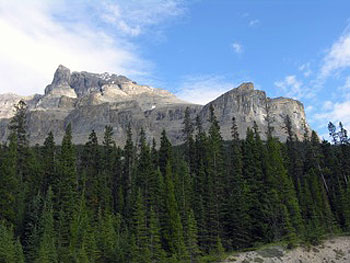 Our second site sat, a hidden Shangri-La, high above the opulence of Lake Louise with its glacial backdrop and turquoise waters. To reach Lake Agnes takes a bit of effort; wending the switch back trail to the rock outcrop upon which a log tea house sits and a thin cascade tumbles free to Mirror Lake far below.

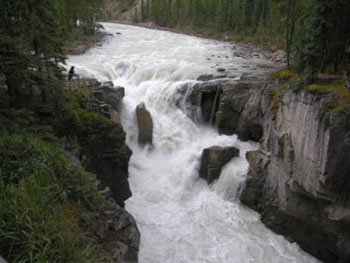
 A short distance west from Takkakaw is the turnoff for Emerald Lake and the Natural Bridge. If it lacks the power of Takkakaw the Natural Bridge makes up for it in methodical carving of rock into forms as unique as a Henry Moore art piece. Where once a full natural bridge hung over the rage-whitened face of water but a vestige remains, itself a passing entity. Emerald Lake lies at the foot of the mountains, red canoes dotting its surface, even as the lodge recalls images of romance. At the parking lot a little ground squirrel community has entertained visitors for years. In the midst of wild beauty sits peace.
 During those family days in Golden we would take the winter drive to Radium Hot Springs and the Sinclair Canyon jaunt into the park under the red-eyed gaze of the canyon cliffs to immerse ourselves in the inviting hot spring pools. The bracing cold did not encourage lingering in the hallway leading to the protected pool access but once within its warming confines soothing sensation embraced the entire body. In my bearded days both beard and hair would freeze in Santa Claus fullness to be melted away with a luxurious dip underwater. Mists covered the pool surface in eerie fullness parting occasionally to bear witness to mountain sheep cavorting on the rocks above. Lounging in the warmth of the pool, an experience even more appreciated with the aches of age, and gazing up to the surrounding mountains, is meditative and renewing.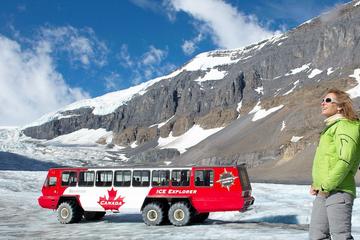
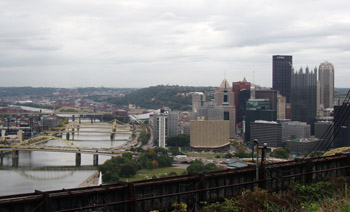
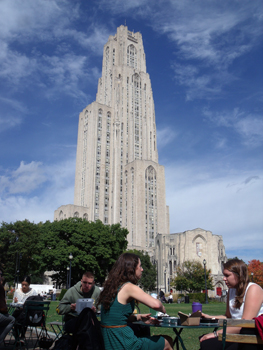 In the neighborhood of Oakland, east of downtown Pittsburgh, resides the University of Pittsburgh campus. Dwarfing this campus is the 42-story high Cathedral of Learning. On the first and third floors of the tallest educational building in the United States resides a collection of 29 different rooms which honor various nationalities who have contributed to Pittsburgh’s history, and which must contain interiors that reflect any period before 1787, the year the university was founded.
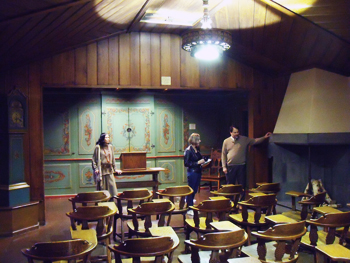 I was fortunate enough to get a tour from the longtime director E. Maxine Bruhns, who came from humble beginnings (deeming herself “a West Virginia hillbilly”) to oversee one of the most special collection of rooms college students have the privilege of matriculating in. Her stories about the various rooms were very heartwarming, including the ones about her favorite room, The Early American Room, where some of the artifacts her ancestors owned are located. It’s best to make an appointment in advance to view the rooms.
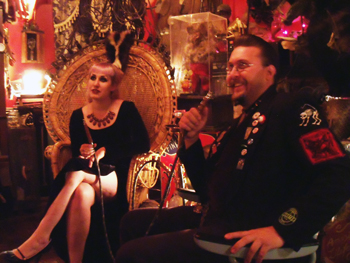 Trundle Manor is billed as “The Most Unusual Tourist Trap in the World Meets the Most Bizarre Private Collection on Public Display.” When I arrived at the museum/home located in Swissdale (a borough east of Pittsburgh), I noticed a funeral limousine parked out front as I sauntered up the creepy steps. I was feeling a bit of trepidation over seeing a collection of dead artifacts and even more apprehensive about just how odd the curator, who goes by the name of Mr. Arm, and his assistant Velda Von Minx, would be.

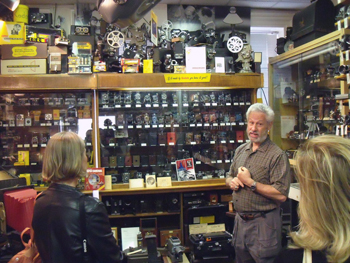 As a travel writer, I’ve developed a passion for finding and taking great shots of the places I write about. So I enjoyed experiencing the history of cameras and photography at Photo Antiquities, located just north of downtown Pittsburgh. Bruce Klein, the director, intrigued me as he took me down the very black and white as well as colorfully historical road of photography, which began with him showing me one of the earliest ever photographs taken by Nicéphore “Joseph” Niépce during the 1820s. This museum prides itself on being the only 19th century photo museum in the United States and only one of a handful on this planet even though 20th and 21st century photographic history and items are also featured from Polaroid to disposable cameras.
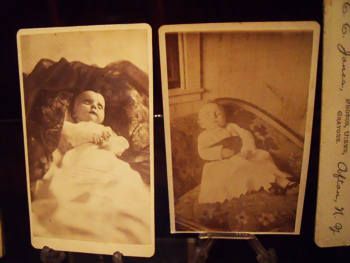 I got to see the special exhibition of 19th century post mortem photos, mostly children, who were made to look as if they were still alive for their final images captured before they were laid to rest. And yes, they did give me the creeps, but my creepy feelings soon melted when I saw more positive 1800s photos of dogs and their owners.
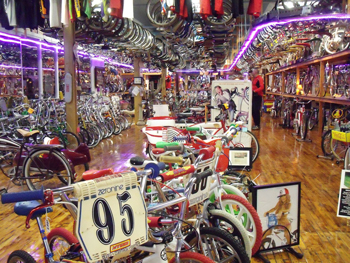 Nice memories of owning a bike as a child flooded my senses again after my visit to Bicycle Heaven, located in an industrial park on Pittsburgh’s North Shore. It’s the result of Craig Morrow’s 30 years of collecting which he had to store the bicycles and parts in various garages around town until he was able to open up this complex that used to be a tractor plant.
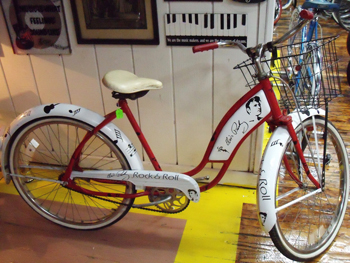 I got to see the world’s largest collection of Schwin Stingrays as well as an array of rare, hard-to-find models like the ones made to honor Oreo Cookies, Marilyn Monroe, Coca-Cola, and Elvis Presley. Movie studios have even rented models from Morrow, and I saw one bicycle on display which was used in an upcoming movie called “Fathers & Daughters” starring Russell Crowe. Those interested in tricycles can view the first ever one made during the 1890s.
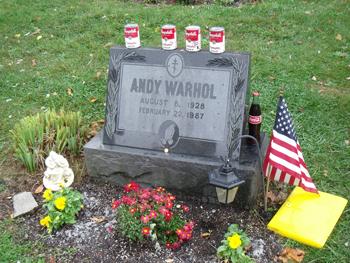 ♦ Andy Warhol’s grave can be seen at St. John the Baptist Byzantine Catholic Cemetery in Bethel Park at Connor Road and Pennsylvania Route 88, south of downtown. A live 24/7 webcam monitors the gravesite.
