Austria
by Bob S. Hale
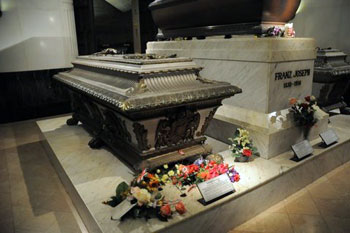
Vienna is the city of castles, palaces, extraordinary churches; it is the city of the Viennese waltz…and the Viennese vaults. Vaults. As in, tombs! Caskets and coffins, and urns filled with ashes. And, urns filled with innards! They are all on display right there…in the church basement.
Go on in, and enjoy the “Viennese Vaults.”
There they rest – rulers of the once-mighty Habsburg Empire. They lie in ornate coffins, in plain coffins, in gigantic tombs and small tombs, and vases for ashes and innards. It is a mesmerizing scene.
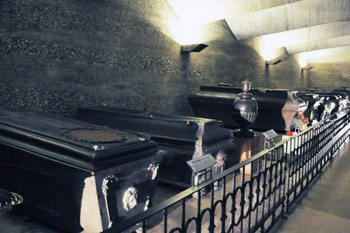
The slightly creepy, yet captivating, display of the dead is in the lower level (where else!) of the Capuchin Church, in the heart of Vienna’s famed “Ring.” There, in several rooms, in many caskets, is the history of Europe as we’ve come to know it.
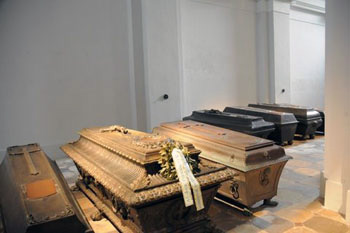 There, in that church crypt, is most of the royalty that led the Holy Roman, and Austro-Hungarian empires. The history of those several hundred years, 1618 to 2011 (the last Habsburg to make it in was laid to rest in July 2011), shaped Europe and the Americas. It wasn’t a well-defined, clearly delineated empire that the Habsburgs governed. At various times they ruled 44 nations, duchies, and a variety of ethnic gatherings; some were part of the Holy Roman Empire, some were not – such was the political jigsaw puzzle of Europe back then.
The Habsburg Empire marks its beginning in 1276, according to one source, when Rudolph of Habsburg moved from the family house – the Habsburg Castle in Switzerland – to Austria, beginning the expansion of the dynasty, as well as the construction of castles, fortresses, palaces and royal hideaways. By the 16th century the Habsburg’s empire had expanded to the point where two Habsburg lines were ruling Europe.
The Habsburgs knew they were creating a unique royal line – it would become the longest running in history – so why not keep their legacy alive, even after death? To that end, Empress Anna, wife of emperor Matthias (1600s), convinced the Capuchin cloister in Vienna that they should create a crypt for her and her husband so they could be visible reminders of the Habsburg legacy.
 Anna, in her will, written in 1617, set aside funds to begin building that crypt. Good thing she did – she died a year later. Her husband died the following year. Politics and war put off the crypt building until 1633. Their burials were the beginning of a practice that reached its royal conclusion this year. On July 4, 2011 Otto von Habsburg, also known as Otto of Austria, “former head of the House of Habsburg and Sovereign of the Order of the Golden Fleece (1922–2007) and former Crown Prince (1916–1918) and, by pretence, Emperor-King (from 1922), of Austria-Hungary—or formally, of Austria, Hungary and Bohemia, of Dalmatia, Croatia, Slavonia, Galicia, Lodomeria and Illyria, and of Jerusalem…” (There’s more, but you get the idea.) — died. He was 98. And that should pretty much do it for the House of Habsburg.
Oh, there is room for one or two more; and, there are a couple of Habsburgs still around who may request “a room at the inn,” but as far as history is concerned the Holy Roman Empire, and the Habsburg Monarchy are fertig, abgeschlossen, geschlagen … kaput! Just shy of 400 years!
There are 144 caskets, and ossuaries containing Habsburg rulers, their children, close relatives, and some internal organs. Visitors reach out and touch the tombs and urns, hands within inches of the long dead. Yes, it is bit macabre; yet, it is magnetic.


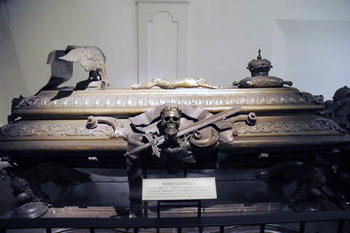 From 1618 on, casket after casket was put in place, making it necessary to expand, creating rooms for more Habsburg royalty. One huge room was designed just to hold the gigantic, highly embellished tomb of Maria Theresia, probably the most famous of all the Habsburgs. The artwork on Maria’s tomb is astonishing. The practice of interring organs in one church, the heart in another, and the body in the crypt of the Capuchin church began with King Ferdinand IV of the Romans in 1654. He left orders that his body was to go to the Capuchins; his heart to Augustinerkirche; and the urn with his viscera to Vienna’s St. Stephens. A few urns remain with the Capuchins. It’s tad ghoulish, to be sure, but a custom – unique to the Habsburgs – that exists to this day. The last three-stages of separation took place July of 2010 for Otto von Habsburg.
The roll call of the dead who are interred in the Capuchin crypt is far too extensive to put on paper. Visitors might want to have a computer print out in hand. While Vienna invites the visitor to enjoy the waltzes, orchestras, pastries, coffee houses, the world-famous Choir Boys, and – of course, schnitzel – it also calls us to the crypts that vividly display its royal history. The dead down there have stories to tell. Oh yes… and remember, in Vienna the Dance of Death is in three-quarter time.
Private 3-Hour Walking Tour of Vienna
If You Go:
A web site to remember: www.wein.info
Getting to Vienna is easy from most major gateway US cities. Lufthansa, Austrian and Swiss Air are major carriers from the US. From European cities numerous low-cost local airlines have departures all day. And, of course, if time permits, a high-speed train is a delightful European experience.
WHERE TO STAY:
Viennese hotels within the “Ring” can be very costly; $500.00 a night is not unheard of. Small “walk-up, ride-up” pensions are more reasonable alternatives. Opera Suites-Kärntenr Strasse 47 (Ph: 512310) – A Very welcoming boutique hotel: clean, comfortable beds. Airy, and brightly decorated; it fees like Vienna; an extremely helpful staff. (195-220 Euros)
Hotel Kaiserin Elisabeth. Weihburggasse 3 (Ph: 512 19 23) – An upscale property. High class; prices are likewise! But the reputation is excellent; service matches. Luxury, European style. (195-232 Euros)
Visit Vienna Hotel Start website. Virtually every one of the 200 properties is listed with rates and available dates.
TIP: The smaller boutique properties have more time to assist guests in getting around the city.
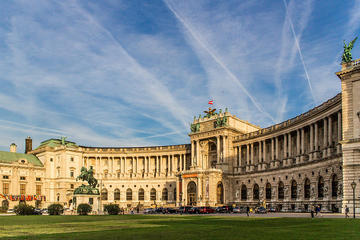
MUST SEE: Vienna Riding School; The Hofburg; St. Stephansdom (Cathedral). Even non-Catholics will sense the richness of history at a Sunday mass. Sit on the right side, upfront next to the tomb of Fredrick III. Also: The Schonbrunn Palace, The Prater (park) and ride the Ferris wheel. Enclosed cars give the rider a stunning view of Vienna.
JUST FOR FUN: Get on a tram and ride until it ends. Then do the return trip from the other side of the car. An inexpensive way to see Vienna.
About the author:
A former Chicago radio and TV broadcaster. Bob has been a DJ, newscaster, interviewer, producer, writer, and “gopher!” Bob’s broadcasting career began at KRIB in Mason City, Iowa where he also hosted a weekly record hop at Clear Lake’s SURF BALLROOM. In Feb of 1959 his guests were Buddy Holly, Ritchie Valens and the Big Bopper – it would be their last personal appearance. Bob moved on to Springfield, Illinois, Peoria, and then WLS in Chicago, joining the station in 1960 when it became one of the nation’s biggest popular music stations. Bob moved into television in 1966 as program host, producer, and news anchor. He has turned his attention to travel writing and photography, with stops in the USA, South America, the Caribbean, Asia, and Europe. Bob’s favorite travel experience? “Trains…anytime, any kind, but especially those that huff and puff, and spew smoke and cinders!” For his article here on Vienna, Bob traveled by air and riverboat. “They’re not bad, either,” he says.
All photographs are by Bob S. Hale.
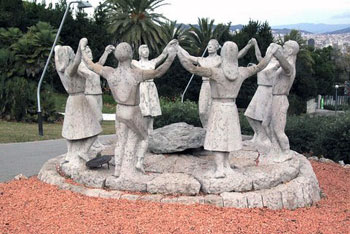


 I had read in a guidebook that on Sundays at noon local Barcelonians gather together to dance the Sardana in the square by the Barcelona Cathedral in the Gothic Quarter where my hotel was conveniently located. The Sardana was on my “to-see” list, but I only had one Sunday in Barcelona and I wanted to spend the day hanging out in Gaudi’s “must-see” Parc Guell on the other side of town.
 When I wasn’t watching the dancers’ feet in exasperation, I found myself alternately intrigued by an elderly man in one of the larger circles and two young couples who had formed their own circle on the periphery.
 While tourists streamed in and out, I stayed for the entire performance that lasted almost two hours. At one point a Sardanista, who “worked the crowd” to solicit donations for the local Sardana organization, accidentally hit me in the back with her foot. I was fine, but profusely apologetic, she kept coming back to me every fifteen minutes to assure herself that I was okay. After the performance she told me, through her French-speaking friend (I know some French), that I must return the following day (Sunday) at noon for the next Sardana performance.
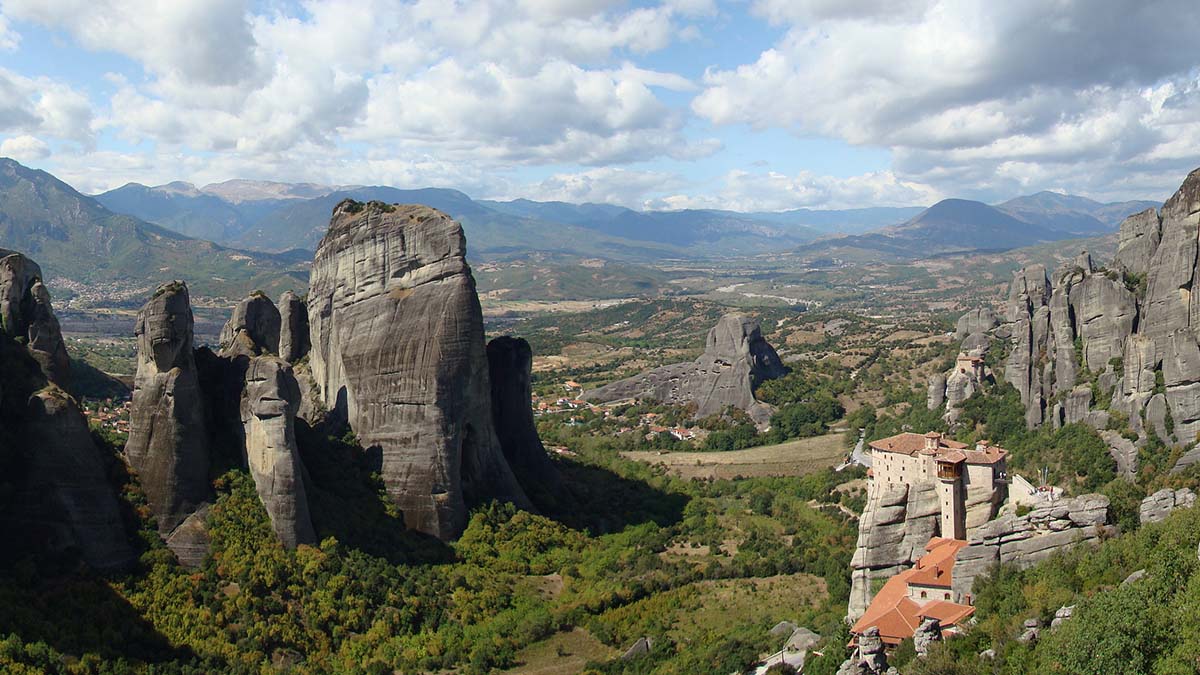
 Green fields are patched with crops of yellow mustard, and splashes of brilliant red poppies carpet upland meadows where flocks of sheep graze idly in the sun. Across the Plain, sunlight glitters off the snow-covered peaks of Mounts Pelion and Parnassus. An eagle soars above a distant crag. Suddenly, out of the plain, gigantic spires of rock emerge, some higher than 400 meters, their strange shapes jutting up out of the fertile soil. Nothing I have seen in pictures has prepared me for this sight. Few places I have seen in Greece are so intensely dramatic.
 Early next morning, I ride up to the Meteora in the small bus provided for tourists. The road passes the village of Kastraki and winds past the rock pinnacles where you can see the remains of ascetics’ caves, many walled off with rocks and rotting timbers.
 The first monastery you see as you approach is St Nicholas Anapafsas, built in 1527. It clings to the top ledge of an enormous rock. Uninhabited for years, its superb wall paintings by artist-monk Theophanes have now been restored.
 Agia Tria, the Holy Trinity, built by the monk Dometius in the late 1400s, is on a pinnacle reached by a circular flight of 140 steps. The view is staggering. I feel suspended in a breathless void.

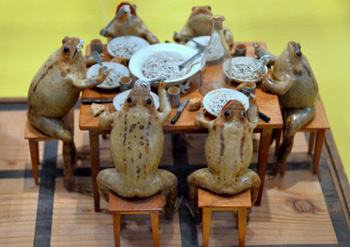
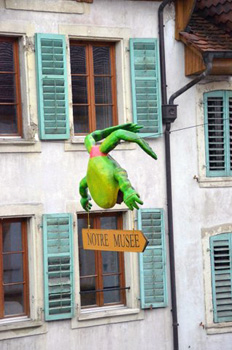 However, it’s not quite as dire as it sounds for Kermit and Jeremy Fisher as they have nothing to fear these days: The Frog Museum in Estavayer-le-Lac is not looking for new acquisitions. The fact of the matter is that the museum’s prized holdings were actually created in the 1850’s by an eccentric Napoleonic guard officer. Francois Perrier, reputedly an officer and a gentleman, had a fascination for frogs and collected them while on walks through the countryside. He also had too much time on his hands: Perrier would take his collection of frogs home, extract the innards through their mouths, and then stuff the hollow skin with sand, all the while modeling and dressing the frog corpses in uncanny human dioramas of scenes from everyday life.
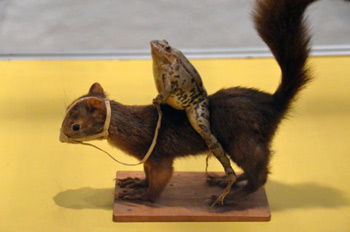 With that being said; nevertheless, there’s something compelling about a Swiss medieval town noted for its obsession with stuffed frogs (they are actually a tannish-brown instead of green) composed of skin and sand. Behind glass and meticulously preserved, the vignettes are parodies of human life in the 19th century. The frogs do human things like playing cards and dominoes, shooting billiards, feasting at a long table, eating spaghetti at a smaller table, getting a haircut at the barbershop, sitting at a desk in an old-fashioned schoolroom…and then there’s my favorite conundrum…a frog mounted on top of a squirrel, riding the furry rodent like a cavalry soldier might ride a horse.
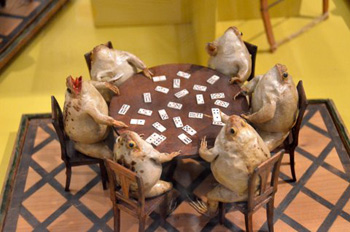 Whether you reel back cautiously from the ludicrously odd or openly admire Perrier’s masterpiece of taxidermy and his tableau interpretations, one thing is for certain: It is an unusual tribute to anthropomorphic art and a social commentary on life in his times.

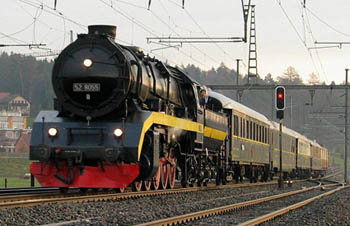
 ’, I wanted to travel on that train. To indulge in the gilded luxury of the train itself, let the mysterious landscapes of the Balkans glide past my window and alight at the final destination: Istanbul, the city which straddles two continents. At the beginning of the 20th century, an infatuation with Istanbul and Turkey had taken hold of European society; actors, artists, writers, journalists and plain rich people, flocked to the Bosporus and their favorite means of transport was the Orient Express.
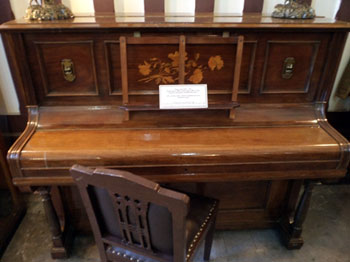 Composed of sleepers, a dining car and a baggage car, the train featured Lalique chandeliers, a piano and the finest crockery and cutlery. The maiden journey started on October 10th 1882 in Paris and reached Istanbul the next day. The menu consisted of no less than seven courses, oysters and turbot in green sauce included, not to mention fine wines and champagne. In 1977 the train ceased to have Istanbul as its final destination and in 2009 the Orient Express disappeared entirely from the time tables. Several other routes continue though and twice a year the historical trip is repeated, at a very stiff price!
 The pink and white structure of the railway station is located in Eminönü on the shores of the Bosporus. Designed by German architect August Jachmund, it’s the best example of European Orientalism, combining elements of Ottoman architecture with modern amenities such as gas and later electric lighting and heating in winter.
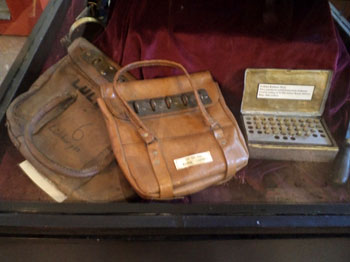 It’s only one room, but the museum documents the history of the Orient Express and the train station in detail. Old log books are displayed as are conductors’ uniforms, the piano, a table laid with the original cutlery and crockery, tickets and many more memorabilia. Photographs adorn the walls and examples of the technology of the time are on display too. I loved the newspaper clipping of when the train got stuck in a snow storm in Bulgaria, very reminiscent of the plot of Agatha’s novel. Admission is free and you are allowed to take as many photographs as you want.

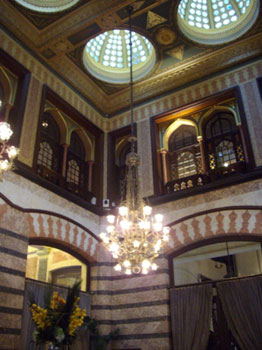
 As affluent Europeans started to descend upon romantic Istanbul, using the Orient Express, they needed an equally elegant place to rest their heads. The city was decidedly short of such type of establishment and that’s how the Pera Palace was conceived. The first super luxury hotel of Istanbul, located in fashionable Beyoglu (then called Pera) opened its door with an inaugural ball in 1892.
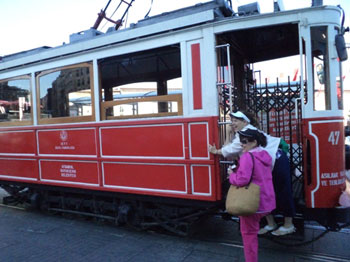 Not carried by a sedan but using the tramway running up and down Istaklal Street, I made my way on foot to the Pear Palace. The hotel was closed for nearly four years, undergoing extensive renovations but is now open again. No better place to get a feel for how people traveled in the past than sitting in the Orient Bar, enjoying a cocktail.

