by Marilyn Escue
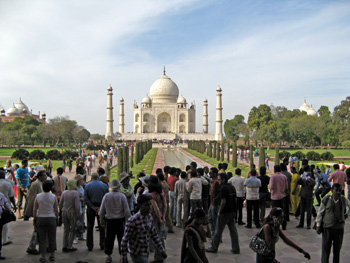
The mesmerizing marble of the Taj Mahal seems to pull us in and allow us to soak in the majesty of this experience. According to Wikipedia, Taj Mahal means “Crown of Palaces”. But, this is no palace. This is a shrine of love one man had for his favorite wife after she died giving birth to their 14th child. The Mughal emperor Shah Jahan was so intensely grieved for Mumtaz Mahal, his third wife. We are now the beneficiaries of that grief given that, centuries later, we still can admire this monument demonstrating his love for her. Immediately upon walking in through a large gate made of sandstone, the gleaming white marble mausoleum beckons to be admired in the distance. It is positioned on a large terrace, called a plinth, along the Yamuna River in Agra, India. Also located on this plinth are matching sandstone buildings that can just barely be seen above the trees from our position at the gate. We spend a few minutes here absorbing the view of the mausoleum, the meticulously landscaped grounds, and the seemingly endless reflecting pool that guides our eyes to gaze upon the building in the distance.
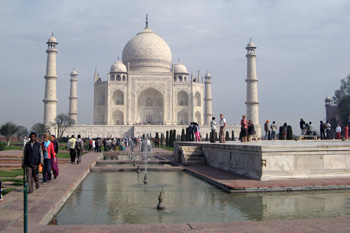 The mausoleum appears to be so far away, almost completely at the opposite end from where we stand admiring it from the southern gate. The complex on this side of the river occupies 42 acres. Regardless, the walk will be worth it.
As we stroll toward our ultimate goal, we pause periodically to take in other features of the complex. While we had entered the southern gate, we walk past matching sandstone pavilions on the east and west and the crenellated walls that enclose three sides of the complex. Continuing onward, we discover that a raised marble water tank sits in the center of the reflecting pool. We had been unable to see that from the gate platform. Standing by this water tank, we see the rest of the reflecting pool along with fountains. We are half-way to our destination.
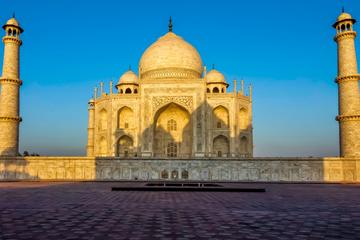
 Arriving on the plinth, we can see that the mausoleum is 8-sided, but not a true octagon. Instead, the corners are chamfered to give four wide faces and four narrower corners of the building. All sides, though, incorporate vaulted archways. From here, we also have a much better view of the onion dome. Four more onion domes grace the chamfered corners. The ivory marble mausoleum sits on yet another raised platform. At the corners of this platform are 130 foot tall minarets. Our guide explains how these minarets are not quite straight. Instead, they are tilted slightly outward so they will fall away from the mausoleum if they collapse. This is a brilliant example of the detailed planning and engineering involved in constructing the Taj Mahal.


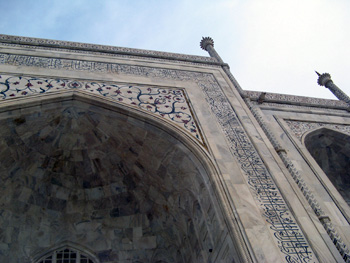
 Finally standing on the raised platform, we can see the exquisite inlay of semi-precious stones in a twining vine and flower pattern above the immense archway of the entrance. Calligraphy of black marble inlay into white marble panels frames the archway as well. Our guide tells us how the calligraphy at the higher levels has been created in slightly larger script so that it appears to be the same height when viewing it from below. Again, the architects and artisans really show their skill in planning and executing this. About 20,000 artisans labored to create the mausoleum and plinth from 1632 to 1643. The rest of the complex took another decade to complete.
The outside lower walls of the tomb have white marble panels that have been sculpted with bas relief flowers and vines and include inlay stones of yellow marble, jasper, and jade. These set the stage for what we will see inside.
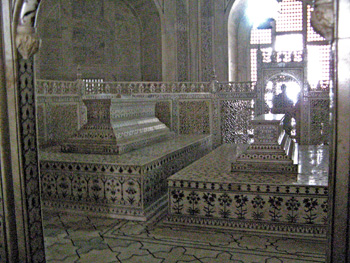
Despite the sunny day, the inside of the mausoleum was surprisingly quite dark, making it a little difficult to fully appreciate the fine craftsmanship of the inlay and intricate carvings. Here, we find that 28 different types of precious and semi-precious stone have been used for the inlay of twining vines, fruit, and flowers. An elaborately carved marble screen encompasses the sarcophagi of Shah Jahan and Mumtaz Mahal.
 Looking beyond this screen, it’s startling to see the positioning of the sarcophagi. Everything else in this complex has been so painstakingly symmetrical, that it’s jarring to see the symmetry interrupted here. The tomb of Mumtaz Mahal had been placed in the center. Shortly after the completion of the Taj Mahal, one of Shah Jahan’s sons deposed and imprisoned him for the rest of his life. Surprisingly, this same son decreed Shah Jahan’s tomb to be added to the side without disturbing the original tomb. We discover later, however, that these are not the real sarcophagi. As per custom, the real ones are located in the same positions in the less elaborate lower level of the mausoleum and are inaccessible to visitors.
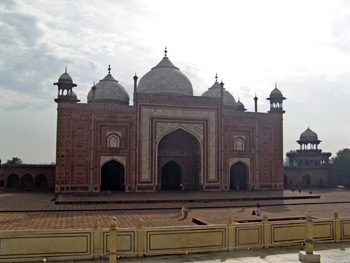
Back outside, we take a brief look at the two other buildings that share this plinth and symmetrically flank the mausoleum. These are the buildings that we could barely see above the trees while standing at the opposite end of the complex. The building to the left of the mausoleum is a mosque and the other is the Jawab or guest house. Rather than marble, these are built with red sandstone and white marble inlays. The red sandstone buildings lend a pleasing view without detracting from the gleaming white mausoleum.


 We also venture to the back and finally discover the river that had been hidden from all the other vantage points. We find out later that another garden had been created on the opposite bank of the river in order to best view the mausoleum in the moonlight. Unfortunately, this garden on the other bank has fallen into disrepair.
Making our way back to the entrance gate, we pause a few more times to admire the garden areas and try to imagine how the original gardens looked with numerous types of flowers and fruit trees. At the end of the 19th century, the British had taken control of the Taj Mahal and redesigned the gardens into the more formal style they enjoyed back in England. We also realize that despite all the crowds, we had not felt rushed through the complex and had ample time to soak in the serenity of this beautiful monument of love.
2 Days Agra Sunset and Sunrise Taj Mahal Private Tour from Delhi
If You Go:
♦ We stayed at the Oberoi Amarvilas which boasts a view of the Taj Mahal from each room. If you have a balcony, splurge for room service for one of your meals so you can enjoy the view with your loved one.
♦ Agra was just one stop on our 15-day escorted tour with Travcoa. While it’s possible to visit India on your own, we highly recommend a guided tour with high-end accommodations in order to take the stress out of getting from one city to another and finding suitable dining options.
About the author:
Marilyn is a freelance writer. She and her husband have been extremely blessed to have visited all 50 states in the USA and over 60 countries. They enjoy factory tours and getting behind the scenes. They also ask many “how” and “why” questions to satisfy their curiosity. Their blog is: travelwithcuriosity.com

Taj Mahal with reflecting pool
Raised marble water tank and fountains
Inlay and calligraphy on the front of the mausoleum
Sarcophagi of Shah Jahan and Mumtaz Mahal
Mosque
View of Yamuna River

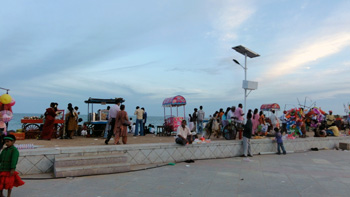 As it is a beach city, the Promenade is a hot spot for locals and tourists alike. About 1.5 km long this runs along Goubert Avenue (Beach road) and overlooks the Bay of Bengal. There are huge rocky boulders that prevent one from getting into the water but there are benches to sit and a fairly broad pavement where you can enjoy your morning and evening walks. Walking along the promenade you can see the statues of Mahatma Gandhi and Jawaharlal Nehru. About four meters tall and surrounded by 8 granite pillars, the Gandhi statue is a prominent figure on the beach front and is of special significance on National days. The French War memorial which is dedicated to the martyrs who laid down their lives during World War I is also along the Promenade. The old lighthouse that is one of the famous landmarks of Pondicherry can also be viewed from here. The place is full of life during the evenings especially on holidays and weekends with scores of hawkers selling street food, souvenirs, trinkets, junk jewellery and the like. The cafes and restaurants along the promenade are also great places to sit back, relax and watch the beautiful sunset.

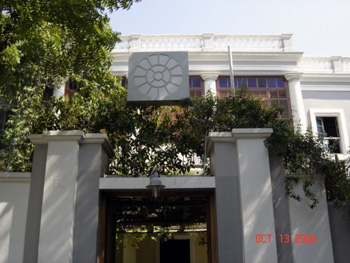 One of the key points of interest in Pondicherry is the Aurobindo Ashram which houses the tomb of Sri Aurobindo. He was a famous Indian nationalist, poet and yogi who joined the Indian movement for independence against the British rule. During his stay in Pondicherry he discovered a technique of spiritual practice called Integral Yoga and with the help of his spiritual collaborator, Mirra Alfassa (“The Mother”), he founded the Sri Aurobindo Ashram. The Ashram and its surroundings are serene and peaceful with a detail for cleanliness. The stone ‘sammadhi’ of Sri Aurobindo and The Mother are located in the central courtyard of the building which itself is set in a beautifully maintained colorful garden. There are several shops, guesthouses around the city that are run by the Ashram. You need to leave your footwear outside and children under the age of 3 are not allowed inside the premises.
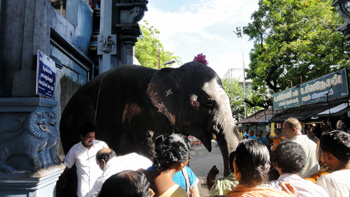
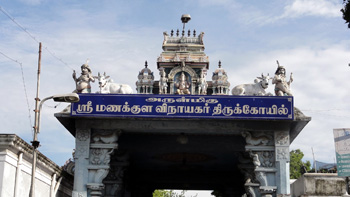 Located in the vicinity of the Ashram is the popular “Manakula Vinayagar Temple” which is a temple dedicated to the elephant God; Lord Ganesha. With beautiful carvings and an elaborate “gopuram” which is the exterior tower of a temple, this place also houses an elephant that is stationed outside the temple. Right in the middle of the old French town, this temple attracts scores of tourists and locals as the deity is considered very powerful. The market outside the temple is equally colorful with flowers, idols and articles of worship on display.
 The Pondicherry museum and the botanical gardens are worth a visit if you are a first time visitor. The museum has a wide collection of a number of sculptures belonging to the Pallava and Chola dynasties and also archaeological findings from Arikamedu, an erstwhile Roman settlement located about 7 km from Pondicherry. The botanical garden boasts of a large variety of plants and includes the Japanese garden and a “toy train” as its main attractions.
 A little away from the city at about 7 km, Chunnambar or Paradise beach is yet another haven for tourists. Accessible by ferry, this is located at point where the Chunnambar River backwaters meet the Bay of Bengal. The view of the pristine waters, sand and sun make this a great addition to the itinerary.
 Auroville or the “city of dawn” is located about 8 km north west of Pondicherry and was founded by the Mother. Conceived as a universal town where men and women of various countries can live together in peace and harmony, this place has over 2000 people living and are involved in activities like agriculture, handicrafts, healthcare, administration etc. The central Matrimandir, which is not a temple but a place for individual silent meditation is stunning and set in an area of 62 acres in the centre of the township. The Auroville visitor center is a unique place to visit and one can spend at least half a day at the boutique stores and cafeteria within.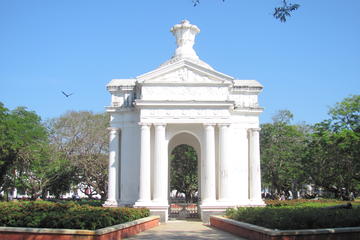
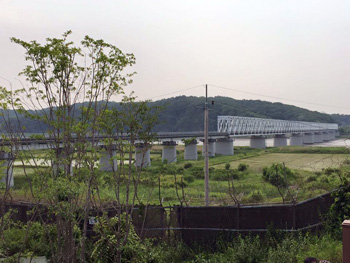


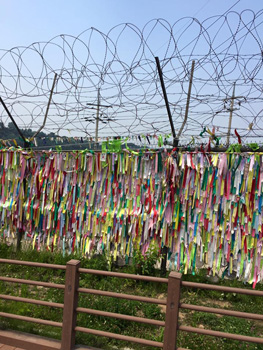 The tour I eventually booked was planned to include a stop at an observation site along the DMZ and the third infiltration tunnel, one of the numerous tunnels from which members of the North Korean Army have tried to infiltrate the South. Unfortunately, I was in Seoul during the height of the MERS scare. From the day I arrived in the city until the day I left, I probably saw the number of Koreans wearing surgical masks in public double. So when the day of the tour came around, the tunnel had was closed due to concerns about the spread of the disease in its close confines. The tour company replaced the trip to the Infiltration Tunnel with one to the Bridge of Freedom, formerly a location where prisoners of war could be repatriated to the South.
 However, other than those early experiences, for the most part the tour did not feel like a propaganda exercise. Of course, the negative aspects of life in the North were emphasized, but this would be hard not to do considering the indisputable realities of life in the Kim family’s North Korea. Most of what was said did not feel over the top. This was refreshing. Often stories from the North that make their way to the United States tend to be filtered through the most fervently anti-North Korea media or are just plain inaccurate. For example, a report that Kim Jung Un’s uncle had been executed by being fed to hungry dogs, which was picked up by media throughout the United States, turned out to not be true. It originated with satirical Chinese social media post.
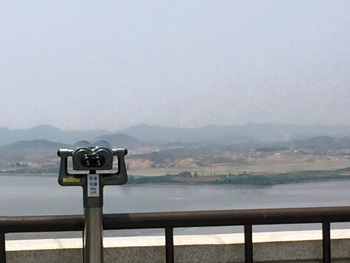
 Far from completely creating a manufactured view of the North, the tour’s first stop was a museum with an observation deck where one could look directly at a small farming village across the DMZ. The museum housed artifacts including treaties between the two countries, North Korean military medals, currency, and even soju, Korea’s national liquor. There were also symbols of reunification, including examples of countries that were once divided. Some of these were inspiring (Germany) and some were less so (Yemen). The most interesting symbol of reunification was the imagined “Seoul-Pyongyang-Paris” bullet train, which the Museum suggested would take tourists from Korea to Europe as soon as reunification was achieved. Dorasan Station located in another part of the DMZ did indeed once connect the North and South by train. It is, however, understandable why a rail link between the North and South might figure prominently in the imagination of some South Koreans, South Korea currently has no land borders, aside from the one with the North.
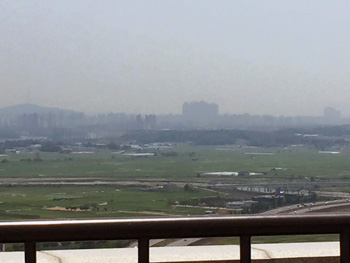 s seen from the overlook at the top of the Museum, the contrast between the two sides of the DMZ was stark. Within sight of the viewing platform were both the dense skyline of Seoul and the vast expanse of suburbs surrounding it. Turning 90 degrees and facing the North revealed a small farming community with a few crudely built structures, some of which lacked roofs. There were about twenty North Koreans working on the farm. The area of the DMZ near Seoul is one of the most populated parts of the DMZ owing to the fertile farming made possible by the Han River.
 After the museum, we headed to the Bridge of Freedom located adjacent to Imjingak Park. During the Korean War, the bridge was a place where defectors could cross from the North to the South, knowing that they that they may never be able to go to the other side again. Since the end of the war, families would come to the sight to remember their relatives from whom war had separated them. Despite the sadness associated with its history, the area has a carnival like atmosphere. For most Koreans, those memories are much more distant that they were in the last century, so to keep the location attracted for the younger generation an amusement park, complete with a Viking ship has been built near the bridge.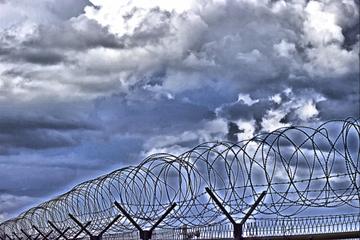

 About the author:
 by Leslie Hebert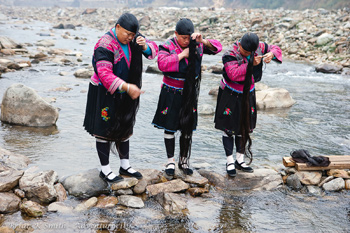
 We retreated out of the icy downpour into a restaurant just in time for a traditional Chinese lunch of fresh stir-fried meat and vegetable dishes. The afternoon turned out to be a bit foggy, with filtered sun coming through the surrounding glossy wet Karst Mountains. As we walked around the lakes and canals towards the Li river, it seemed like a dreamscape. There was an ethereal glow over the city with the moist warm afternoon air.
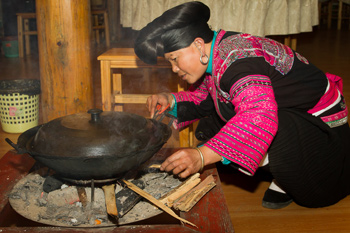
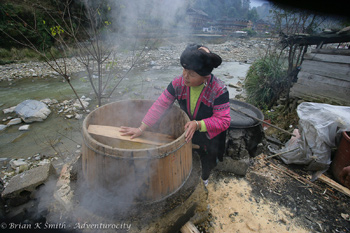
 Christmas morning was grey, but without rain. Yanhua had given me a choice of going to her friends sisters wedding or back to her Red Yao village of Huang Luo to meet her family. I wanted to see what village life was like – I had been to enough weddings – as participant and observer! Three hours later we arrived at Yanhua family’s hotel. Her mother, Pan Luifeng, in full hand knitted traditional dress, greeted us as we stepped off the bus. Yanhua changed into the Red Yao woven clothing that young and single girls wear. Shortly after we arrived the three of us headed across a swinging cable bridge to take some photographs and video at the riverside. I immediately felt I had know this family for a long time. They laughed and sang songs together while my camera clicked away. The village name, Huang Lou, actually means Long Hair. Yanhua’s mother holds the Guinness world record for the longest hair. It is very black and shinny, and wrapped around her head in a traditional bonnet style.
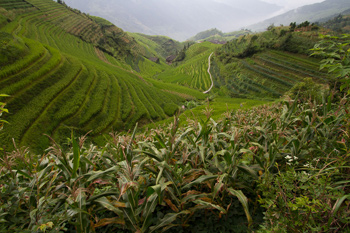
 In the afternoon Yanhua and I took a bus trip up the narrow terraced valley to Dazhai Village. From there we hike for two hours up smooth stone steps to the “Thousand Layers to Heaven” viewpoint. The terraces truly did disappear up into the etherial fog. It was so quiet on the side of the mountain – only our heavy breathing from climbing thousands of steps could be heard. We were treated to a little sun, but the clouds thickened on our return and a cool light mist fell on our shoulders. This was Christmas Day – what a special way to spend it no matter the weather was!
 Grandma sat across from me with a glint in her eye. It was that kind of glint that means “I think you are the right man for my granddaughter!” At the start of the dinner I stood up thanked everyone for making me feel so welcomed on my special day of the year to spend with family. Yanhua’s mother returned the thanks by saying I am part of the family and always welcomed!