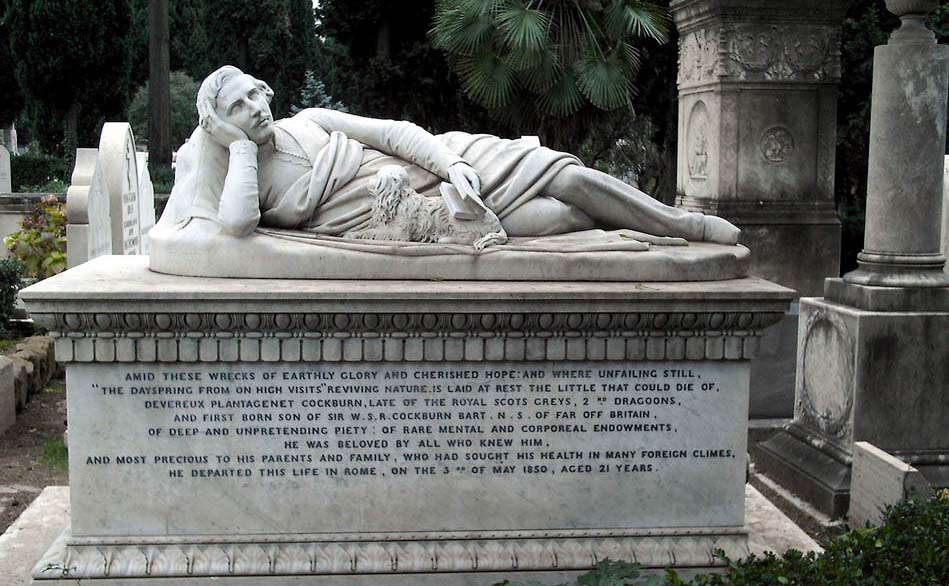
Cimitero Acattolico: Rome’s Protestant Cemetery
by Ellen Johnston
The sun stopped shining and the rain came in, as if it knew where I was going – past the Palatine Hill and the Coliseum to the subway, which would take me to Piramide station in the un-touristed south of the city – Rome, that is. The station is named for the nearby Pyramid of Cestius, built in 18-12 B.C. as a tomb for a forgotten local magistrate, a piece of folly that marks the entrance to far more hallowed ground.
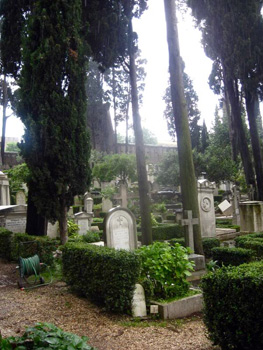
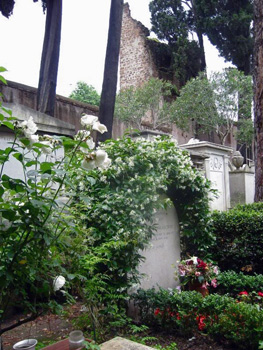 Perhaps Italians might disagree with me when I use this term, since this, the Cimitero Acattolico, is the last resting place for those who could not, or would not be buried in the traditional Catholic cemeteries here in the heart of Roman Catholicism. But hallowed it is, nonetheless, since this patch of land, overgrown with weeds and flowers, contains the remains of the some of the most important figures of the last few centuries: local dissidents and those from other lands, ex-pats, writers, revolutionaries, atheists and Jews who, famous or not, all came to rest together here in this painfully beautiful monument to non-conformity. Antonio Gramsci, Gregory Corso, and a cat named Romeo are some among this motley crew, though none of them hold higher places in the echelons of artistic memory than the two greats of English Romanticism buried here: John Keats and Percy Bysshe Shelley. How could it not be raining, then? It was as if the luminous Roman sky had been replaced for a moment by a melancholy English one, pausing to weep a bit for two lost sons, entombed amidst the ruins, far far away.
 Though their names are often intertwined, John Keats and Percy Shelley came to Italy for very different reasons. Shelley, the rebellious Etonian from an Aristocratic family, was leading a wild life, one easier experienced abroad. He was best friends with Lord Byron and romantically entangled with Mary Wollstonecraft Godwin (turned Shelley), the author of Frankenstein. His lifestyle, radical views, and writing had brought him not only fame, but also infamy. Like many writers and artists of his day, he was attracted to the warmth of the European south, to its classical pagan origins, and to that fact that he could live freely there, away from the scandals that plagued him in England. Keats, on the other hand, came to Italy to die.
Born in London of far more humble birth, Keats’ life had been plagued by poverty, the loss of his parents, unfulfilled sexual desires, and the death of his brother to tuberculosis. Unlike Shelley, who attended Oxford, Keats never had the opportunity to reap the benefits of the English academic establishment, never mind rebel against it. Instead, he apprenticed as an apothecary and then studied medicine at Guy’s Hospital, in the city’s unfashionable south. His desire to write, however, eventually drew him away from the medical path – though he never lived its consequences down. In an England where class meant everything, including who could or couldn’t be an artist, John Keats’ Cockney origins and practical training were simply too much for some critics to bear. Of Keats’ poem Endymion, John Gibson Lockhart wrote that “it is a better and a wiser thing to be a starved apothecary than a starved poet; so back to the shop Mr. John, back to plasters, pills, and ointment boxes.”


 Besides the cruelty inherent in this statement, the irony was palpable too. Keats’ medical training, no matter how practical it may have been, could do nothing to stop what was then an almost incurable disease, tuberculosis. Not long after his brother died, it became clear that John Keats had contracted the illness too. Knowing that he would not survive the English winter, his friends gathered whatever money they could in order to send him to a gentler climate, a last ditch attempt to save his life.
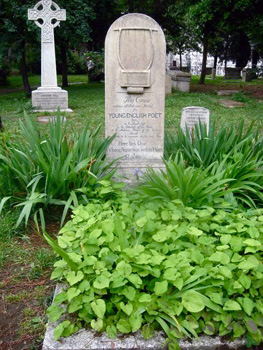
John Keats sailed to Rome with his friend Joseph Severn in the autumn of 1820. The climate, however, proved not gentle enough, and the disease too strong. Within a few short months, Keats was dead, believing himself to be a failure. He asked to be buried in a grave bearing neither his name nor date of death, only the words “Here lies One Whose Name was writ in Water.” Those very words adorn his grave today, though his friends, in their belief that he should be recognized as a great poet, added some of their own.
Despite the critics, Keats’ close personal friends were not the only ones to defend him. He also had an advocate in the very man who now lies buried some twenty metres away. When Keats died, Percy Shelley wrote “I weep for Adonais – he is dead!”, the opening to his poem, Adonais, which was written as an elegy to Keats, and considered by some to be his best work. Shelley had met Keats through a mutual friend on a visit to Hampstead, admired his talents, and considered him to not only be a rival, but one who would surpass him. Not long after Keats’ death, Shelley went to visit his grave in the Cimitero Acottolico. Of the visit Shelley said “the cemetery is an open space among the ruins, covered in winter with violets and daisies. It might make one in love with death, to think that one should be buried in so sweet a place.” When I visited it myself, there in the broody mist, somber and romantic, I couldn’t help but agree with Shelley’s words.
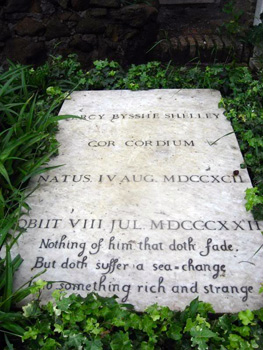 Shelley was buried in the same cemetery a mere year later, the victim of a violent Mediterranean storm that drowned him while sailing off the coast of northern Italy. A book of John Keats’ poetry was found in his pocket. Shelley’s cremated remains (all but his heart, which was kept by Mary Shelley and eventually buried in England) can be found under a small flat tombstone a short walk from Keats’, bearing the Latin “Cor Cordium” (heart of hearts), and a quote from Shakespeare’s The Tempest: “Nothing of him that doth fade, But doth suffer a sea-change is to something rich and strange.”
Visiting the Cimitero Acattolico is easy, though few Italians can tell you how to get there. Almost none I asked even knew it existed. It is free to enter, though donations are requested. There is a tiny visitors centre that sells books and postcards at the entrance, manned by staff who speak English, usually ex-pats themselves. Through the gate, Keats’s grave can be found by walking directly to the left, until you reach the first corner. A plaque written by his friends (complete with an acrostic based on his name) adorns the wall above it. A small bench lies in front, should you choose to sit and contemplate the great poet who believed his life’s work would make fewer impressions than ripples in a pond.
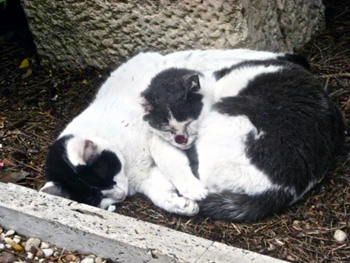 On my own visit, while I sat there overcome with tears, I heard a rustling from the wall above me. From out of one of the vines came a black and white cat, who jumped down onto the bench, and then snuggled up onto my lap. Through my own teary-eyed haze and quixotic imagination, it was easy to believe that in that moment I was being visited by the spirit of the poet himself. Of course, as I got up to walk to Shelley’s grave, straight ahead and to the right, I realised that the cat was just one among many strays who live in the cemetery, and to whose livelihood you can also donate money. However, the impression stayed with me, there on that wet rainy day, as I wandered alone through the grounds of the Cimitero Acattolico. And I emphasize the word “alone”, because visitors here are many fewer than in other famous cemeteries such as Père Lachaise or in Roman tourist spots like Saint Peter’s. When Oscar Wilde visited in 1877, he called it “the holiest place in Rome”. There, breaking bread with the dead, it’s not hard to see why.
Rome Tour with Private English Speaking Driver
If You Go:
♦ The Cimitero Acattolico can be easily reached from the Piramide metro station. It’s a few short blocks away, and can be accessed on Via Caio Cestio.
♦ The suggested minimum donation is €3.
♦ If you’re worried about getting hungry, visit the Jewish Ghetto before you hop on the metro, and pick up a taste of non-conformist Rome. Pasticceria Boccione Limentani sells delicious pizze, a fruit and nut filled bread – sweet, dense and perfect after a long walk. The bakery can be found at Via Portico D’Ottavia 1.
About the author:
Ellen Johnston is a cultural nomad —a traveller, writer and musician who bounces all over the world. Originally from Vancouver, Canada, she has West Coast roots, a Mediterranean soul and a Chilanga heart, thanks to a recent stint in the Mexican capital. She currently resides in the San Francisco Bay Area, trying to soak up a little of all three. You can find links to her other writing and photography at www.chamacaloca.wordpress.com
Photo credits:
Top photo of Cimitero Acattolico by LuciusCommons / Public domain
All other photos are by Ellen Johnston.

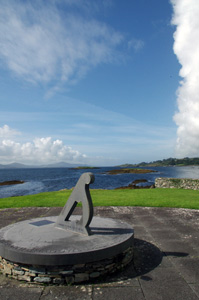 Visiting the Air India memorial is not easy, and the usual response from people in Ireland was “never heard of it” and occasionally, “I remember something about that. When did it happen?” The memorial is not on any tour route nor do tour buses get close so I organized my visit through the hotel in Killarney where I was staying. Killarney is the largest town in the area and a major southern Ireland tourist spot. A local cabbie, who does customized tours, offered a flat rate for the day. The other option, and cheaper choice, would have been to rent a car.

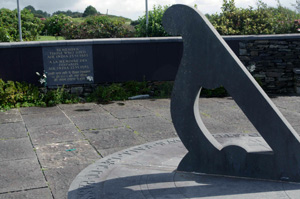 The memorial includes a well kept with a sundial that commemorates the day and hour of jumbo jet’s explosion in the air. There is a low, stone, semi-circle wall with the names of the victims that appears to cup the sundial. (Picture 4)A tidy garden maintained by the village borders the path to the memorial, which is oriented towards the breezy, wide-open ocean.
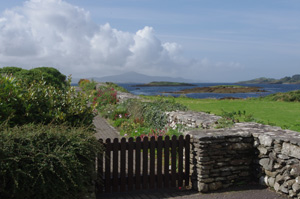 At one point, we had to stop for a flock of sheep across the road which gave the weathered sheepherder time to walk up to the van. He quickly fired off about a dozen personal questions in a sing-songy Irish accent including asking where were we from, where were we going and was I married. Driver Walsh had predicted we were going to be there a long time when the sheepherder headed towards us. Walsh was greatly relieved when another car came around the bend and the sheepherder had new people to question.
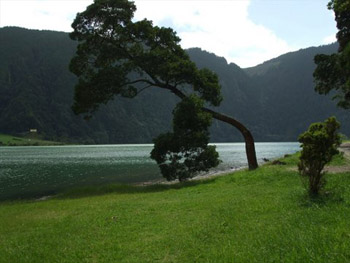
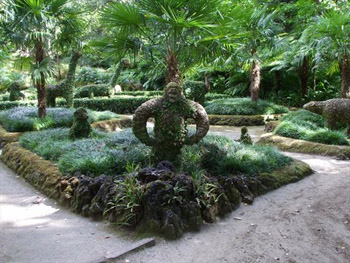 The old spa village of Furnas is our tranquil retreat for a few days before we head to the capital, Ponta Delgada. Here in Furnas is the delightful Terra Nostra Park, a botanical garden created in the 18th century by the American Consul Thomas Hickling. Walking the avenues and winding paths of these gardens we pass monuments, grottos, koi carp ponds, and a whimsical area of animals carved in stone – my favourite is a laughing gorilla stood with hands on hips. Also in the grounds an ochre coloured geothermal lake overlooked by Hickling’s house is popular with many visitors for a restorative swim. Perhaps less popular is the yellowing of swimming gear from the water. I opt not to ruin my swim shorts and instead enjoy an hour lazily swimming in the hotel’s otherwise empty indoor pool.
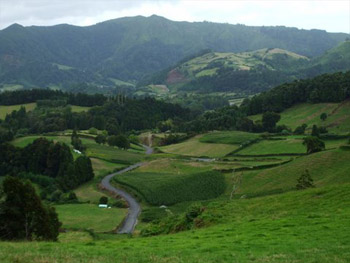 The track could be a tricky ascent when wet and muddy, and is best tackled in dry weather. A few minutes hard walk is amply rewarded by a view across the verdant valley in one direction, and to the other Furnas lake with Jose do Canto’s chapel visible at the far side. A reminder of the volcanic nature of this land is the eggy aroma of sulphur wafting up from the fumaroles below. A young bull chained up nearby is less than enthralled by our presence. His distressed calls eventually signal an end to our viewing. We start the trek back to the village in search of somewhere to get a cold drink.
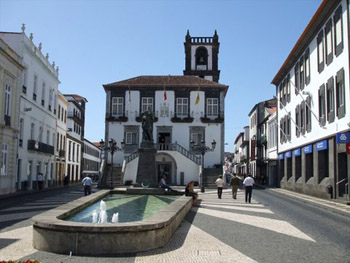 After a mellow few days in Furnas we head to the other side of the island where Ponta Delgada lies in the south-west corner. Here trappings of modern life mix happily with traditional Portuguese architecture – monochrome stone buildings of whitewash edged with black basalt. Squares and narrow cobbled streets in the old part of town can become crowded. So it’s with some relief that we find the drivers to be mostly tolerant of pedestrians.
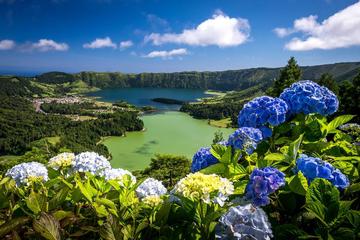
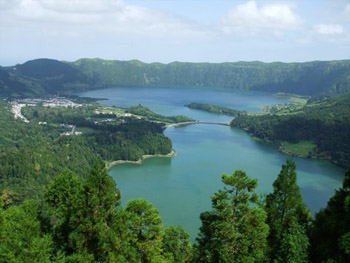 We arrive at the best vantage point, Vista do Rei, where all the brochure pictures of the caldera are taken from. It’s located just off the main road opposite an abandoned concrete hotel, just before the road heads down to the village. Our reward is a superb panorama of the caldera: its twin lakes Azul and Verde, and the village of Sete Cidades nestled on the flat land to the western side. Giant blobs of cloud shadows move across the murky green and blue lakes like giant Rorschach tests. From this spot the adventurous can embark on a long walk around the ridge of the caldera on a narrow path edged by vertiginous drops through trees and other foliage.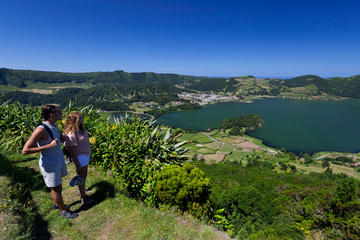
 I settled in on the first two days, and on Saturday visited Montjuic Park for the marathon expo; to collect my race number and timing chip. The Museum of Arts towers over the front of the park; above cascading fountains framed by rows of steps. Musicians and giant dolls entertained in the square at the bottom of the cascading fountain.
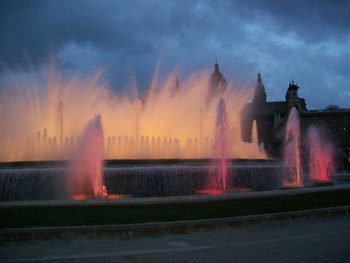 I returned in the night to watch the Magic Fountain show. Every fifteen minutes between 7pm and 9pm the circular fountain at the foot of the hill seems to be awakened by music, spraying water high in the air while changing colours.
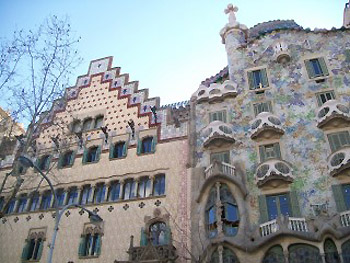 After about four miles the circuit took us past Camp Nou; the 98,000-capacity home of FC Barcelona is the largest stadium in Europe. That night I joined 68,000 people at the stadium to watch Barcelona beat Rayo Vallecano 3-1. Climbing to a seat about five rows from the top of the 150-feet-high stadium was hard work, but worth it, with the sensation of emerging into the steep-sided seating above the bright green pitch reminding me of the Lost Horizon story of a Shangri-La hidden in the Himalayan mountains.
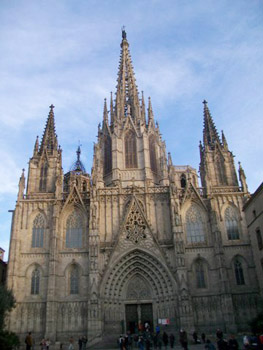 Antoni Gaudi was Modernisme’s most famous artist, and a couple of miles later we passed the movement’s crowning glory. La Sagrada Familia is still under construction a century later. The 13,000-capacity cathedral’s size distinguished it from other cathedrals while passing, and on closer inspection so does its blending of nature into the design. Gaudi liked curves rather than straight lines, claiming there were none of the latter in nature; and some spire-tops are decorated with balls of fruit-colours.

 The sky cleared the next day, and temperatures rose into the 60s Fahrenheit. I took the train out to Monistrol de Montserrat, and hiked to the Santa Maria de Montserrat monastery. To the north-west, snow-capped Pyrenees signified the border with France, while the Mediterranean Sea was visible to the east.
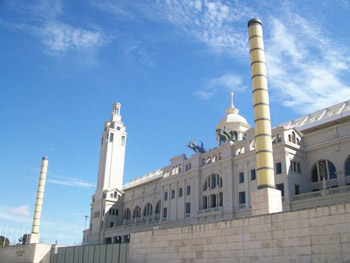
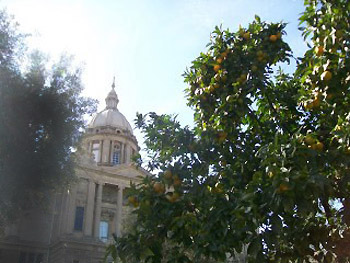 The next day I returned to Montjuic Park, going past the Arts Museum to the Olympic Stadium, which brought back memories of the 1992 Games. I walked past torch-pillars and the Telefonica tower to the tree-filled green zone leading up to Barcelona’s castle. Cannons point up and down the coast and there are great views of the city all the way to Tibidabo Mountain, overlooking Barcelona on the western horizon. The castle has a chequered past, being used to hold and execute prisoners in the civil war and other twentieth-century conflicts.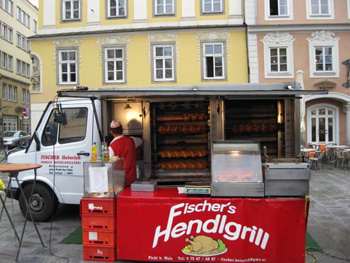
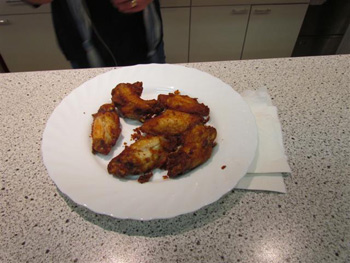
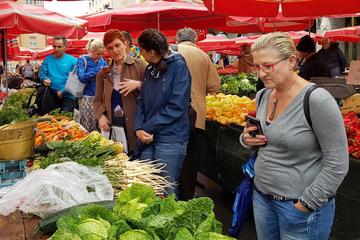
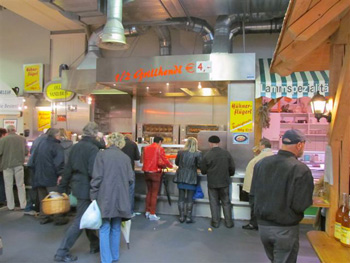 Some of my personal favorite ethnic eats are in Austria. In Wels a small town in the Northwestern section of the country there is a local market which is very similar to the Westside Market in Cleveland, Ohio. A new building was recently constructed to house the vendors. On the outside of the market vendors sell various fresh fruits and vegetables etc. Nothing there is prepackaged. Inside the building the vendors provide various types of fresh food including meat, poultry, eggs, cheese and even schnapps (whiskey). My favorite vendor has barbecue roast chicken on a spit and as of late a new item lightly breaded chicken wings which go well with a stein (a traditional German beer tankard) of beer. Priced by the kilogram (2.2 pounds) US $3.00-$5.00.
 There are other taste treats to learn about and experience. Crossing from Slovenia into Croatia passing through village after village the signs for roast pork (svinjina) and lamb (jagnjetina grilled lamb both roasted on spit) began to appear. The local Gostionas (Restaurants, Bars) were preparing their grills for roasting. As luck would have it, we always seemed to miss many of these establishments. It might have been sheer luck and or just bad timing. We were either too early or too late for lunch or there was not a Gostiona located in the area where we were.
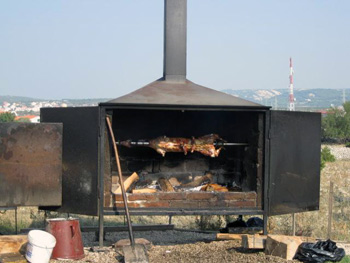 Having been in the former Yugoslavia a few times we learned over the years on what to look for when it comes to roast pork and lamb. Normally vendors and restaurateurs post signs advertising their wares along the road. Driving through Split on the Jadranska Magistrala along the coast toward Dubrovnik about lunch time we just could not find an establishment that had roast lamb or pork. Either we missed the signs or there just weren’t any. Finally we stopped at a local restaurant and we were given directions on where to find janjetina. Down the road and up the side of a sparsely covered mountain, we traveled higher and higher on the narrow pebbled road turning this way and that as the road curved back and forth along the side of the mountain, my cousin sitting in the back seat hanging firmly on to the hand strap fixed to the car roof. We drove on and on for over an hour. Finally we found it. The war had taken its toll. It was a bombed out building and on the side of the building a faded wooden sign advertised jagnjetina. My cousin started laughing hysterically!!! Someone was having a good laugh on us. Consequently we did not have roast pork or jagnjetina this day.
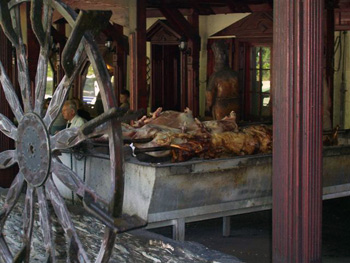
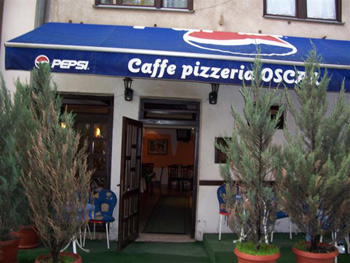 On another occasion we were traveling by bus from Sarajevo to Mostar we stopped in the town of Jablanica to view the local historical sights. We learned from the locals just on the outskirts about one kilometer south of Jablanica was the restaurant Zdrava Voda (Health Water). There on six roasting spits was lamb grilling on an open fire continuously throughout the day enough to quell the hunger for both the tourist traveling between Sarajevo and Mostar and the local population. The price was US $15.00 which included potatoes, salad, and bread. Jablanica is known for this mouth watering delicacy and that there are over 8 restaurants in the vicinity that serve it. www.zdravavoda.co.ba

 In Sarajevo the restaurant Cevabdzinica Zeljo, on street Kundurdziluk 18, in the Bascarsija seems to be the favorite place for locals to enjoy a “healthy” meal of cevapcici with onions, sour cream and yogurt. Cevapcici is beef minced meat in a roll served with pita bread and priced under US $7.00. Other versions of this delicacy are made with ground lamb, veal, and pork.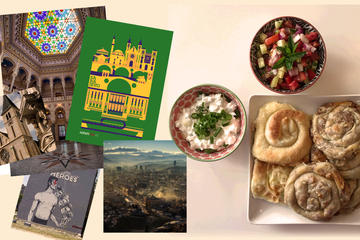


.jpg)