Mainz, Germany
by W. Ruth Kozak
Imagine shopping in an ancient Roman temple dedicated to Isis and the Great Mother. In Mainz, Germany a modern shopping mall is built right over such a place. The archaeological ruins of Taberna Archaeologica are part of the attraction of the busy mall discovered when excavations were made revealing remains of two temples celebrating ancient female divinities: Isis the Egyptian Goddess of Fertility and Mater Magna, or Great Mother, a goddess who was favoured by soldiers.
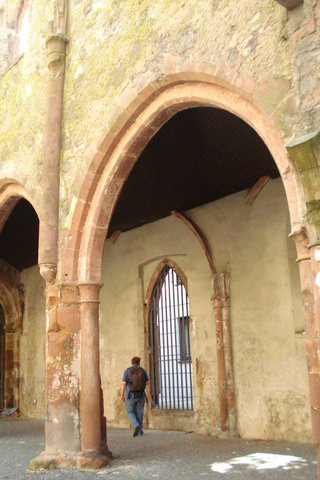 Mainz history goes back to when the Romans built a fort here around the 1st century BC. The name “Mainz” may have derived from the Roman name for the river, Main. But until the 20th century it was referred to in English as Mayence. Besides this temple there are other ruins nearby including the site of the original Roman citadel where there is a cenotaph raised by legionaries to commemorate their hero Drusus. Among the sites are the ruins of an aqueduct and theatre. Some of the artifacts of Roman times can be viewed in the Museum of Antike Schiffahrt and Mainz most important museum, the Landesmuseum.
Although much of Mainz was destroyed during the war, it has retained much of its beautiful old architecture. It’s the largest city and capital of Rhineland-Palatinate, located on the west bank of the river Rhine about 40 kilometers north east of Frankfurt.
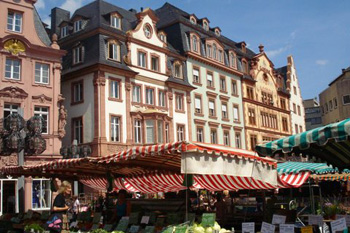
I was fortunate to visit a friend who lives in Mainz so he acted as my tour guide as we explored this architecturally rich and scenic city, from the Baroque Gautor Gate built in 1670 that was once part of the city walls, to the Copper Mountain Terrace, an upscale residential area where people grow their own grapes to make sparkling wine and the modern shopping district of downtown where the rich archaeological finds of the past blend with the new cityscape. I especially enjoyed Mainz’s Old Town with its pretty squares and half-timbered houses and unique shops.


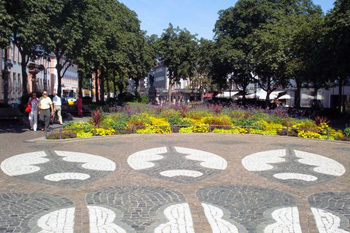 Mainz is home to a Carnival, the Mainzer Fassenacht, originating in the 19th century. We walked around the carnival square where there’s a statue of Friedrich von Schiller, a 19th century writer and poet for whom the Square is named. The Carnival is held on Rosenmontag (Rose Monday), before Ash Wednesday and is one of the city’s biggest celebrations.
Once the main ecclesiastical centre north of the Alps, Mainz is noted for its Baroque churches. The Church of St. Stephan, a Gothic structure built between 1290 and 1338 is one of Mainz most visited attractions. Be sure and go inside to see the magnificent stained-glass windows depicting scenes from the Old Testament by exiled Russian-Jewish artist Marc Chagall. They bathe the Gothic hall with luminous blue light. Chagall intended his work to be a contribution to Jewish-German reconciliation and chose St. Stephan due to his friendship with Monsignor Klaus Mayer who was then presiding priest of the church.
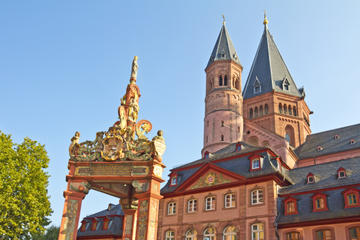
 The immense Cathedral of Saint Martin is nearly 1000 years old, built in Romanesque style. It has six individual pipe organs inside all accessed from one large console. The Augustine Church with its magnificent Baroque facade was built originally as a hermit’s monastery in the mid l700’s and is now a seminary church noted for its beautiful interior with ceiling frescoes that provide insights into the life of St Augustine. The Catholic Church of St. Peter is one of the most important Baroque building in the city. Originally a monastery, the present church was built between 1740 and 1756 by architect Johann Valentin Thoman. Inside you’ll see amazing Baroque altars and ceiling frescoes. Christuskirche is an evangelical church in an Italian High Renaissance style. It serves as a music venue as well as church. The old Gothic Church of St. Christoph dates to the 9th century. It contains an original 15th century baptismal font. Johannes Gutenberg, inventor of the first printing press was baptized here.
The Gutenberg Museum is nearby, a history of the printed word where you can see the earliest typesetting machines and books that were published centuries ago including Gutenburg’s first printed Bible.
Read more about the Gutenberg Museum here.
 There are several interesting day-trips out of Mainz. The region is rich in variety with idyllic river scenery, historical towns and picturesque villages. The Rhineland-Palatinate is famous as a wine region and the romantic castles along the river and was named by UNESCO as one of the most beautiful landscapes and world heritage sites.
My friend and I visited nearby Wiesbaden a city with elegant architecture and idyllic squares. We took a bus to ride the Neroberg Mountain Railway, a water-driven elevated train, the largest one in Europe. The train climbs up Neroberg Mountain to a beautiful park where we had magnificent views of the entire city of Wiesbaden, We later walked down the hill, stopping to visit an impressive Russian chapel, built in 1855.Next to the chapel, which has tall gold onion spires, is the largest Russian cemetery in Western Europe.
Another day we took the train to historic Koblenz where the Rhine and Mosel Rivers meet. After walking the lovely riverside promenade, our special treat was a boat trip up the Rhine to view the many castles perched on the hills.
Wiesbaden and Mainz Day Trip from Frankfurt
If You Go:
♦ THE SACRED SITE OF ISIS-MATER MAGNA
Taberna Archaeologica,
Roemerpassage 1
Hours:Monday – Saturday 10 am – 6 pm
Free Admission.
♦ MAINZ TOURIST INFORMATION:
The Art and Science of Beer Brewing
Self-Drive Tour from Wuerzburg to Wiesbaden, Koblenz and Trier
♦ ACCOMMODATIONS: I was lucky enough to be a guest of my friend, but if you are looking for accommodations, you’ll find everything from budget to luxury hotels listed here.
All photos are by W. Ruth Kozak:
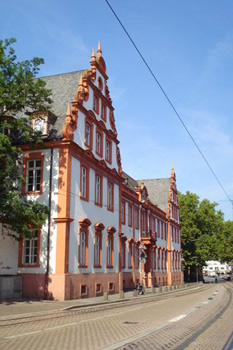
Mainz street scene
Church of St. Stephen
Carnival Square
Cathedral of Saint Martin
About the author:
Ruth is a historical fiction writer as well as a seasoned travel journalist. She enjoys combining her love of history with travel. This was her first visit to Germany and the wonderful city of Mainz. www.ruthkozak.com
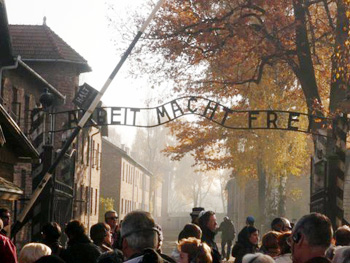
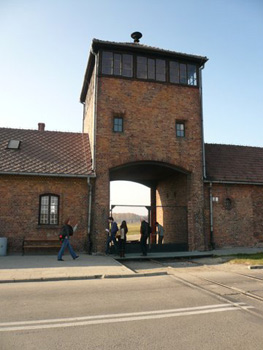 We were part of a continuous line of visitors from around the world who did not need a Silence sign. The only noise came from the shuffling of feet. We were on a tour of Poland and had been visiting Krakow. After making the one hour drive from Krakow, we arrived at Auschwitz I. (Auschwitz II or Birkenau, is a mile away). Admission is free.
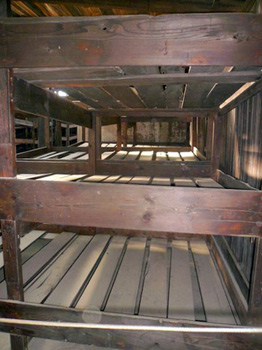 During the early days, the Nazis would take pictures of each inmate. These seemingly endless 8 x 10 glass-covered photographs surrounded a long narrow hall. The inmates looked healthy, for they had just arrived. The name was printed below each photo and included the date of arrival and the date of death—sometimes just days apart. When photography became too expensive, the Nazis started tattooing numbers on the inmates’ arms.
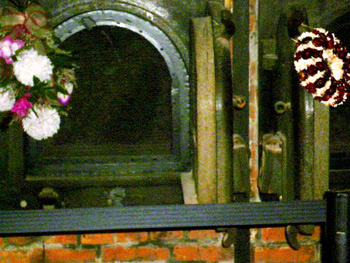
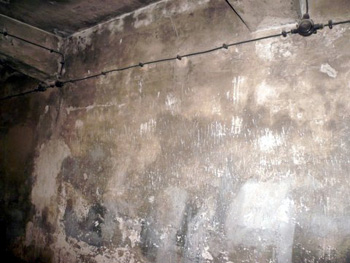 Those who were not selected for the barracks were told they were to take showers. Only Zyklon-B gas was used instead. (The shower heads are still embedded in the cement wall). From there, their bodies were taken to the crematorium The Nazis destroyed evidence of the gas mass killings by blowing up the buildings. Anya told us they liked to use gas because they didn’t have to look at the person while he was being killed.
 This was confirmed by Jerzy Kowalewski, an eighty-eight-year-old Auschwitz survivor. We attended a seminar he had given in Warsaw.
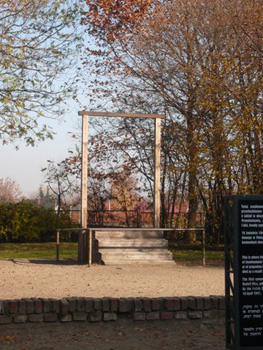
 At the daily roll call, the entire camp stood in their meager rags as the SS guards called out their names. The roll call was given as a collective punishment for the wrongdoing of just one prisoner. The inmates stood for up to four hours in the rain and snow. Some of the extremely weak and sick prisoners would die in the lines during the roll call. After roll call, the prisoners received their ration for breakfast. They were given 10 ounces of bread with a small piece of salami or one ounce of margarine and brown, weak coffee, with no sugar.

 In the Block (or Building 5), on either side of the middle aisle, behind glass, were piles fifteen feet high of human hair on both sides. Rows of long braids popped out at me first.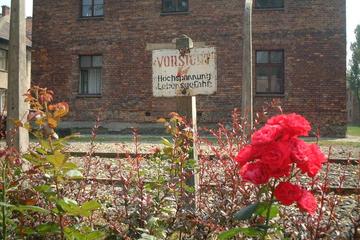
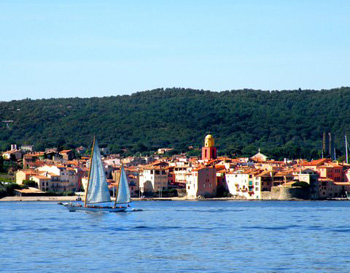
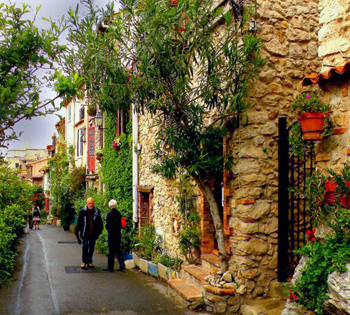 My wife and I are on a Mediterranean cruise along the coasts of Italy and France celebrating our 20th anniversary, sailing on the ultra-deluxe Norwegian ship. Sea Dream I, which carries just over 100 passengers. Sea Dream I is a magic carpet, easing us in comfort and style through a region full of fascinating history. We have been anticipating visits to some wonderful ports and are not disappointed. What we had not foreseen, though, is the many ways that Napoleon, or perhaps just his spirit, would keep making his presence felt, as if popping up unexpectedly in little cameo appearances. These underscore just how completely he dominated Europe in his brief but dramatic era of war and conquest, supreme glory and abject defeat.
 The next planned destination is the Italian island of Elba, the one place where we would expect to find sites intimately linked to Napoleon’s life. It was on Elba that he was forced into exile (along with about 1000 servants and troops as bodyguards) after a series of defeats in 1814.
 Then we anchor off Viareggio, back on the Italian coast in Tuscany, and take a day trip inland to Florence. We have arranged a walking tour to enjoy the glorious and stunning medieval and Renaissance architecture, monumental public sculptures and inviting pedestrian-only piazzas. It is far too brief, of course, but our personal guide takes us to some special places, such as the studio of a blacksmith who creates fantastic birds, fishes and other creatures in steel, and to the guide’s own favourite and funky “Cafe of the Artisans.” We stroke the snout of an iconic bronze wild boar and share a kiss, thus assuring our return to Florence some day.
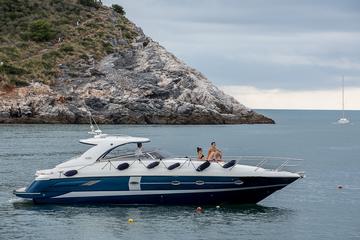
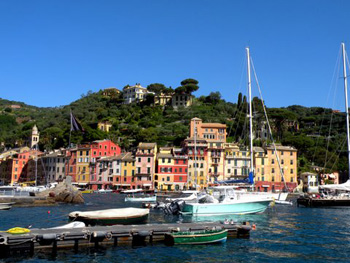
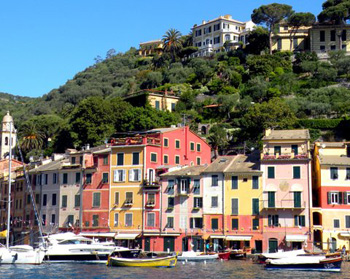 Farther north on the Italian Riviera, our ship anchors off the picturesque village of Portofino, with its brightly painted old houses. Once a simple fishing village, it now has an upscale yacht harbour catering to the rich and famous. Going ashore for a few hours, we hike up to a striking castle that dominates the small bay. And sure enough, Napoleon left his mark here as well during the years when France controlled northern Italy. What we see is an ancient fortification that Napoleon modernized, greatly expanded and equipped with better cannons. Not one for modesty, he renamed the village Port Napoleon.
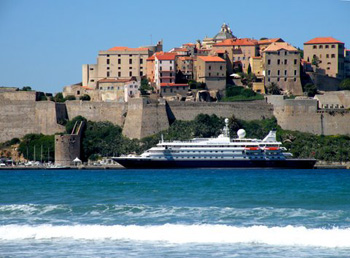 While a student, I had bunked at a unique youth hostel in a little modern castle overlooking Finale Ligure, a lovely stretch of coastal villages on the Italian Riviera only an hour east of Monaco. We decide to return to explore those intriguing shores, with their rich and diverse history. It was here that the 15-year-old Margaret Theresa of Spain stopped briefly in 1666 while on her way to Vienna to marry Leopold I, the Holy Roman Emperor. A triumphal arch commemorating the event dominates the central piazza, not far from ancient fortifications that marked the long-fought-over boundary between Spanish and Genoese-controlled territories. A few miles east is the village of Varigotti with its strikingly Moorish houses. These were built in the ninth and tenth centuries by the Muslim Saracens, who ruled the area for nearly 100 years. Long thereafter, they remained both a threat and a trading partner to the region, bringing such goods as salt from Ibiza when Spain was still under Moorish rule.