
by Georges Fery
Easter Island history turn and twist through time, as all human histories do.
We are familiar with the “when,” “what” and “how” of the island’s past, its society’s rise and fall in the confine of an extreme isolation, but we are still grasping with the “why.” The island’s past is a tragedy for, unlike events that shaped other cultures of the Americas, its past unfolds through the mind-made faith in “another world” that, together with its unusual environment and isolation, ended dreadfully. We are familiar with the settlement of people on this isolated speck of land and its archaeology, so let’s examine the undercurrents that led to the islanders’ demise.
What happened on Easter Island is not unique and is found in the histories of other cultures. The uniqueness of Rapa Nui, its Polynesian name, is that the ecological collapse took place on sixty-seven square miles of a volcanic island in the middle of the South Pacific. The now extinct three major volcanos and seventy-tree minor volcanic cones are a testimony to the geologically tumultuous birth of the island; today there are no volcanic activity. We know that the people of Pitcairn and Henderson islands interacted with the islanders during the early phase of their settlement. The interaction may have stopped in about 1150 or 1200, why? The record is not clear, but we are confident that it took place within that time frame. From late thirteenth century, the isolation of the island had its people believe that they were at “te pito o te henua” or “the end of the land” in Polynesian. Generations that followed the last wave of settlers never saw another human being for hundreds of years. They believed that they were the only living people on earth, but for the seasonal migrations of sea bids in time with the rising of the Pleiades and the Austral Solstice.
The Moais are at the heart of Easter Island’s history. Today the distinguishing feature of the island are its giant stone statues called Aringa Ora which means “live face” a name that applies to ancestors in Rapanui language. Ninety-five per cent of the statues are made from a single solid block of volcanic tuff from the Rano Raraku volcano, while others are made of trachyte, red scoria, or basalt. Once shaped, the Moai was transferred to a clan’s altar located at the apex of its land closest to the seashore. It was then raised on a rectangular platform made of massive rock slabs, with a core filled with stone rubble.
On Rapa Nui the Moais were those of ancestors at the head of each clan and family. In the “otherworld” those ancestors were believed to receive mana the supernatural power from the paramount god Make’make, that was then passed on to their living descendants. Mana was entrusted to clan heads, the Arikis and the supreme chief, the Ariki Mau who received the most. Moai carving and erection on clan lands illustrate the importance of knowing the ancestry of each family, as well as clan hierarchy and its members subordination, as are the Tikis in the Tuamotus. The increasing need to demonstrate power and prestige through the Moai eventually led clans to severely tax the environment to the extent that people had to fight for resources, essentially food and wood.
A small lake of fresh water in Rano Raraku volcano caldera, supports a bed of totora reeds. At last count, there are 887 recorded Moai. Of those, 288 were moved to their destination, while 46 are still in the quarries inside the crater and 103 outside on the southern slopes. 92 are scattered beyond, lying down on the way to their altar, and are mostly intact. The statues are unique for there is nothing quite like them anywhere else. There are large stone statues, such as the Tikis in the Marquesas and other islands of eastern and central Polynesia. But never do they occur in size or number approaching those of Easter Island, and their shapes are different from that of the Moai. With few exceptions, the statues represent a man’s body from the head to the level of the hips with hands and long fingers placed bellow the belly button, sculpted in low relief. A posture common in the Cook, Austral and Society Islands’ art, and recognized as a burial posture in the Tuamotus.

The carving of a Moai was both a technical and a ritual process that required two constituents to transfer nature, the rock, to culture, the Moai. A team of five to six carvers worked on each statue using basalt and obsidian tools. Repeated incantations with magical power, was believed to help ancestors, through the carvers, to materialize the Moai out of the rock. The close similarity in the shape of the faces of Moais underline the fact that they are not actual physical representations of dead ancestors. Why then did they not have identifiable facial features specific to ascendants, as remembered in each family, or that of a clan leader? This observation leaves one possible option to the riddle: it is because they represent souls in the other world believed to have no identifiable features. The uniformity of the Moais physical aspect is grounded in a common model that did not intend to show appearances that vary with individuals, but that of the common shape of a soul in an indescribable world.
But who qualified as ancestor? As a rule, it was a senior male that traced his line of descent with the descendants of Ariki Hotu Motu’a’s six sons. They also were those which left significant resources or position in their community. Above all, ancestors were “go-between” with the “other” world and its paramount god Make’make, dispenser of the all-powerful mana. This wellspring of ancestral power was common in the mythological pantheons of most cultures of the Pacific and beyond.
With such perception of life and Make’make’s backing through their ancestors, the Rapanui people could not possibly come to terms with the cumulative cause and effect of their actions, nor their failures. In other words, they did not relate, as in modern minds, to the consequences of their actions for they assigned those to a third party, the ancestors in the “other” world”. But, from where did Make’make came from? For the name is unknown elsewhere in the Pacific where the paramount god is Tangaroa, creator god and master of the seas. Make’make can only be the Ariki Hotu Motu’a’s creation for its power yielding dominion over its own Miru clan, paramount in all social and religious affairs. Of note it that Hotu Motu’a was not a political ruler but the main mana holder.

Make’make’s mythological powers were like those of Tangaroa, in command of the climate, animal migrations from birds to fish, food crops success or failure and other life sustaining needs. Those and more were now believed to be Make’make’s exclusive domains. As for all human communities, the society in the new land needed spiritual guidance beyond that of secular authority, Make’make was Hotu Motu’a’s answer to that need. Furthermore, Make’make was believed to be the sole master and dispenser of mana he granted or withheld at will through ancestors. No success or failure, from nature’s rewards to joy or sadness, wellbeing or deprivation could happen in this world without mana.
Most activities including cooking, took place outside. A several yards away from the house or cave, was the manavai or garden, where edible plans were grown in two to three feet deep holes below the ground surface, covered with a bed of lava rocks. The purpose of a bed of rocks for the manavai was to create a two to three feet deep sunken garden to grow small plants, or a three to five feet high rock enclosure above ground for trees, such as bananas or others. The function of the manavai was to protect the plants from extreme weather and winds in a depleted environment. This so-called lithic mulch agriculture was the answer to trap humidity in the soil to slow its dissipation to the winds and the sun.
It is estimated that a sharp population decline through famine and wars took place in the period late 1500s to early 1600s, from an estimated six to eight thousand souls at the peak of the period, to about half that number at the beginning of the Decadent Period. Several factors need to be taken into consideration for such a precipitous decline. Of note, is that Rapanui people, like others in similar exacting environments, tend to see ritual requirements as an integral part of their natural environment. This perception stresses that neglect of ritual duties was believed to cause imbalance in the natural world and, that imbalance could only be righted by extending or increasing ritual behavior. Since their environment did not improve, despite pleas to ancestors, ritual behavior was given priority over reality. The Rapanui were unable to overcome the “ancestor factor” that governed their lives, for that factor was deeply rooted into a mind-made belief, that had them dig their own grave.
Easter Island sixty-three square miles is the only landmark in over a million square miles of the south Pacific, with no other landmass to slow the winds blowing from all quarters. Foremost, the two forces, the sun, and the wind in a depleted environment, were intensely destructive. The question is: how Easter Island’s environment looked like before human arrival? Archaeobotany support the historical record that, upon arrival of the Ariki Hotu Motu’a and his people, the island was covered by a sub-tropical forest with massive coccoid trees, the sixty-foot tall Chilean Wine Palm (Jubea chilensis), witnessed by channels cut by its roots underground, and baby coconuts remains found in lava tubes, with Polynesian rat teeth marks.
So, what happened? By the end of the seventeenth century the land, devoid of trees, was left open to the harsh and ill-force winds blowing from the four quarters. With no significant vegetation to speak of to slow the winds and reduced trees and bushes to hold humidity and plant decay to feed the topsoil; evaporation took place rapidly; it could not be stopped. When the first settlers arrived, the archaeological record indicate that the island was lush with Chilean Wine Palm and other trees, among which was the eight to ten feet hard wood Toromiro (Sophora toromiro), small bushes, and undergrowth plants. Annual rainfall averaged forty-five inches, but water from the rains quickly filtered below a porous volcanic soil in the extensive network of lava tubes that crisscross the island underground, draining the water in the ocean at low tide. As their environment deteriorated, the islanders did work at finding other ways to protect their shrinking ecosystem to grow their food; the manavai was one of the answers.

Impact of severe storms and droughts together with the island extreme geographical isolation, were not overriding factors for, extreme climate events took place in the past, without lasting outcome. Over population and unchecked depletion of resources, were the destabilizing factors. The Rapanui people were aware of their shrinking ecosystem and mobilized to find ways to overcome it. However, the mindset of ancient cultures merges actual and mythic views of life and their existence. In other words, nothing happened in this world without its simultaneous counterpart, positive or negative, in a mythic world, abode of benevolent or malevolent gods and deities, and home to ancestors. Were they not assured by ancestors that with mana, nature would forever replenish itself? After all, so said the Arikis, the lineage chiefs and shamans, backed up by generations of successful petitions to the ancestors and to Make’make provider of the inexhaustible mana.
The belief in an inexhaustible bounty had dramatic consequences. Large birds, such as Frigates, avoided the island for their nesting habitat, depleted by humans, had shrunk dramatically, they kept flying to the Marquesas and beyond. There were no more wood to build boats to go out to deep water fishing grounds for, unlike most coral islands, a volcanic island like Rapa Nui lacks a lagoon for inshore fishing. Fish and shellfish made a smaller contribution to the islander’s diet, as found in kitchen middens. The Rapanui could no longer build canoes to escape from a condition of need and fear, they were trapped! The ancestors had failed their descendants, and people realized that Make’make had turned its back on their ancestors by withholding its mana.
The ecological disaster could not be assigned to clan leaders alone. Studies place the abandonment of belief in the Moai cult, towards the end of the 18th century for, at that time, the cult had already lost most of its political and religious credibility. The Rapanui, however, could not understand that they were the ones responsible for their ecological disaster that, even the unblinking eyes of the Moai, were unable to foresee.
This is the first of a two-part article. Follow this link to see Part Two.
Photos & Credits:
1. Rapa Nui Ancestors
2. Ahu Tahai
3. Make’make by https://commons.wikimedia.org/wiki/User:Rivi~commonswiki licensed under the Creative Commons Attribution-Share Alike 3.0 Unported license.
4. Long House and Manavai
5. Rapa Nui
Photos #1, 2, 4 and 5 are ©georgefery.com
Bibliography:
Van Tilburg, Jo Anne, 1994 – Easter Island Archaeology, Ecology, and Culture
Treister, V. Casanova P., & Cristino, 2013 – Easter Island’s Silent Sentinels
Father Englert, S., 1970 – Island at the Center of the World
Thompson, William, J., 1891 – Te Pito Te Henua or Easter Island
Edwards Edmundo & Alexandra, 2013 – When the Universe was an Island
Heyerdahl, T., 1957 – Aku-Aku
Heyerdahl T., 1975 – The Art of Easter Island
Jennings, J. D. – 1979 – The Prehistory of Polynesia
Macmillan Brown, 1924 – The Riddle of the Pacific
Noury A. & Galipaud, J-Ch., 2011 – Les Lapita, Nomades du Pacifique
Routledge, K., 1919 – The Mystery of Easter Island
Sand C., & Connaughton S. P., 2007 – Oceanic Explorations, Lapita, and Western Pacific Settlement
About the Author:
Freelance writer, researcher and photographer, Georges Fery (georgefery.com) addresses topics, from history, culture, and beliefs to daily living of ancient and today’s indigenous communities of the Americas. His articles are published online in the U.S. at travelthruhistory.com, popular-archaeology.com and ancient-origins.net, as well as in the quarterly magazine Ancient American (ancientamerican.com). In the U.K. his articles are found in mexicolore.co.uk.
The author is a fellow of the Institute of Maya Studies instituteofmayastudies.org Miami, FL and The Royal Geographical Society, London, U.K. rgs.org. As well as member in good standing of the Maya Exploration Center, Austin, TX mayaexploration.org, the Archaeological Institute of America, Boston, MA archaeological.org, NFAA-Non Fiction Authors Association nonfictionauthrosassociation.com and the National Museum of the American Indian, Washington, DC. americanindian.si.edu.
Contact: Georges Fery – 5200 Keller Springs Road, Apt. 1511, Dallas, Texas 75248 (786) 501 9692 –gfery.43@gmail.com – www.georgefery.com
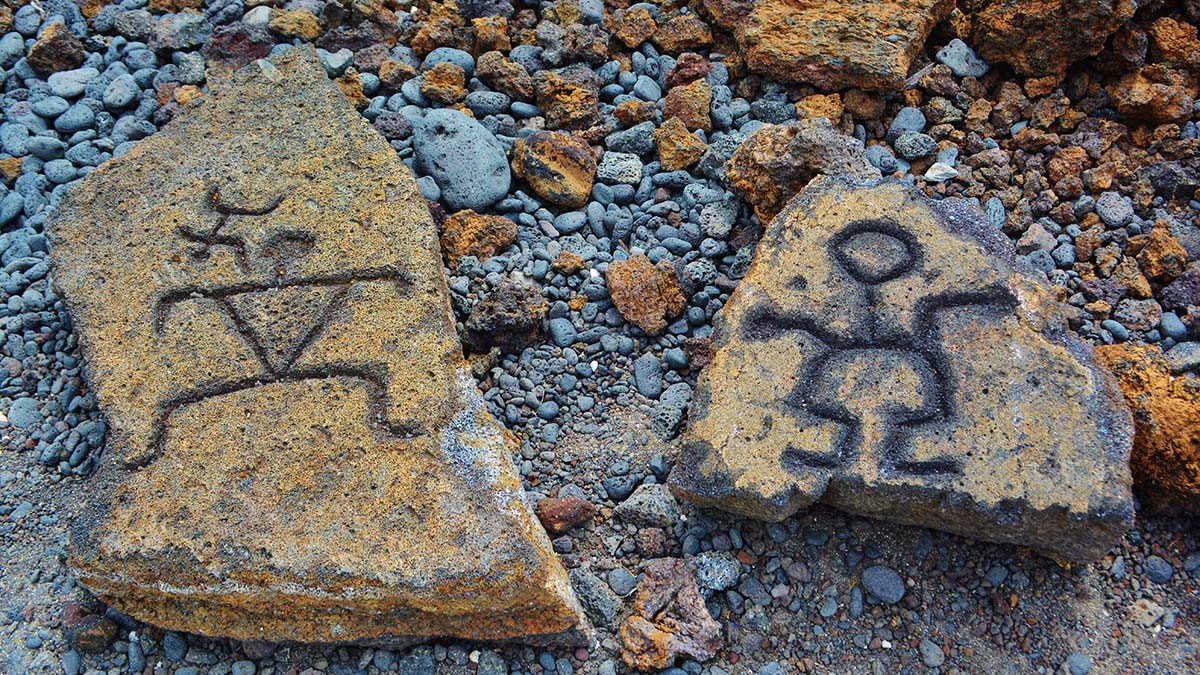


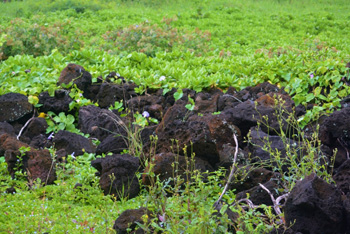
 Petroglyphs were often left made as a recording of the ancient Hawaiian’s visit and a wide variation of these carvings were found intact within these craggy lava fields. Shallow caves thought to have been made as weather retreats are also found here. And this area, just a short distance from an upscale shopping center is the most accessible petroglyph field on the island.





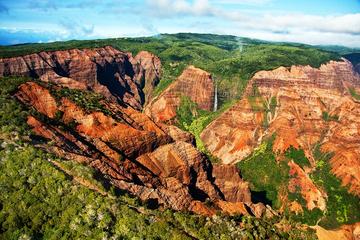
 Our hearts were set on introducing our fellow travelers to the spectacular Na Pali Coast, globally renowned for its rugged, breathtaking grandeur, secluded beaches, rainbow waterfalls and, yes, challenging, daunting hikes. Three days of heavy rains and flooding foiled our plans. Steep treacherous cliffs and slick trails make for heart failing excitement, but, not the kind of excitement we were looking for. Even under the best conditions the Na Pali Coast can be dangerous with its washed out trails and narrow, stony paths clinging precariously to the edge of cliffs. With more rain expected in the forecast, we reluctantly took the locals advice and headed south to the sunny shores of Poipu. It is here on the south side of Kauai that we found unexpected treasure.
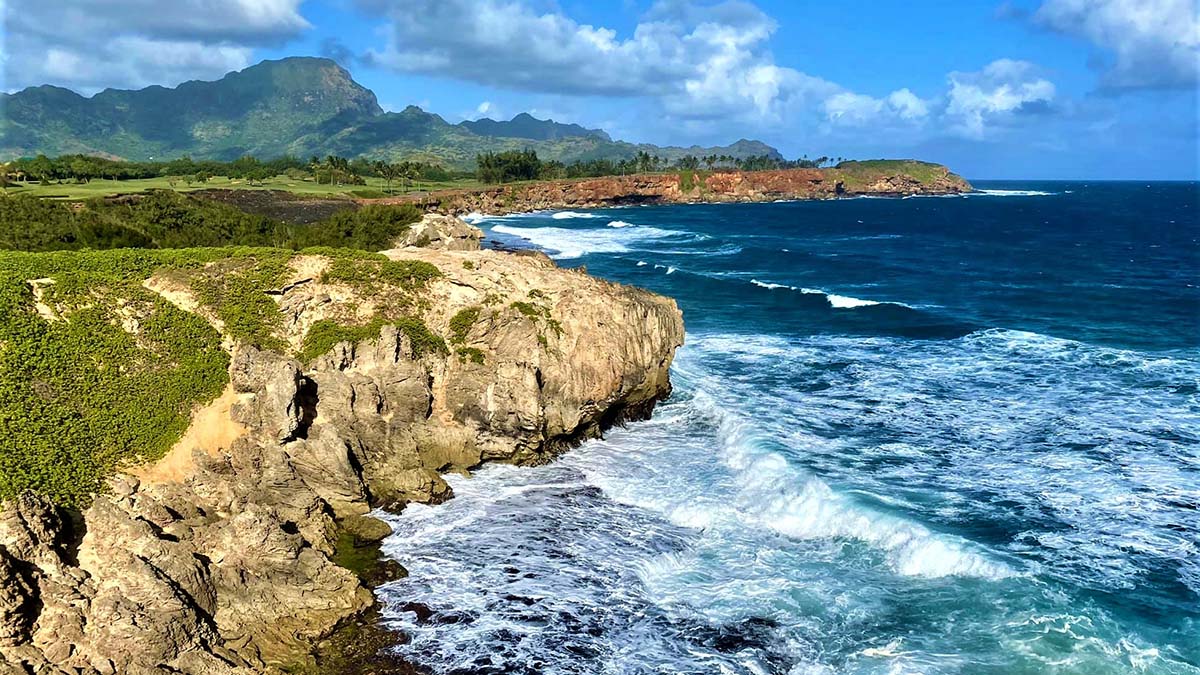
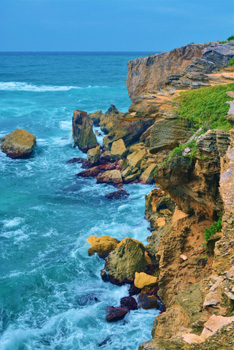
 After climbing a gentle upgrade, we emerged into a completely different world. Greeted by azure skies and miles of crystal deep blue sea, the stunningly rugged coastline stood before us. Commanding views of the churning Pacific waters were visible from vantage points overlooking the edge of sun bleached cliffs. Magnificent coves in the distance appeared like a perfect painting. Blowholes shooting occasional sprays of salty ocean water along the path demonstrated the immense power of the ocean at high tide. Binoculars in hand, we ventured closer to the water, our excitement piquing with the unexpected sight of massive humpback whales breaching in the distance.
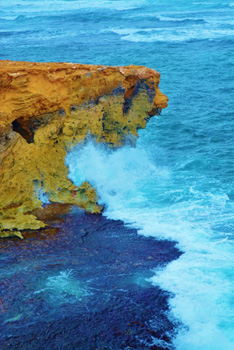
 The Makawehi Lithified Cliffs loomed ahead, appearing like an alien landscape. These cliffs were formed from sand dunes weathered by wind and surf over thousands of years. Crashing wave action carved sharp ridges and deep pockets in the cliff side. Lithification occurred when sediments compacted, then filled pores with ground water containing high levels of minerals. Fascinating scientific explanation that translates to- spectacular views.
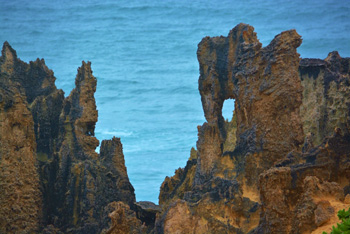 Each bend in the path yielded more surprise- the element of any good journey. Crystal clear tide pools teemed with tiny fish and miniature crabs all scurrying to find safety as each wave brought more water surging into the pool. Treasure troves of fossils and petroglyphs carved into the rocks line the coastal pathways. Skeletal remains of extinct birds that once lived on Kauai before Polynesian voyagers first arrived over 1500 years ago have been discovered by paleontologists.
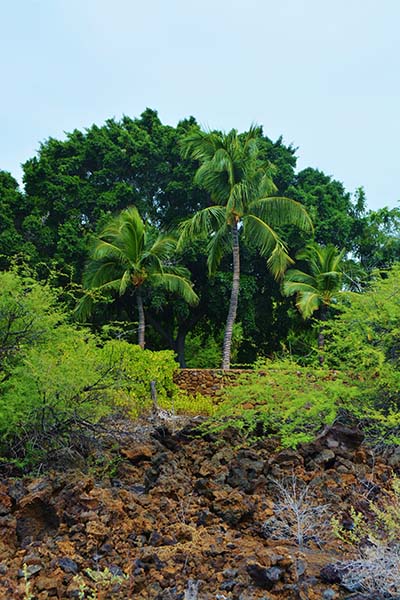
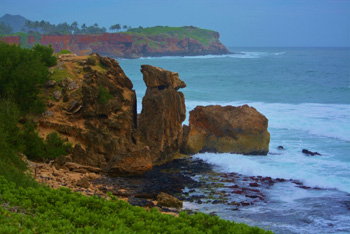 On our return trip, we followed the inside trail away from of the direct sun and into the welcoming shade of the palm and coconut forest. Since the paths split and merged repeatedly, we were able to easily navigate a completely different route back. Much to our surprise, we unexpectedly stumbled across a sacred ancient Hawaiian burial site. The stillness was interrupted by a gentle breeze stirring through the treetops, reminding us that for the ancient gods, their mana still lives here. Eyes closed, we sensed the spirit of the ancient Hawaiians and heard their whispers urging us to respect this sacred ground.
 Arriving back to Shipwrecks Beach at the end of our trek, we were certain we could undertake this adventure multiple times and it would never be the same. Though not an exceptionally challenging hike, we instead experienced a relaxing trek with breathtaking views and fascinating discoveries perfect for a casual or family hike. Oh, and about that initial disappointment in forgoing the Na Pali trail, nature’s artistry took care of that.


 All photos by Noreen Kompanik: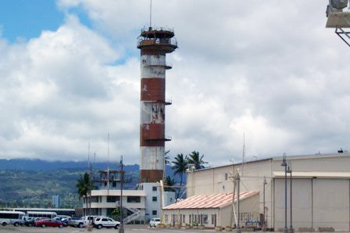
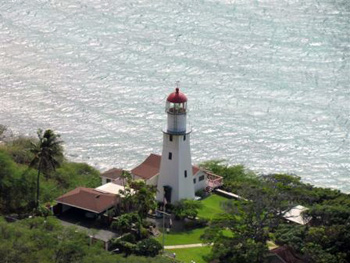 Fort Shafter is the oldest U.S. military installation on the island. Visit Quarters 5 residence of General Walter C. Short who was head of security on Oahu in 1941. Palm Circle which was strafed on December 7, 1941 houses the Pineapple Pentagon, Headquarters of the U.S. Army Pacific Command.
 Haleiwa Field on December 7, Lt. George S. Welch and 2nd Lt. Kenneth M. Taylor were at Wheeler field when the attack started and not waiting for instructions called Haleiwa field to have their fighters fueled, armed and warmed up. They raced to Haleiwa field by car and jumped into their cockpits and took off. They shot down 6 Japanese airplanes and were both awarded the Distinguished Service Cross for their bravery and valor during the attack.
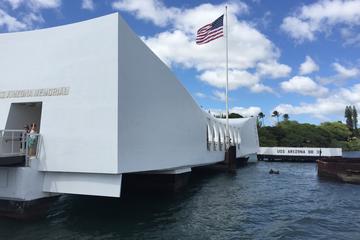
 Pearl Harbor Visitor Center/ Museum/ Battleship Row, the Arizona Memorial is probably the most visited site on Honolulu and begins at the visitor’s center with an outstanding film documenting the attack on Pearl Harbor, with actual footage of that day. There are informative displays to learn more about the events that took place that changed the course of American History. There are snack areas and food vendors where you can relax and grab a bite to eat. We met some of the survivors and were able to thank them for their service.
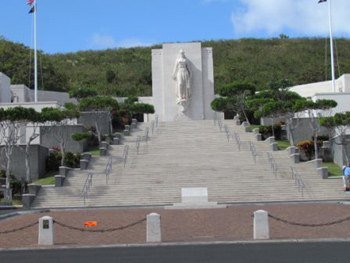
 The Punchbowl National Memorial Cemetery of the Pacific is known to the Hawaiians as Puowaina or “Hill of Sacrifice.” This is the final resting place of over 35,000 Americans who proudly served their country. Experience the serenity of the Cemetery and discover the cemetery’s meticulously landscaped acres. There are also the Courts of the Missing, the chapel and the finely detailed mosaic maps of the Pacific theaters of action in World War II.
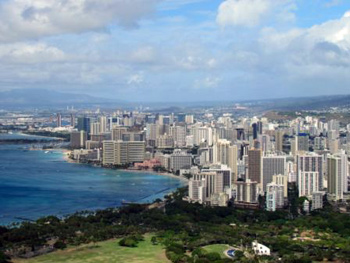
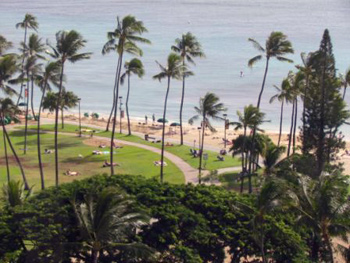 Waikiki Beach meaning (pouting fresh water) in Hawaiian in Downtown Honolulu is probably one of the most famous beaches in the world with it’s the white sand beach. The area of Waikiki is home to public places including Kapiolani Park, Fort De Russy Military Reservation, Kahanamoku Lagoon, Kuhio Beach Park, and Ala Wai Harbor.

 Between the months of November and February are the best times to watch the more experienced surfer’s battle the big waves that can reach up to thirty feet. However from May to September the waves are smaller and more tranquil for beginning surfers and excellent for swimming and sunbathing. There are fifty one beaches on the North Shore some of the more famous include Waimea Bay, Sunset, and Ehukai (home of the Banzai Pipeline) and have thick white sands that stretch for more than eleven miles.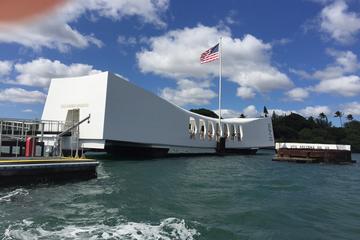



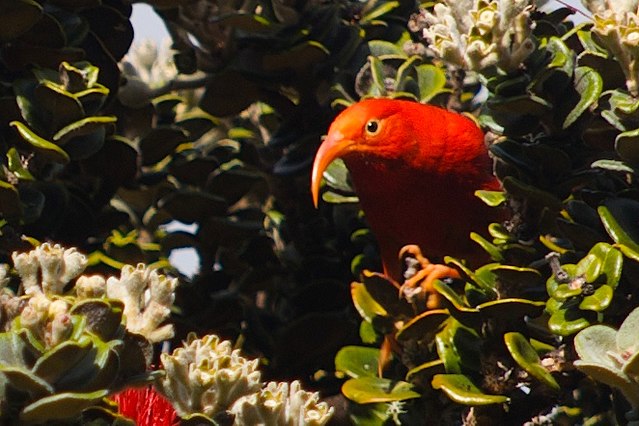



_-_Pu%27u_O%27o_Trail_-_Big_Island_-_HI_-_2015-11-06at15-07-451_(22419194588).jpg)
_Palilia_Discovery_Trail,_Mauna_Kea,_Big_Island,_HI.jpg)

_Hosmer_Grove,_Haleakala_Nat_Park,_Maui_co,_Hawaii.jpg)