by Roy A. Barnes
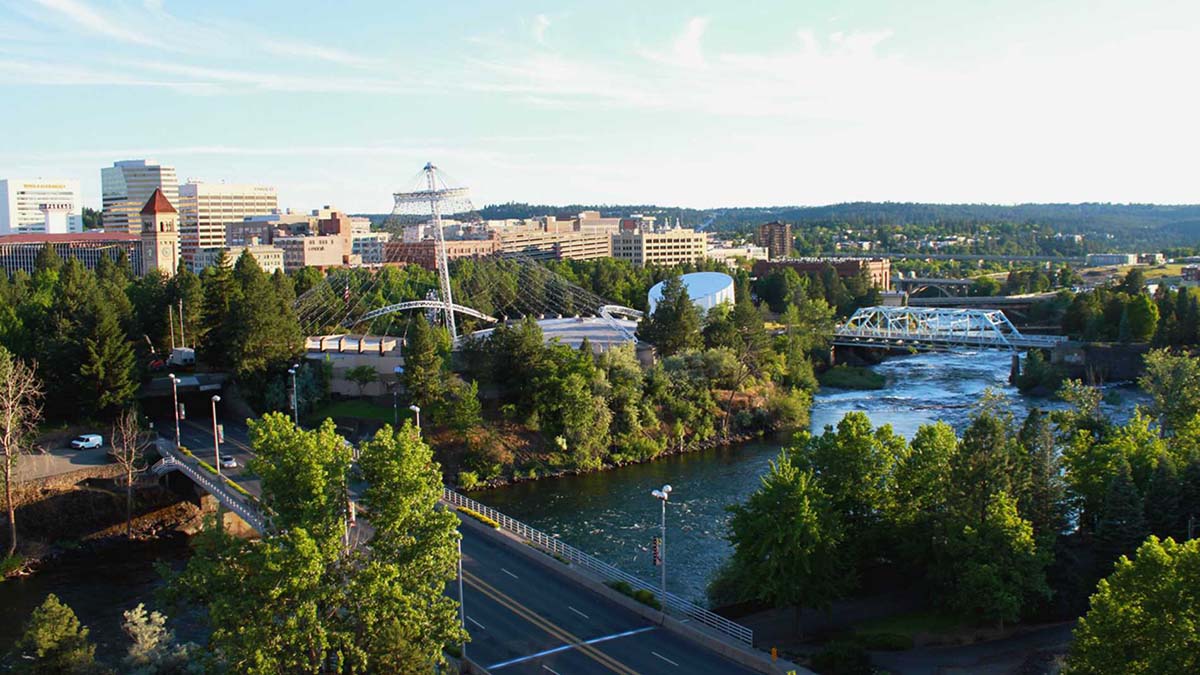
As a mining, agriculture, and forestry hub, beginning in the late 19th century, Spokane has played an important role in shaping the Pacific Northwest, despite being overshadowed by other cities in the region like Seattle and Portland. But I found that the city offers so much colorful history and character, especially in downtown.
Out-of-this-world fish at a former steam plant
 As I walked through the downtown area, I couldn’t help but notice just how much brick, stone, and terra cotta dominated the exteriors of the buildings. This came about after the fire in 1889, which destroyed 32 blocks. One of the city’s landmarks, Steam Plant Square, once provided much of the steam heat and electrical power for the city from 1916-1986, then it would remained neglected for ten years. To make a long story short, the building has been restored with some of its original infrastructure in tact that helps make the existing businesses and offices a unique place to explore or work in.
Inside, I found a number of panels discussing the plant’s history and was able to walk into one of the two smokestacks, which form part of the city’s skyline. The coal elevator and pit exhibit can be viewed, and was once a place where coal trains were backed up some 30 cars waiting to dump coal into the pit just to feed the city’s need for power.
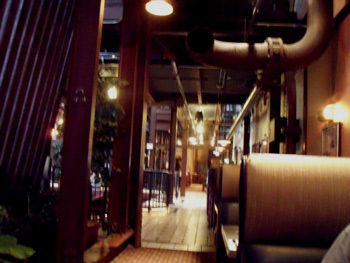
 But I also savored some great-tasting beer and fish inside the landmark at the Stacks at Steam Plant. It has an intimate atmosphere dominated by an industrial brown and black motif. I dined amidst the factory’s old fixtures. The restaurant features a full menu of seafood, beef, chicken, and pasta dishes and brews its own beer, including one uniquely-flavored and really smooth tasting Double Stack Stout, which contains chocolate, vanilla, and espresso. I highly recommend the Smoked Steelhead, which has a taste to die for, as the fish was smoked over alder wood and brined in the restaurant’s Highland and Scottish ale and spices.
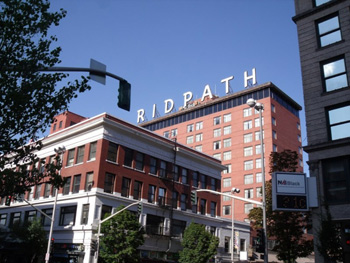
While this place has been lovingly restored, many other Spokane city landmarks like the Ridpath Hotel do yell for some attention through its large neon letters “RIDPATH.” It had the designation of being Spokane’s longest continuously-run hotel from 1900-2008, until it closed.
The Davenport Hotel helped put Spokane on the map
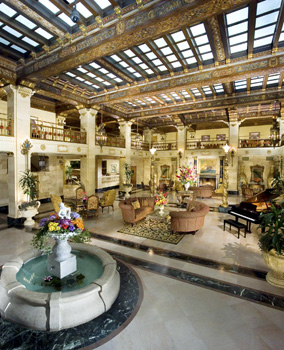 As a travel writer, a hotel is generally the first and last place I visit during a stay in a city. I’m more concerned about its functionality than anything else. Yet I couldn’t appreciate Spokane’s history without appreciating the history of a hotel that helped put Spokane on the map, The Davenport Hotel.
A flour mill clerk named Louis Davenport came to Spokane to help rebuild the city after that 1889 fire discussed above. The ambitious man later started a business of his own, but it burnt down, so he started another one, a restaurant. Yet this time, he had the foresight to build it out of brick.
As it flourished, he added on to it in the early 1900s by having a former bank clerk, Kirtland Cutter, design a grand ballroom inspired by the Doge’s Palace in Venice. Eventually, and thanks to a hotel design by Kirtland, that complex would eventually become part of a hotel so famous, that if someone (anywhere on the globe) addressed a letter to “The Davenport Hotel” only, it would get to Spokane. Since 1914, celebrities like Elvis, The Kingston Trio, Bing Crosby, Theodore Roosevelt, and the like have graced themselves here. It was the first hotel to have air conditioning, a pipe organ, and to deliver free ice water to each of the 400-plus guest rooms’ faucets. Even though I quickly accepted my deluxe room as a temporary home away from home because it functions so well with free high speed internet, ample work and closet space, and a comfortable bed, I became further impressed with the place after I took the walking tour on the first and second floors of hotel through the free hotel tour brochure. I was able to see such spectacles as the Marie Antoinette Ballroom on the second floor, which is elegantly adorned with crystal chandeliers, part of its French Neo-Classical Design. After Charles Lindbergh made his famous flight across the Atlantic, he was honored in this ballroom. Each guest had to pay $4 a plate, more than a night’s stay at the hotel. Many couples first learned how to do the “hokey pokey” there.
I also got to see the Hall of the Doges nearby on the second floor, which was actually cut out of the old part of the complex Davenport first had built because much of the original structure was demolished to help serve the bigger part of the hotel better during its restoration from 2000 to 2002. It had been left to rot for 15 years and was on the verge of demolition.
To see the hotel’s beautiful meeting rooms, check the hotel’s website above under “Meetings & Events.”


Art Deco comes alive at an old 20th Century Fox theater
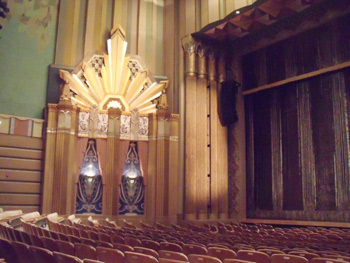 I’m impressed with Art Deco design, and in the heart of downtown an old movie house that originally showed 20th Century Fox pictures has become one of the city’s cultural meccas. The Martin Woldson Theater at the Fox was first opened in 1931, and what drew people there weren’t only the feature films, but the fact that it got to be the first place in town to get air conditioning, a must-see for Spokane’s curious locals. After it was closed down in 2000 during its bargain-movie-showing period, the long road to restoring it to its Art Deco glory would begin. Seven years and $31 million later, the dream came to pass. I was especially impressed with the auditorium, which holds 1,620-1,720 people and has green and pink stripes on the walls. The lobby exudes tropical designs on blue and gold walls. It took considerable time to remove the thick layers of red paint that dominated those days of cheap second-run flicks.
The city’s symphony orchestra and other top music acts now grace the stage here. Our tour guide told us that performing artists have complemented the excellent acoustics in the auditorium.
Dining Recommendation
After a hard day of exploring, nothing beats a bit of comfort food. Just a few blocks east of The Davenport Hotel is CHKN-N-MO, which serves up large (I mean LARGE) and yummy pieces of Southern fried chicken and catfish. My to-die-for chicken and catfish was cooked upon ordering. It’s a quintessential “chicken shack,” with booths, paper towels for napkins, plus a lot of retro advertising, license plates, and sports-themed pictures on the walls.
Disclosure: The author attended a press trip hosted by Visit Spokane, but what he wrote were his own observations without any vetting from his hosts. The author is a frequent contributor to Travel Thru History, and resides in southeastern Wyoming.
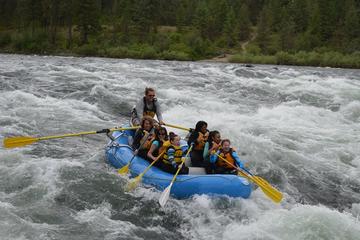
Scenic Rafting on the Spokane River
If You Go:
♦ Steam Plant restaurant
♦ Davenport Hotel
♦ Martin Woldson Theater at the Fox
♦ CHKN-N-MO
♦ Spokane Tourist Information
About the author:
Roy A. Barnes writes from southeastern Wyoming. During his lifetime, he’s worked in the travel agent and airline industries, and has traveled on the North American, Asian, African, and European continents.
Photo credits:
With the exception of the Spokane Skyline and Davenport Hotel lobby photos (both credited to Visit Spokane), all pictures are credited to Roy A. Barnes and may not be used without permission:
Spokane Skyline
Dining in Steam Plant Square
Ridpath Hotel
Davenport Hotel Lobby
Martin Woldson Theater at the Fox
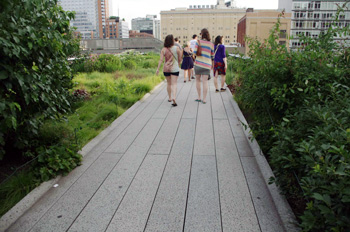
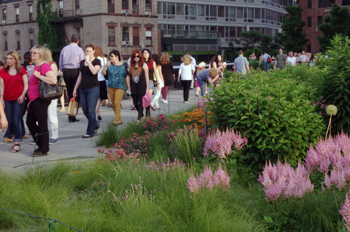 The High Line was set to be demolished around 1999 when a couple of New Yorkers started a movement to not only save the structure, but make it an extraordinary space for park goers to enjoy. The High Line is perfect for an early evening stroll when the Big Apple starts to cool down on a hot summer’s day. It’s free and although uncomfortably crowded in spots, you can’t beat enjoying the ever-changing streetscapes and unexpected scenery at your feet.
 My travelling companions and I started the High Line near its northern terminus on West 30th Street between 10th and 11th avenues. Signage was not great and we got on the High Line by climbing a metal staircase only to find that there was an elevator nearby.
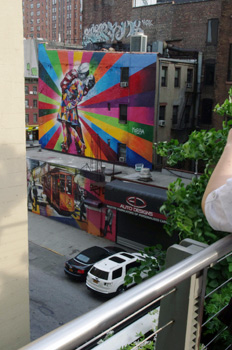 The walking path itself narrows to several people wide and expands to triple that in places with seating when it is most unexpected and appreciated. This includes a place called the 10th Avenue Square, complete with bleachers and huge picture windows for a broad view of the street life.
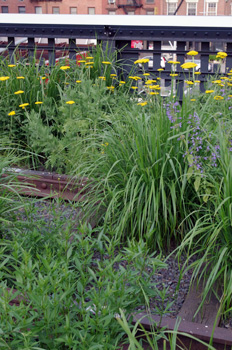 Sections of rusted track can be spotted throughout the High Line, but they are not always easy to find. This caused our group of park goers to each try to be the first to find a piece of old rail line at every change in garden space. The searches bordered on the obsessive by the end of our walk. Sometimes the old rails were far from the walking path and shaded by lush plants, growing among the rail ties like weeds did in the 1980s.

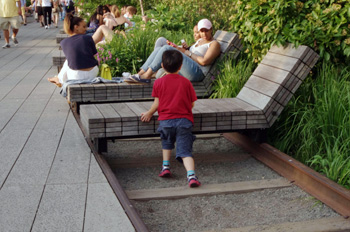 The High Line’s scale is more manageable than upper Manhattan’s huge Central Park. The two share a quirky characteristic in how the old concrete jungles appear to butt up against the green space of the parks for abrupt visual contrasts.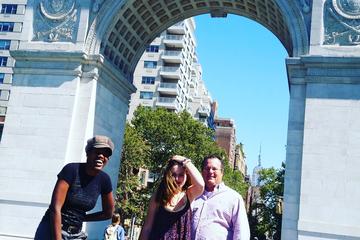
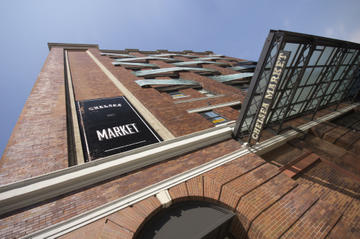
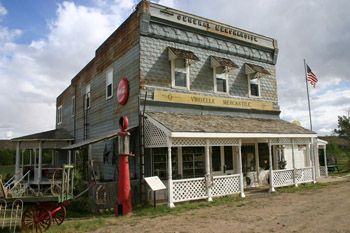
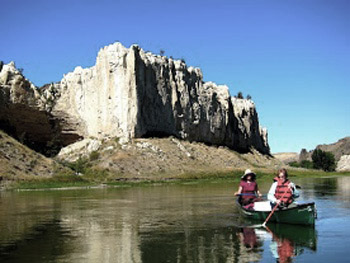 Rather than the tame goings-on of the last couple of centuries, it’s the little-known facts about Lewis and Clark and their expedition through un-mapped Missouri River wilderness which guide Mike Nottingham loves to discuss. This mountain man, trapper, fisherman, and river guide for the Missouri River Canoe Company even teaches you how to pronounce Sacagawea’s name correctly.
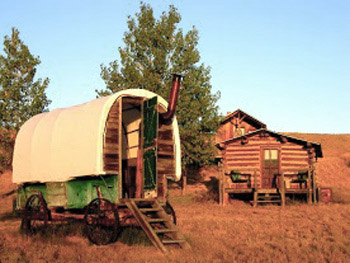 I went one step further. I chose the sheep wagon. How could I resist? It looked like one of the coolest places I would ever sleep. And it was. All night I heard coyotes howling in the distance as the light of the half moon glimmered through my canvas-topped covered wagon. I felt like Laura Ingalls.
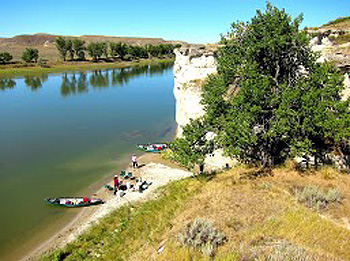 From our canoes, we didn’t see another soul on the river or bank, not a house, not even a broken-down homesteader’s shack. In fact, the Missouri Breaks landscape today, thanks to stewardship and land management, looks pretty much the way it would have looked to Lewis and Clark, even more so now than in the brief late-19th century steamboat days when trees were felled to fuel the boats. “The only difference now,” said Nottingham, “are the occasional Russian olive trees along the banks, which are invasive.” There’s also the odd cow which comes down from one of the ranches for a drink. Back then, of course, it would have been buffalo.
 In Virgelle, Montana, ghosts of the American west seem to be everywhere, their stories longing to be heard.
 , and Kite Strings of the Southern Cross: A Woman’s Travel Odyssey, shortlisted for the Thomas Cook Travel Book Award, and silver medal winner of ForeWord Magazine’s Travel Book of the Year. See: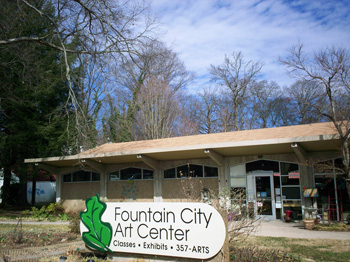
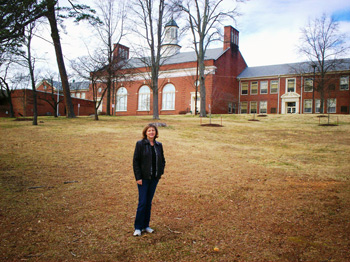 I did not attend Fountain City’s funeral, but a friend told me about it later and said it was quite an event that ended with the playing of “Taps.” Actually, as a teenager, I didn’t notice much difference after we were annexed, except that we got street lights on our street, which was a positive effect to me. I lived in Fountain City from the time I was nine until I got married and left, so I consider it my hometown. This trip was a sentimental journey for me.
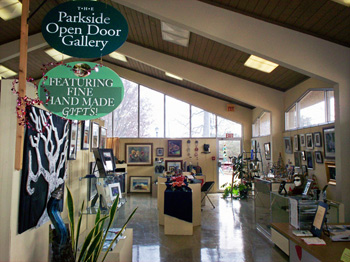 I remembered when I lived there that the building was home to the Fountain City Library. The Center was in-between main exhibits when we were there, but two new exhibits are now on display. The Knoxville Book Arts Guild and the Southern Appalachian Photography Society will be on view until April 8. Student exhibits from different area schools are also exhibited in the Center. There were some excellent works from middle school students on display when we were there.
 The eight-acre park now has lots of colorful playground equipment in addition to the swings and slides that were there when I was a youngster. Unlike some playgrounds, it seems to get a lot of use during good weather. The park is also now circled by a paved walking path, with freestanding “porch swings” scattered along the trail where you can sit and rest and watch the people and look at the old trees and the natural spring which flows through the park into First Creek. Fountain City Park is not owned by the City of Knoxville, but is owned, operated and maintained by the Fountain City Lion’s Club. The Lion’s Club Building is in the park and can be rented for meetings. My late father was a member of the club and we held his eightieth birthday party there.

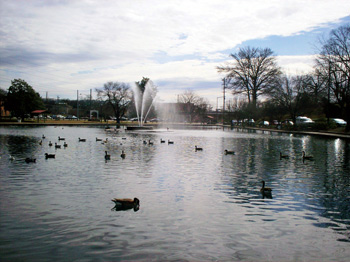 Before going to Litton’s, we walked around the block of Hotel Avenue and crossed the street to Fountain City Lake, also known as the duck pond. The lake was constructed around 1890. Designed by civil engineer F.G. Phillips, the heart-shaped body of water features a large fountain in the center gushing water skyward. We walked all around the lake, being careful to watch where we stepped. There were families there feeding the ducks, young couples and older couples strolling around, and even a couple of men fishing, and lots and lots of ducks.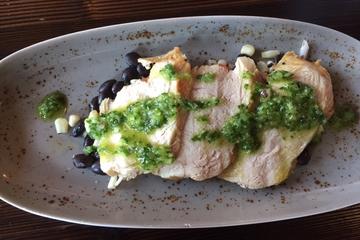
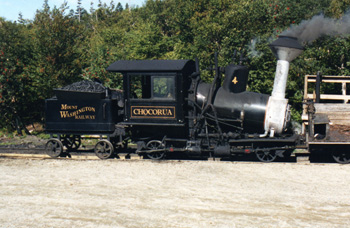
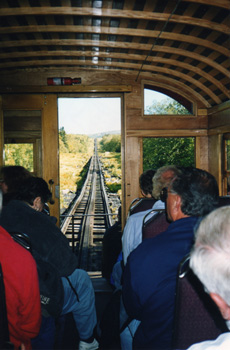 Crowding into our seats, old wooden benches polished and stained as if new, we wait for the jolt of the engine rejoining us. There are no CDs or TV screens to entertain us on the long haul but we have our tour group leader, brakeman and jack-of-all-trades, John, to keep us informed over the course of the 2.5 hour round trip.
 Up from the full forests of the valley through increasingly stunted and twisted growth and into the struggling bushes of the broad mountain slope we rise. The engine chugs behind us eating coal and spitting black smoke in a long trail; straining to reach the next water stop. That pause gives us a chance to regard an old shed clinging to the mountain at a severe angle or so it seems. In fact the shed is perfectly horizontal, it is us who are off kilter.
 The summit rises temptingly before us but again we pause, this time for another engine easing its coach back down to the distant valley. As seems so natural its passengers wave to us and us to them, a shared commonality in the experience. Trust in the engine is tested as we back off our siding to resume the climb. The comforting forward pitch sets us back on course.

 This summit is visited by a quarter million people a year and is seen by many in regular New England weather reports. Here winds have reached 231 miles an hour and the temperature dropped to -47 minus the wind factor. This September day was good with winds at 37 mph, gusting to 75. In winter it is a frost covered fairy land.